
On January 18, 1931, a sixty-year-old Whittier man went to see his doctor. He complained of stomach cramps, nausea, vomiting, and severe diarrhea. Unable to diagnose the patient, the doctor sent him to the local hospital for tests. The lab tested him for amebic and bacillary dysentery—both were negative. They administered a Wasserman test for syphilis and he tested negative.
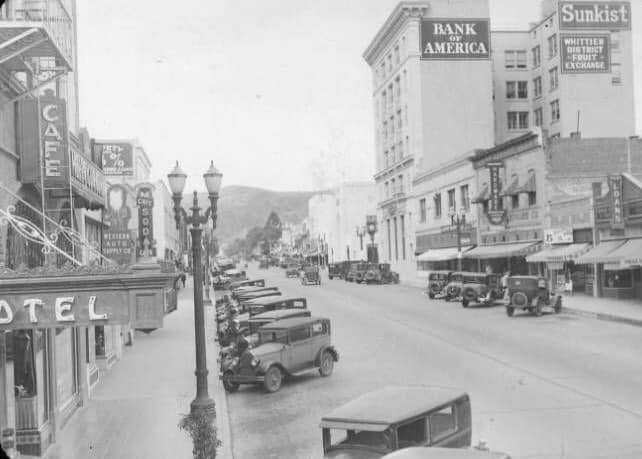
The hospital kept him under observation without arriving at a definitive diagnosis. Maybe he had caught a seasonal influenza. After three days, his symptoms had almost entirely cleared, so they released him and he returned home.
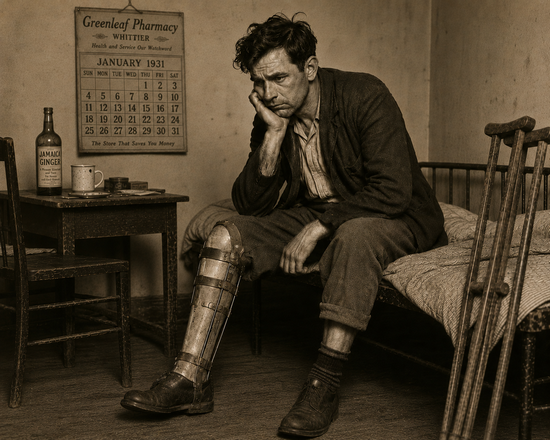
About ten days later he developed muscle soreness in his calves, and stiffness and numbness in his toes. The symptoms worsened. He had difficulty walking and suffered a bilateral foot drop. When he tried to walk on his own, he was forced to hold on to something for support.
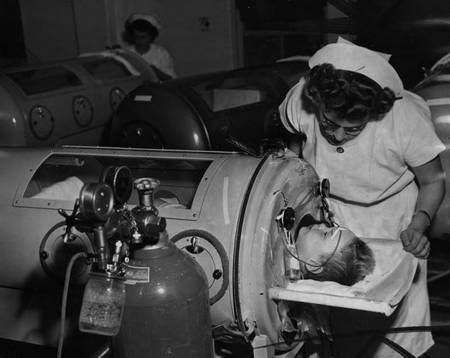
His doctor reported the case to another Whittier physician, Dr. Frank G. Crandall, as suspected poliomyelitis. Polio would be devastating. There was no vaccine or cure for the disease. A patient could die or spend years in bed without recovering.
Within days, he lost the use of his fingers. His wrists dropped. His hands atrophied. Doctors transferred him to County General Hospital, where he remained confined to bed—unable to walk, stand, dress, or feed himself.
Dr. Crandall consulted with Dr. George H. Roth of the Los Angeles County Health Department. The polio virus was too small to be seen with the available technology, so doctors manually checked for muscle weakness or “physical defects.” Drs. Crandall and Roth agreed that the patient did not have polio.
If not polio, then what else could render a man helpless in such a short period of time?
They had heard reports from the Midwest and South of a malady caused by drinking adulterated Jamaica Ginger. During the summer of 1930, 10,000 cases of the disease were reported in the South.
Jamaica Ginger was a patent medicine in continuous use since the 1820s used to treat everything from flatulence to upper respiratory infections and menstrual disorders. It was a common household remedy, which made its poisoning even more monstrous. The victims in some cases were children.
The extract typically contained 70% to 90% ethanol by weight, which was necessary to keep the ginger oleoresin in solution. Not only did Jake, as it was called, have a kick, as a medicine it was legal to purchase during Prohibition. That was a huge plus for people who couldn’t afford to frequent local speakeasies or buy from a bootlegger. When compared to standard whiskey, which contains 40% to 50% alcohol, a two-ounce bottle of Jake, costing about fifty cents, was a cheap high.
As soon as the government learned about the legal loophole, it was determined to close it. They did it by requiring manufacturers of Jamaica Ginger to include a high concentration of bitter ginger solids to make it too disgusting to drink.
The government’s solution worked for a while until some manufacturers and distributors bypassed the regulations. They experimented with various substances that would fool government tests and finally found a cheap industrial plasticizer called tri-orthocresyl phosphate (TOCP). A powerful neurotoxin.
Following the Whittier case, two men in Los Angeles, J. D. Hoagland (46) of 1129 ½ Mignonette Street, and David Grant (66) of 403 Court Street, sought treatment for Jake paralysis. Dr. John S. Fox, assistant city health officer, supervised their treatment. The victims admitted to consuming the ginger extract. One of them drank a bottle a day for 15 days, and the other downed five bottles a day for five days.
Dr. Fox issued a warning against the use of the extract as a beverage. He said a single drink could result in paralysis. But even with Dr. Fox’s warning, four new cases were reported from the North Bunker Hill district. One man not only suffered from “drop foot,” a defining characteristic of drinking the poison, but his face and limbs were also paralyzed. Another victim permanently lost their sight.
City laboratories analyzed samples of the extract sold in drug and grocery stores on Bunker Hill. The labs found TOCP.
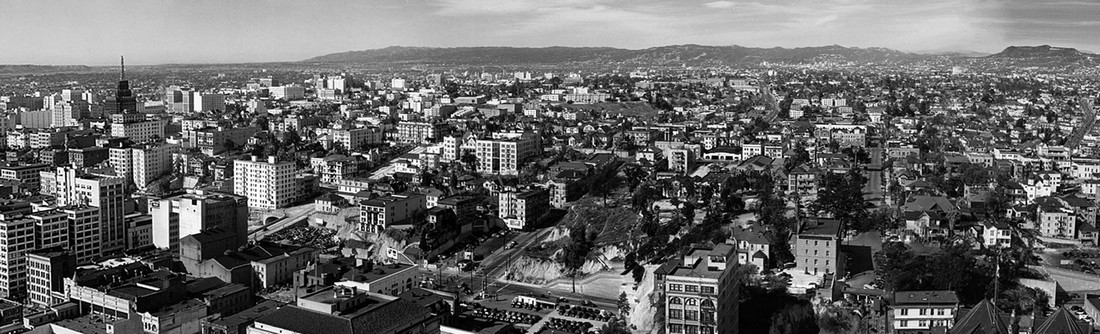
The number of victims continued to rise. Many of them lived in cheap hotel rooms in the vicinity of Seventh and Central and San Pedro Streets. They said they obtained their extract from drug stores in the area. Many cases went unreported and the health department asked physicians to submit reports so they could track the spread the disease—which was fast becoming an epidemic.
Reporters heard from one health official that the Jamaica ginger blamed for the paralysis cases arrived in the city in barrel lots. They had no way of knowing how much of it had been sold, and the situation was further complicated because the paralysis did not develop until ten days to two weeks after consumption.
Dr. J. L. Pomeroy, Los Angeles County Health Officer, investigated each of the cases and found the source of the poisoned extract was a New York firm operating under the name of Jordan Brothers. A local man, Jacob Rosenbloom, his wife, and sons, bottled, labeled, and distributed locally two-ounce bottles of the extract through their company, California Extract Company.
One thing became evident early on. The victims of Jake paralysis were among the most vulnerable of the city’s residents. They were poor, some of them were pensioners living in rooms in the faded Victorian mansions on Bunker Hill. The same was true of the thousands of victims in the Midwest and South. They were not people of means. Ginger Jake was the poor man’s way of getting a drink of liquor. During Prohibition, sellers could still offer products with high alcohol content if they classified them as medicinal, culinary, industrial, or cosmetic. People drank vanilla extract, cologne, medicinal bitters, and Jamaica ginger.
Managing the Jake crisis fell largely to local officials. The Federal Hygienic Laboratory—the underfunded precursor to the National Institutes of Health—had fewer than a dozen physicians and little authority. The only federal agency with real jurisdiction was the Treasury Department’s Bureau of Prohibition, whose agents carried badges, tommy guns, and responsibility for anything involving alcohol.
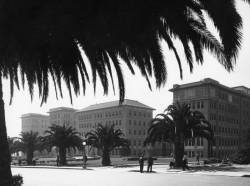
The horror of awakening to find you could no longer get out of bed was made even worse when in early March 1931, thirty-seven veterans in the Soldiers Home in Sawtelle (West Los Angeles) were struck down after drinking Jake. All of them were in critical condition, except for two who died.
The victims in the Soldiers Home were already dependent upon institutions. They were likely dealing with disability, poverty, trauma, or alcoholism.
Promises were made to find and prosecute those responsible for the manufacture and sale of the lethal ginger concoction. The Pure Food and Drug Act of 1906 was invoked, but the consequences were laughable. A first offense was punishable by a fine not to exceed $500 and/or up to one year in prison. Subsequent offenses were punishable by a fine of not less than $1000 and/or up to one year in prison. Even the violations involving interstate commerce were light.
Jake paralysis was killing people, or letting them survive with no hope, and the worst punishment a violator could receive was a fine and a sentence that could be served in the county jail. One wonders if the poison had been added to bonded liquor smuggled in from Canada and served to the swells who could afford it if the outcome would have been different.
There were attempts made to find a cure. Researchers at the University of Oklahoma claimed they had not found “a single case of a Negro being affected.” They suspected Black Americans had a natural immunity. To test their theory, the dosed black and white chickens with known paralytic ginger extract because they believed that the black feathered chickens were the genetic equivalent of Black Americans.
The chickens, black and white, fell ill indiscriminately. Researchers concluded that “color plays no part” in the disease.
Long before historians and toxicologists explained how TOCP ravaged the nervous system, ordinary people understood the epidemic through the language available to them: limber leg, numbness, shame, failed romance, neighborhood gossip, and song.
The most heartfelt commentary on Jake came from blues musicians. Jake paralysis entered blues music because it had already become a part of everyday life. The lyrics spoke of the effects of the paralysis in ways that weren’t reported in newspapers.
In 1930, Willie Ray wrote “I Got the Jake Leg Blues”
“I woke up this morning,
I couldn’t get out of my bed,
This stuff they call jake leg,
Had me nearly dead.”
The mostly male sufferers did not just lose their ability to walk without evidence of “Jake Leg,” they were just as often made impotent by the disease.
“I’m a Jake walk papa
I’m a Jake walk papa
And the Jake walk’s got me now
Can’t eat, can’t sleep
Can’t even make my woman smile.”
Willie Lofton, “Jake Walk Blues,” 1930
In May of 1931, some Oklahomans organized United Victims of Jamaica Ginger Paralysis. They claimed 30,000 to 50,000 members. Oklahoma Governor William “Alfalfa Bill” Murray said, “There are three kinds of people I haven’t much use for. One is the man with Jakeitis; another is the investor on the stock exchange, and the other I won’t mention.” Sadly, many others shared his low opinion of the victims. With their characteristic walk, sufferers were physically and mentally abused in their communities.
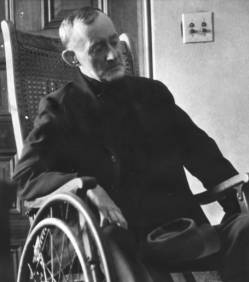
Courtesy Los Angeles Public Library, Herald Collection.
Iron leg braces worn by some victims were called “Jake Socks.” Temperance advocates and preachers joked about the physical twitching and shuffling. Some suggested God was forcing sinners to do a “forbidden dance” as a warning to anyone who contemplated breaking Prohibition Laws.
Law suits went nowhere. Activists lobbied Congress for years, but it never passed a bill for victims’ relief.
The suffering of Jake victims became a source of ridicule for temperance advocates and preachers, many of whom interpreted the paralysis as moral punishment for violating Prohibition.
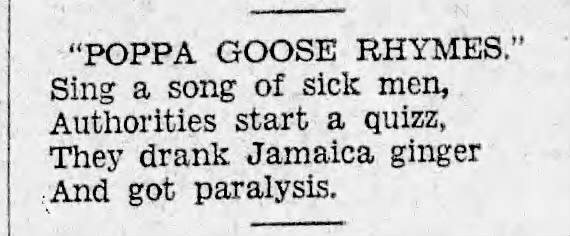
At every stage, the Jake epidemic exposed the brutal realities of class in America. The victims were overwhelmingly poor, vulnerable, and disposable in the eyes of institutions that failed to protect them. Their suffering became a source of ridicule long before it became a source of public responsibility.
Note: There were many songs about Jake Leg. This one is by the Ray Brothers.