The Lower 13th Murder Case: Epilogue

“Oh my God, he’s killing me!”

Martha Brinson’s screams tore through the Pullman car, jolting passengers awake in the middle of the night. Moments later, she was dead — murdered in berth 13.

The killer was on the train from Oregon to Los Angeles. But I don’t believe it was Robert E. Lee Folkes.

Wartime paranoia and racism made Folkes the perfect suspect. Black. Working class. Union agitator. Southern Pacific’s second cook. From the moment Martha’s body was discovered, Folkes was railroaded — literally and figuratively.

He worked long shifts in the dining car, sweating over a hot stove, under constant supervision. The train’s conductor later testified there was no opportunity for him to sneak away, let alone murder a woman in her sleep. A physical exam found only flour and grease beneath his fingernails — not blood.

But Folkes was Black. In 1943, that wasn’t a description. It was an indictment.

And he wasn’t just Black. He was political. His father died in the 1920s during the violent white backlash against Black sharecroppers organizing in the Arkansas Delta. His mother, Clara, fled with her children to South Central Los Angeles, chasing safety that never fully arrived.

Folkes grew up in the shadow of that violence. He got his education, then joined Southern Pacific — one of the few decent-paying jobs open to Black men. He started as a fourth cook. He worked hard, and rose to second cook.

By 1942, he was a problem. The company assigned thugs to follow him. They didn’t forget. But Folkes kept pushing, and by January 1943, he’d earned the position of second cook — a step up, despite the pressure from above and below.

So, when Martha Brinson was found dead, the company didn’t have to look far. Despite the pressure, the surveillance, the threats — he remained unbroken. And that made him dangerous.

The detectives dragged him off the train. Stripped him. Locked him in a lavatory. Grilled him through the night. No lawyer. No charges. No real evidence.

Meanwhile, one passenger should have raised every red flag. Harold Wilson, a Marine, had the berth directly above Martha. He was the first to discover the body. He was found with her blood on his clothes. But Wilson wore khaki — and in 1943 America, that was a get-out-of-jail-free card woven into the uniform.

He wasn’t questioned, nor was he detained even though witnesses saw him crawl in and out of his berth. He acted suspiciously. Yet the investigation stayed focused on Folkes.

The trial was a farce. It was never intended to get justice for Martha, the twenty-one-year-old newlywed so callously murdered. The prosecution showed no regard for her as a person. Her death became leverage.

Wilson testified for the prosecution; but he faltered when asked if he could positively identify Folkes. The newspapers labeled Folkes a “zoot-suit wearing negro” — dog-whistle journalism dressed up as coverage. He was never just a suspect. He was a symbol. And symbols don’t get acquitted.

Despite inconsistencies, the unsubstantiated confessions, and a case built more on fear than fact, the jury — nine women, three men — delivered a verdict. Guilty. In Oregon, that meant death.

In 1945, Folkes was hanged. Wilson walked into obscurity.

The courts called it justice.

History calls it something else.

What do you call it?

The Lower 13th Murder Case

On the night of January 22, 1943, a young woman boarded the Klamath, from Oregon, a crowded wartime train bound for Los Angeles. Her name was Martha Virginia Brinson James. She was twenty-one, newly married, and hopeful—one of thousands of wives trying to reconnect with their men in uniform.

Before the sun rose, she would be dead—her throat slashed in a sleeper car while dozens of passengers slept nearby. The man accused of the crime confessed, then recanted. No one saw him do it. No physical evidence tied him to the murder. Yet he stood trial, and the country watched.

The Klamath c. 1940s

Martha and her husband, Richard, would have preferred to travel together, but heavy wartime ridership made it impossible. She socialized with other Navy wives, each of them looking forward to a reunion, then she retired to a lower berth, number 13.

Typical Pullman car. c. 1940s

About 3:00 a.m., people in the sleeping car heard a woman scream, “My God, he’s killing me!” It was Martha. Bleeding, her throat cut, she tumbled from her berth and stumbled to a nearby lavatory where she died.

Private Harold Wilson, a Marine, occupied the berth above Martha’s. When he heard the scream, he opened his curtains in time to see a burly, black-haired man in a brown pin-stripe suit rushing down the aisle.

Detectives E. A. Tetrick and Richard B. McCreadie met the Klamath at Los Angeles Union Station. Oregon authorities requested they hold the train’s second cook, Los Angeles resident, Robert Folkes, as a material witness. Due to a legal technicality, they booked him on suspicion of murder instead.

Folkes, a 20-year-old black man, came to California from Arkansas with his mother and siblings in the late 1930s The family was part of a large influx of people fleeing the Jim Crow south. They heard that Los Angeles offered more opportunities—which was true to a point. There were restrictions that forced blacks to live in segregated, neighborhoods. Like many of the transplants, Folkes’ family landed in South Central.

Martha Brinson James

Wilbur Brinson, Martha’s father, made a good living as a manager for a coal company. Her mother, Grace, was a housewife and the family had a live-in black maid. They lived on North Shore Road in Norfolk, Virgina. The homes on North Shore Road were large, situated on beautiful tree-lined plots of land; walking distance from the Lafayette River, near the Chesapeake Bay.  Nothing about Martha’s background could have prepared her family to lose her in such a brutal way.

LAPD detectives conducted a background check on Folkes; standard procedure for anyone involved in a murder case. They discovered he had a police record. On August 24, 1940, he was arrested on suspicion of assaulting a white woman. She refused to prosecute. On July 30, 1941, police arrested Folkes on a drunk charge after he entered a home and went to sleep. On December 28, 1942, Folkes cut the screen on a house in which three women slept.

During initial questioning, Folkes made a bizarre statement. He said, “I didn’t do the actual killing.” But then he confessed to Captain Vern Rasmussen of LAPD’s homicide detail. A confession he immediately retracted. Something about Folkes’ demeanor made detectives think he might be protecting someone.

Police wanted Folkes to open up, so when he promised to tell them “something important” if    they allowed him to visit his wife at home, they took him there. Once the visit was over, he reneged on his promise and continued to maintain his ignorance of the murder.

Police psychiatrist Paul De River questioned Folkes and pronounced him “sane, but a definite exhibitionist.” 

On January 27th, District Attorney Harlow Weinrick of Linn County, Albany, Oregon, told the Associated Press he had filed a first-degree murder charge against Folkes. Los Angeles would have to send him there.

Folkes continued to flip-flop. The authorities would not immediately release the details of his confessions until Oregon officials arrived. However, sources said Folkes admitted whetting a boning knife before going to Lower 13, where he attacked Martha James. According to Detective Rasmussen, Folkes admitted getting drunk on the train and walking through Car D, where he noticed Martha sitting up in her berth. He said she “appealed to him.”

He set his alarm clock for an hour earlier than usual, 3 a.m., and when he got up to prepare the galley stoves, he picked up a knife and sharpened it. He slipped it up his sleeve.

He walked past Lower 13 several times to determine if Martha was awake. She was sleeping. He unbuttoned the curtain, and climbed into the berth. Martha resisted and screamed. He cut her throat.

One story Folkes told police was that a man paid him $1000 to kill Martha. Nothing supported that story.

Once Folkes was identified as the chief suspect, much of the reportage focused on his race and referred to him as a “zoot suit wearing negro”—a highly pejorative characterization. Racial and cultural tension in Los Angeles was high, and zoot suits exacerbated the situation.

Cab Calloway in a zoot suit for the 1943 film, Stormy Weather.

A zoot suit was an oversized style of clothing. Long jackets with heavily padded shoulders, wide lapels and baggy trousers pegged at the ankles. Wearers accessorized the suit with a wide-brim hat and a watch chain. Many people considered the zoot suit unpatriotic. Cloth was rationed, so the zoot suit was seen as wasteful. In the minds of most zoot suiters their clothing was a form of self-expression, defiance, and protest.

The suit resulted in racialized policing. Wearing a zoot suit was a sure way to bring unwanted attention from the police. Fueling the already volatile situation, the media linked crimes to zoot suiters and stoked fear and prejudice.

Folkes made another confession, which he refused to sign. He said, “If I were not guilty, I would not make this confession. I have kept my word. As long as she (the stenographer) has it down and I read it thoroughly and understand it, I will be willing to take the medicine, which the killer should take.”

About the murder, he said: “It was all in a fog to me. I reached first with my right hand, then with my left, but evidently in my mind I figured. . .  And there is where I killed her . . I guess I cut her . . .”

Chief Deputy Clay E. Kirk of Linn County, Oregon, arrived in Los Angeles to take Folkes into custody and return him north. Folkes waived extradition.

Soldiers armed with submachine guns patrolled the Albany train station platform to discourage any attempt to harm the prisoner. To ensure his safety, they took Folkes off the train at Springfield, 48 miles south of Albany, and transported him to the jail by car.

Not everyone took Folkes’ guilt for granted. The California Eagle, a newspaper serving Los Angeles’ black community, reported that a spokesman for a Citizens Committee, said, “Grave doubts exist as to Folkes’ guilt and it is imperative that his constitutional rights to a fair trial be safeguarded by seeing to it that he has competent counsel.”

Louise Beavers

The Eagle also reported that despite Folkes’ conflicting statements and numerous confessions, the physical evidence was non-existent. Detailed examinations of his clothing and chemical analysis of scrapings from his fingernails and shoes showed no blood or other incriminating evidence of any kind was found.

Hollywood stars including Ben Carter, Hattie McDaniel, and Louise Beavers came forward to support Folkes. They planned to appear at a dance at an Elks Club to raise money to fund his defense.

The marine who saw a man fleeing the scene was vague. He couldn’t identify Folkes—and he couldn’t explain how one minute he was in his pajamas in his berth, and the next he was fully dressed and chasing the killer.

None of Folkes’ co-workers believed him guilty. He performed all his usual duties on the morning of the murder. Nothing in his demeanor was unusual.

Folkes said he would prove his innocence at his trial in April.

NEXT TIME: Folkes’ trial and the conclusion of The Lower 13th Murder case.

Hop Heads

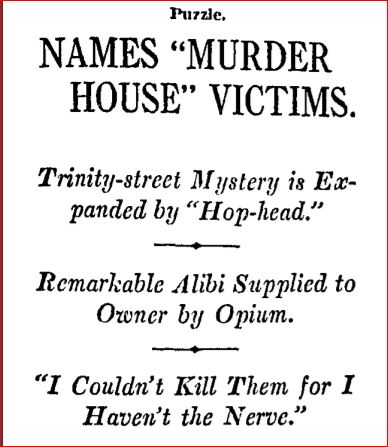
Charles Henderson was high on opium when Los Angeles Police officers, lead by Detective Bean, raided his home/club room at 3631 Trinity Street. The cops weren’t  looking for drugs, they were following up on a tip they’d received from a local hop head. The tipster, whom the police refused to name because they feared for his safety, had told them that he knew of at least four men who had been murdered by a gang operating out the Trinity Street house. According to the snitch, the gang was killing men in order to collect insurance policies which they had taken out on the men’s lives.

When Charles was coherent enough to make a statement to police, he scoffed at the idea of a murder house. Charles said, “You know anyone who has got the ‘habit’ ain’t got nerve enough to pull off a stunt like that fellow described. If a man ever did have any nerve he certainly loses all of it when he becomes an opium fiend. Why I couldn’t kill a chicken much less a human being.”

Charles spoke with the authority of a long-time hop head with a $9/day habit. That may not sound like much now, but in 1915, when Charles was buying dope, $9 was equivalent to $220.

Poster found here: https://bit.ly/2LgsRNh

Local police and Federal authorities had arrested Charles many times. His club room was a safe haven for opium users, and they were willing to pay for a refuge. The room made Charles a lot of money, but he set fire to most of it every time he filled a pipe.

“I have been smoking the pills for twenty years,” Charles told Bean, “and know the game all the way but I can’t believe there is any murders that can be traced to the fiends in this city.”

Charles had a point. When police raided his home/club room he was flying so high he hadn’t the will to to resist or flee.

He told Detective Bean that when the raid began he thought, “This ain’t no dream.”

He continued, “I have been one of the worst victims of the whole bunch. The other morning when you folks came and got me I was about the happiest man in the whole world. You know this stuff makes you feel that way. For a little while I didn’t know what you meant when you started to going through my house with all of them electric lights. They looked like shooting stars to me and I kind of thought that I was riding in an airship and that was the reason so many stars was so close to me.”

Captain Bean waited for Charles to resume.

“When I woke up here in jail and didn’t have no more opium it all came back to me. I realized then that I was just naturally arrested again. I tell you this comes hard on me. It costs me $9 every day to keep me dreaming right and of course I am no millionaire.”

“Gee, but I wish times was like they used to be. When I was down in Mexicali I used to get all the opium I wanted for $1.50 a day,” Charles reminisced.

“I have been tryin’ off and on for twenty years to get away from the habit but it don’t seem to be any use. In fact I don’t remember of a single man who ever quit the stuff for good who had smoked it as long as I have.”

There were no further reports regarding the murder house on Trinity Street in the Los Angeles Times, so we can only assume that Charles was right, the snitch had related one of his more sinister hop dreams to the cops.

As for Charles, did he ever quit kickin’ the gong around?*

Not that I know of.


* kickin’ the gong is 1930s slang for smoking opium.