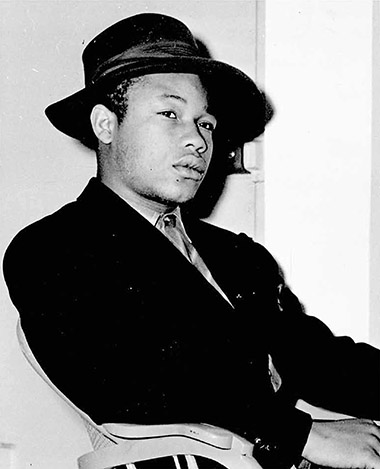
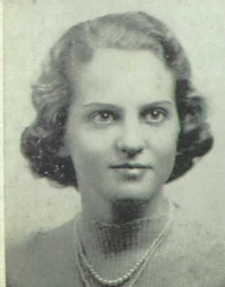
Martha Brinson’s screams tore through the Pullman car, jolting passengers awake in the middle of the night. Moments later, she was dead — murdered in berth 13.
The killer was on the train from Oregon to Los Angeles. But I don’t believe it was Robert E. Lee Folkes.
Wartime paranoia and racism made Folkes the perfect suspect. Black. Working class. Union agitator. Southern Pacific’s second cook. From the moment Martha’s body was discovered, Folkes was railroaded — literally and figuratively.
He worked long shifts in the dining car, sweating over a hot stove, under constant supervision. The train’s conductor later testified there was no opportunity for him to sneak away, let alone murder a woman in her sleep. A physical exam found only flour and grease beneath his fingernails — not blood.
But Folkes was Black. In 1943, that wasn’t a description. It was an indictment.
And he wasn’t just Black. He was political. His father died in the 1920s during the violent white backlash against Black sharecroppers organizing in the Arkansas Delta. His mother, Clara, fled with her children to South Central Los Angeles, chasing safety that never fully arrived.
Folkes grew up in the shadow of that violence. He got his education, then joined Southern Pacific — one of the few decent-paying jobs open to Black men. He started as a fourth cook. He worked hard, and rose to second cook.
By 1942, he was a problem. The company assigned thugs to follow him. They didn’t forget. But Folkes kept pushing, and by January 1943, he’d earned the position of second cook — a step up, despite the pressure from above and below.
So, when Martha Brinson was found dead, the company didn’t have to look far. Despite the pressure, the surveillance, the threats — he remained unbroken. And that made him dangerous.
The detectives dragged him off the train. Stripped him. Locked him in a lavatory. Grilled him through the night. No lawyer. No charges. No real evidence.
Meanwhile, one passenger should have raised every red flag. Harold Wilson, a Marine, had the berth directly above Martha. He was the first to discover the body. He was found with her blood on his clothes. But Wilson wore khaki — and in 1943 America, that was a get-out-of-jail-free card woven into the uniform.
He wasn’t questioned, nor was he detained even though witnesses saw him crawl in and out of his berth. He acted suspiciously. Yet the investigation stayed focused on Folkes.
The trial was a farce. It was never intended to get justice for Martha, the twenty-one-year-old newlywed so callously murdered. The prosecution showed no regard for her as a person. Her death became leverage.
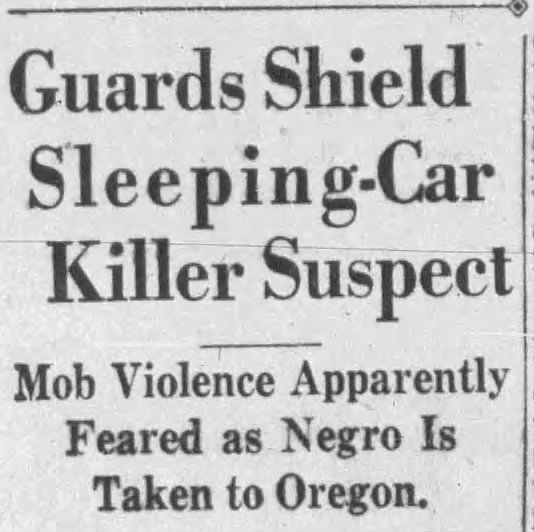
Wilson testified for the prosecution; but he faltered when asked if he could positively identify Folkes. The newspapers labeled Folkes a “zoot-suit wearing negro” — dog-whistle journalism dressed up as coverage. He was never just a suspect. He was a symbol. And symbols don’t get acquitted.
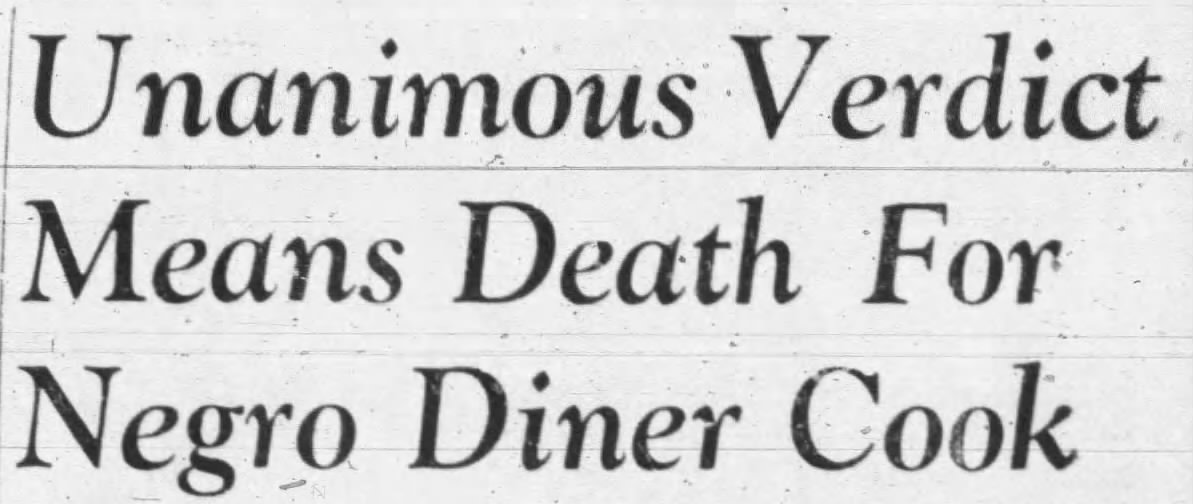
Despite inconsistencies, the unsubstantiated confessions, and a case built more on fear than fact, the jury — nine women, three men — delivered a verdict. Guilty. In Oregon, that meant death.
In 1945, Folkes was hanged. Wilson walked into obscurity.
The case against Robert E. Folkes unfolded against a tense backdrop of wartime fear, racial prejudice, and rising public paranoia. The press inflamed the tensions, describing Folkes as a “zoot-suit wearing negro,” a phrase loaded with menace, meant to reduce him to a caricature and paint him as capable of slashing the throat of 21-year-old newlywed Martha James.
District Attorney L. Orth Sisemore questioned the Black trainmen on board when the train stopped in Klamath Falls, Oregon. Southern Pacific Railroad detectives zeroed in on Folkes. Somewhere between Klamath Falls and Dunsmuir, California, on the night of January 22-23, they pulled him into a men’s lavatory, stripped him, and interrogated him through the night. They released him only for his shifts in the dining car. They treated the sleep-deprived and humiliated man as the prime suspect, even though they did not arrest him.
Not everyone on the train believed in Folkes’ guilt. The conductor stated Folkes couldn’t have committed the murder. According to him, the configuration of the diner and Folkes’ workload made it impossible. He pointed instead to another passenger—Harold Wilson, a white Marine who had occupied the berth above Martha’s. Given his proximity to the victim, Wilson should have been a suspect. Instead, they treated him as a material witness and quietly removed him from suspicion.
When the train arrived in Los Angeles on January 23rd, LAPD detectives took Folkes into custody. He was sleep-deprived, unrepresented, and vulnerable. They bounced him between Central Jail and Police Headquarters, questioned him without legal counsel. LAPD officers phoned Linn County District Attorney Harlow Weinrick in Oregon to report that Folkes had cracked.
But in every official statement before the supposed confession, Folkes had denied guilt. He did not sign or review the alleged confession. The investigators did not record it; the lawyer did not witness it; it seemed coerced.
LAPD’s interrogation practices at the time weren’t just aggressive — they were dangerous. Coercion took many forms: physical abuse (beatings), psychological pressure (threats against family, exploiting a suspect’s fear of mob violence or racial prejudice), or improper inducements (offering alcohol, sexual access, or other rewards). Days earlier, the department faced scrutiny after Stanley Bebee, a 44-year-old accountant, died following a brutal beating in custody for public intoxication. The jury acquitted the officers. However, the case highlighted the LAPD’s violent methods.
Although the Folkes investigation showed no proven evidence of bribery or case-fixing, the environment surrounding his interrogation was badly compromised. Some interrogators used coercive tactics, custody chains were blurred, and courtroom conduct varied from irregular to unethical. It is easy to conclude that the LAPD mistreated Folkes while he was in custody.
There was no physical evidence linking Folkes to the crime. No eyewitness identified him. But the so-called confession was enough for an arrest. Initially, Folkes refused to waive extradition to Oregon. But during arraignment before Judge Byron Walters, he relented and agreed to return north for trial.
On the night of January 29, 1943, accompanied by Sheriff Clay Kirk of Linn County and two Southern Pacific special agents, Folkes boarded a train for Albany.
His trial began in April. The jury of eight women and four men was unusual. In Oregon, women could serve only if they filed a written declaration, making their presence more striking. Their makeup may have influenced how testimony was weighed.
The state’s only link between Folkes and the murder was the testimony of Harold Wilson—the Marine who had been in the berth above Martha. His description of the suspect was vague: “a swarthy man in a brown pinstriped suit.” He never identified Folkes. And witnesses saw Folkes in the kitchen, dressed in his work clothes, minutes after the murder occurred. The police never found a brown pin-striped suit.
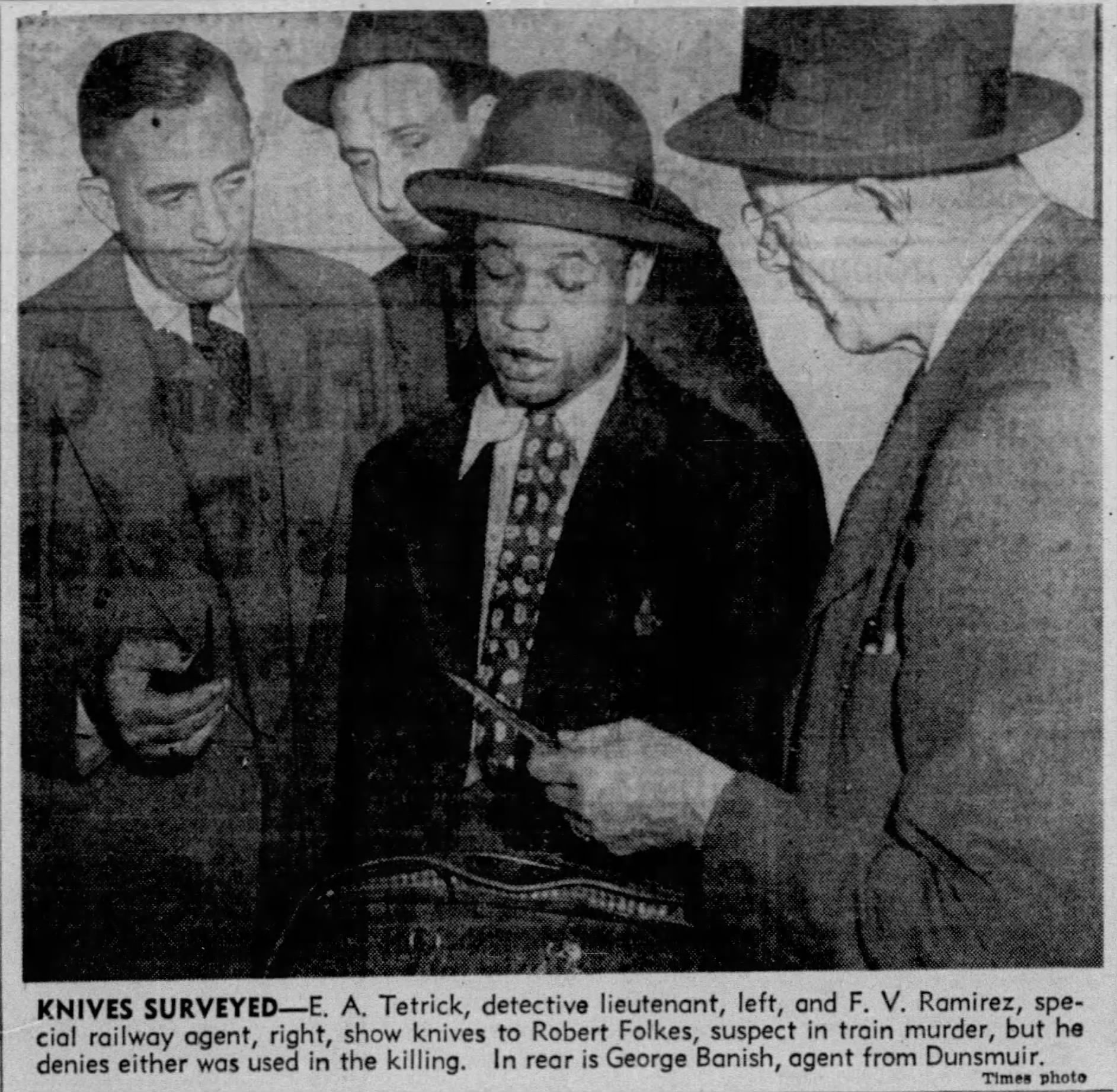
Though the defense objected, the court admitted two alleged confessions into evidence. Many red flags riddled both confessions. On April 16, LAPD Lieutenant E. A. Tetrick testified Folkes gave an oral confession after officers brought him a pint of whiskey and let him visit his common-law wife, Jesse. Circuit Judge J.G. Lewelling called the practice “reprehensible,” though he insisted Folkes was sober and in “full possession of his faculties.”
Dr. Paul De River—LAPD’s controversial police psychiatrist—later infamous in the Black Dahlia case, testified that he spoke with Folkes after the confession. According to De River, Folkes “may have had a drink or two,” but was not intoxicated. No one asked how he had reached that conclusion. De River also reported no physical injuries on Folkes’ body and described him as “in good physical condition.”
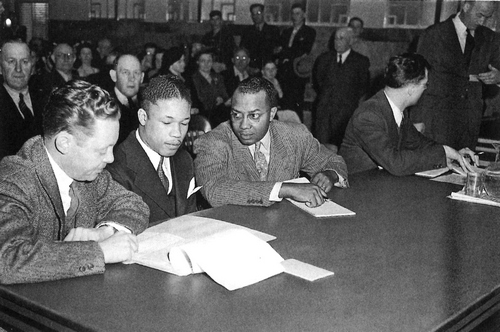
Robert E. Lee Folkes consults with his defense attorney, Leroy Lomax, left, as his friend and adviser William Pollard, right, looks on. (Image: Oregon Journal)
On cross-examination, Folkes’ attorney, Leroy Lomax, asked if De River had referred to Folkes as an exhibitionist. De River replied, “I might have said that.”
The defense rested its case on April 20, 1943.
The jury began deliberations but returned to the judge saying they couldn’t reach a verdict. He ordered them to continue and provided army cots for them to sleep on inside the courthouse. After thirty hours of deadlock and courtroom drama, the jury filed in at 3:13 p.m. on April 22. Their verdict: guilty of first-degree murder. Death was mandatory.
“I know it was a fair and impartial trial,” Folkes said afterward. “I’m sorry the jury thought I did it, as I didn’t, and I’m sorry my mother and Jesse had to go through this.”
In a letter to his mother, Clara, he was more candid:
“I was not convicted on evidence. I was convicted through prejudice.”
Folkes added: “I truly believe that I could take any one of those jurymen that convicted me, or even the judge who heard the case, and on the same grounds, either one of those people could be placed in front of a Negro jury and convicted. Of course, this incident will never happen, but I assure you it is amazing what prejudice can do.”
On November 5, 1944, a group of Los Angeles clubwomen formed the Robert Folkes Defense Club and pledged to raise $2,000 to bring his case to the U.S. Supreme Court. The court declined to hear the appeal on November 23.
Lomax worked tirelessly, appealing to the Governor of Oregon to commute the sentence to life. The governor refused.
On January 5, 1945, at 9:13 a.m., Robert E. Folkes died in Oregon’s gas chamber for a crime he insisted he did not commit.
NEXT TIME: In the conclusion of “The Lower 13th Murder Case”, we’ll examine the case more closely—and ask whether wartime prejudice condemned an innocent man.
Welcome! The lobby of the Deranged L.A. Crimes theater is open. Grab a bucket of popcorn, some Milk Duds and a Coke and find a seat.
Today’s film is an outstanding film noir from 1945, directed by Otto Preminger, FALLEN ANGEL. It stars Alice Faye, Dana Andrews and Linda Darnell.
IMDB says:
One night, drifter Eric Stanton is forced to disembark a San Francisco-bound bus because he has not paid the full fare. Eric is let off in the small town of Walton, and when he goes to Pop’s, a local diner, he finds Pop distraught over the disappearance of his beautiful waitress Stella. Retired police detective Mark Judd assures Pop that Stella will return, and soon she does appear, much to Pop’s relief. Eric then leaves and, after seeing a poster for a show by “psychic” Professor Madley, convinces Madley’s assistant, Joe Ellis, that he is friends with the professor. Ellis confides that ticket sales have been slow due to the influence of Clara Mills, the former mayor’s daughter, who has been telling her friends not to attend. Seeing an opportunity to make money, Eric goes to the Mills house the next morning, and asks the cynical Clara to give the professor a chance. Clara dismisses Eric, saying that the professor is a charlatan, but her lovely younger sister June is intrigued by Eric, and tells Clara that Madley is merely trying to make a living. June convinces her sister to buy tickets to the show, and soon many of the townspeople follow suit.
Welcome! The lobby of the Deranged L.A. Crimes theater is open! Grab a bucket of popcorn, some Milk Duds and a Coke and find a seat. Today’s feature is MIDNIGHT MANHUNT (1945), starring Ann Savage, William Gargan, and Leo Gorcey.
Ann Savage appeared in four movies in 1945, one of them is tonight’s feature; another is DETOUR, a cult favorite. Her co-stars in MIDNIGHT MANHUNT are William Garagan and Leo Gorcey. Gargan,was a Academy Award-nominated actor known for’ THEY KNEW WHAT THEY WANTED, and his work on NBC radio and TV. You may recognize Gorcey from the DEAD END KIDS and the BOWERY BOYS.
Enjoy the movie!
IMDB says:
Master criminal Joe Wells is shot and left for dead in his hotel room. Wells rouses himself and wanders into the street before finally expiring in an alley next to a wax museum. Reporter Sue Gallagher, who lives upstairs from the museum, is first on the scene, and conceals the body among the wax exhibits in order to get a scoop.
Welcome! The lobby of the Deranged L.A. Crimes theater is open! Grab a bucket of popcorn, some Milk Duds and a Coke and find a seat. Today’s feature is THE UNSEEN starring Joel McCrea, Gail Russell, and Herbert Marshall.
The movie is an unofficial sequel to the THE UNINVITED (1944), which starred Ray Milland and Gail Russell, and based on a novel written by Ethel Lina White. Another of White’s novels was adapted for the screen and became Alfred Hitchcock’s wonderful film, THE LADY VANISHES.
Enjoy the movie!
TCM says:
On Crescent Drive in New Bristol, on a dark, rainy New England night, an elderly housekeeper named Alberta sees a man lurking inside the boarded-up house at Number Eleven, and is strangled by him in nearby Salem Alley. Young Barnaby Fielding watches the scene from his bedroom window at Number Ten, and retrieves Alberta’s gold watch. The murder is still unsolved when Elizabeth Howard arrives at the Fieldings’ to be the new governess for Barnaby and his sister Ellen. Barnaby is strangely devoted to their former governess, Maxine, who orders him to keep watch at night and leave his stuffed elephant in the window. Elizabeth finds the gold watch and gives it to Barnaby’s father David, but because he was suspected of killing his wife, who died in an automobile accident two years earlier, David is afraid to give it to the police.
Welcome! The lobby of the Deranged L.A. Crimes theater is open. Grab a bucket of popcorn, some Milk Duds and a Coke and find a seat. Tonight’s feature is AND THEN THERE WERE NONE [1945]. It is based on a 1939 Agatha Christie novel, and stars Barry Fitzgerald, Walter Huston, and Louis Hayward, Enjoy the film.
TCM Says:
On a stormy Friday afternoon, Judge Francis J. Quincannon, Dr. Edward G. Armstrong, Philip Lombard, Vera Claythorne, General Sir John Mandrake, Emily Brent, William H. Blore and Prince Nikita Starloff are taken on a fishing boat to Indian Island, off the coast of Devon, England, for a weekend visit with the mysterious U. N. Owen. The eight passengers, who are all strangers, are greeted by butler Thomas Rogers and his wife Ethel, the cook, who reveal that they have not met their new employer. While eating in the dining room, the guests become intrigued by the centerpiece, which consists of ten figurines of Indian boys. Vera begins to recite the nursery rhyme about ten little Indian boys who are killed, and Starloff continues the rhyme in the parlor. Rogers then puts a record on the phonograph, as he was instructed to do, and the guests are astonished to hear Owen accuse them of various crimes that led to the deaths of others.
Welcome! The lobby of the Deranged L.A. Crimes theater is open! Grab a bucket of popcorn, some Milk Duds and a Coke and find a seat. Today’s feature is BRUTE FORCE starring Burt Lancaster, Hume Cronyn, Charles Bickford, Yvonne De Carlo, Ella Raines, Ann Blyth, Anita Colby and introducing Howard Duff.
Enjoy the movie!
TCM says:
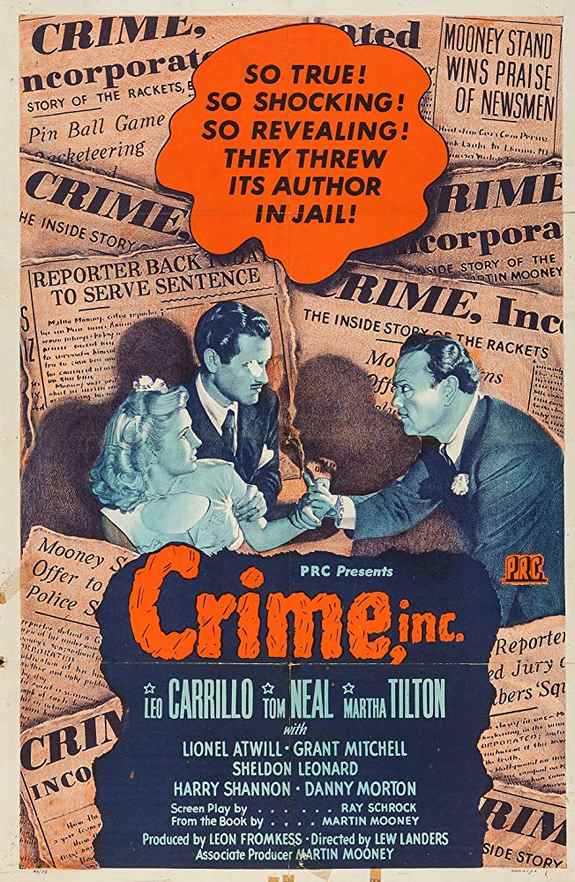
In the mid-1930s, after two of his henchmen are shot down in a café, New York racketeer Bugs Kelly confides to reporter Jim Riley that a newly formed crime syndicate committed the murders after he refused to join. Unknown to Bugs, the syndicate’s boss, who hides his illegal activities by posing as the president of National Brokers, Inc., a phony company, has also ordered Bugs’s execution. When the order to kill Bugs is issued, however, one of Bugs’s men overhears “finger man” Tony Marlow passing the word to Barry North, a racketeer posing as an exporter, and alerts Bugs. Bugs kidnaps Tony, a nightclub owner, and forces him to arrange a rendezvous with the hoodlum who was hired to kill him.
Welcome! The lobby of the Deranged L.A. Crimes theater is open. Grab a bucket of popcorn, some Milk Duds and a Coke and find a seat. Tonight’s feature is THE GREAT FLAMARION starring Erich von Stroheim, Mary Beth Hughes, Dan Duryea and Stephen Barclay. Directed by Anthony Mann and produced by William Wilder.
Enjoy the movie!
TCM says:
In 1936, a performance in a Mexico City vaudeville hall is interrupted by the sound of gunshots emanating from backstage. After the body of Connie Wallace, one of the performers, is found, the police investigate and arrest Eddie Wheeler, her husband, for strangling her. Following the departure of the police, Tony, the clown, is collecting his stage props when a man with gunshot wounds falls from the rafters. Tony recognizes the man as “The Great Flamarion,” a former vaudeville marksman renowned for his skill.
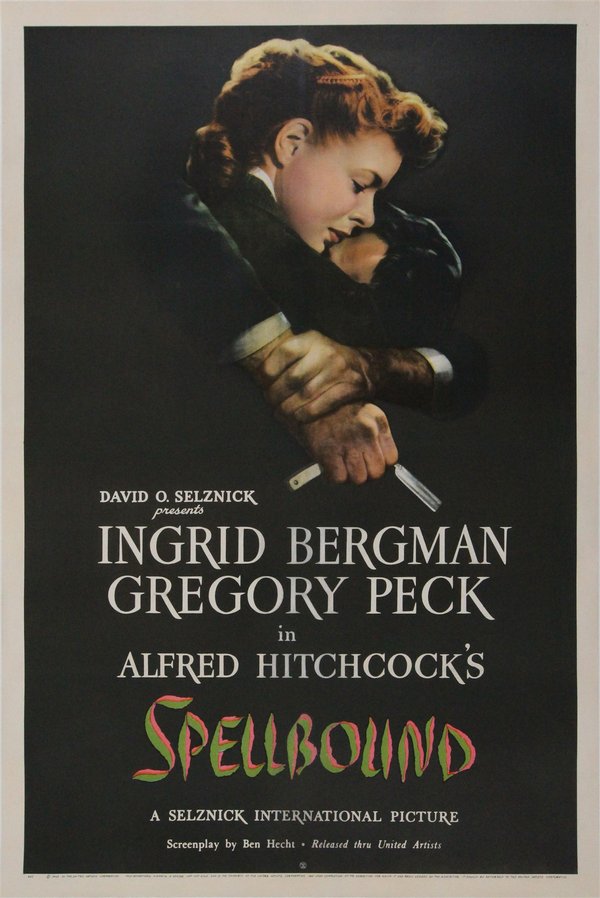
Welcome! The lobby of the Deranged L.A. Crimes theater is open. Grab a bucket of popcorn, some Milk Duds and a Coke and find a seat. Today’s feature is SPELLBOUND starring Ingrid Bergman and Gregory Peck.
Enjoy the movie!
TCM says:
When Dr. Anthony Edwardes, the distinguished psychologist who is to take over as head of Green Manors mental hospital, arrives at the countryside facility, his colleagues, including the outgoing head, Dr. Murchison, are surprised to see how young he is. That evening, Dr. Constance Peterson, the hospital’s only female psychologist, meets Dr. Edwardes at dinner and is immediately attracted to him. At the doctors’ table, Constance, who has been accused by her amorous colleague, Dr. Fleurot, of being cool and detached, talks animatedly about her idea for a woodside swimming pool and starts to draw her proposed design on the tablecloth with the sharp edge of her knife. Dr. Edwardes responds to the curved lines with a sudden burst of anger, baffling his peers.
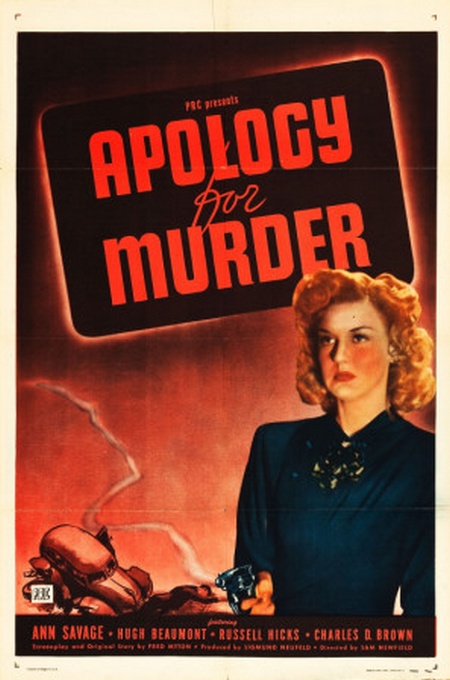
Welcome! The lobby of the Deranged L.A. Crimes theater is open. Grab a bucket of popcorn, some Milk Duds and a Coke and find a seat. Tonight’s feature is APOLOGY FOR MURDER starring Ann Savage, Hugh Beaumont, Russell Hicks and Charles D. Brown.
Enjoy the movie!
TCM says:
Reporter Kenny Blake (Hugh Beaumont) falls in love with scheming Toni Kirkland (Ann Savage) not knowing that she is married to a man years older than she. By the time he finds out, he is so under her spell that he murders her husband which is what Toni had planned all along. City editor McKee (Charles D. Brown), Kenny’s boss and best friend, begins to pursue the tangled threads of the crime relentlessly and gradually closes the net on Kenny. The latter is mortally wounded by Toni, who has deserted him for another man.