Happy New Year!

Welcome to Deranged L.A. Crimes. Ten years ago, I started this blog to cover historic Los Angeles crimes. I am not surprised that I haven’t even scratched the surface of murder and mayhem in the City of Angels.

I have been absent from the blog for a while, focusing on finishing my book on L.A. crimes during the Prohibition Era for University Press Kentucky. It’s not done yet, but I’m close. No matter, it is time to return to the blog. It is something I love to do.

Focusing my energy on the book, I failed to pay tribute to the inspiration for Deranged L.A. Crimes, Agness “Aggie” Underwood, on December 17, 2022, the 120th anniversary of her birth. If you aren’t familiar with Aggie, I’ve written about her many times in previous posts.

Aggie Underwood

In 2016, I curated a photo exhibit at the Los Angeles Central Library downtown. The exhibit, for the non-profit Photo Friends, featured pictures from cases and events Aggie wrote about over the course of her career. I wrote a companion book, The First with the Latest!: Aggie Underwood, the Los Angeles Herald, and the Sordid Crimes of a City.

Aggie is a dame worth learning about. She is a legendary crime reporter, who worked in the business from 1927 until her retirement from the Los Angeles Herald in 1968. A force to be reckoned with, Aggie worked as a reporter until her promotion to City Editor of the Herald in January 1947, while covering the Black Dahlia case. She was the only Los Angeles reporter, male or female, to get a by-line for her reporting on the ongoing investigation.  

On her retirement, she told a colleague that she feared being forgotten. That won’t happen on my watch. Thanks again, Aggie, for the inspiration. Deranged L.A. Crimes is dedicated to you.

Among the things I’ve learned over the years researching and writing about crime, is that people don’t change. The motives for crime are timeless: greed, lust, anger, betrayal, and jealousy are but a few.

What is different is crime detection. Science has come a long way. Detectives no longer use the Bertillon system to identify criminals—they use DNA. I think part of the reason I’m drawn to historic crime is the challenges overcome by former detectives and scientists. Despite the advancements in science, it is my belief that if it was possible to pluck the best detectives and scientists from the past and set them down in the present, they would still be great. I am amazed at the cases they solved.

Class on the Bertillon system c. 1911

I look forward to this new year, and to the challenges it will bring. I am so glad you are here, and I invite you to reach out if you have questions and/or suggestions.

Best to all of you in the New Year.

Joan

November 1969: The Scientology Murders

On Saturday, November 22, 1969, a man living in the Pico Union district found the mutilated bodies of Doreen Gaul, 19, and James Sharp, 15 in an alley between Arapahoe Street and Magnolia Avenue, south of 11th Street.

Doreen was naked except for a string of multicolored beads—hippie beads—de rigueur for teenage girls in 1969. James wore a corduroy jacket, striped T-shirt and black Levis—the uniform of teenage boys.

Someone stabbed Doreen and James between 50 and 60 times each.  Seventeen of the stab wounds inflicted on Doreen were near her heart. She was raped. Their right eyes were cut out. The overkill recalled the brutality in the Tate/La Bianca murders in August, but police uncovered no link between Doreen and James and the other victims.

Following the autopsy, the coroner concluded that Doreen was a recent arrival in Los Angeles because her lungs were smog free. The coroner was right, Doreen came to Los Angeles from Albany, New York a few months earlier to study Scientology. James was also a recent arrival to Los Angeles. He traveled west from Crestview, a St. Louis, Missouri suburb.  He came to study Scientology, too. In fact, their study of Scientology was the only thing linking them.

DOREEN GAUL

Scientology, founded in 1950 by science fiction writer L. Ron Hubbard, was attractive to Baby Boomers, teenagers in the 1960s, who sought spiritual guidance in non-traditional religions, communes, and radical political ideologies.

In Los Angeles Scientology provided communal living arrangements in a few of the old mansions in Pico Union and near MacArthur Park. Doreen lived at 1032 S. Bonnie Brae Street and James lived less than a quarter of a mile away at 921 S. Bonnie Brae Street. On the evening of the murders Doreen left “Thetan Manor” to meet with James who was going to “audit” her.

For those of you unfamiliar with the basic tenets of Scientology, Thetan is “an immortal spiritual being; the human soul.”  An audit is conducted by a Scientology minister or minister-in training using an electropsychometer (E-Meter) to locate and confront areas of spiritual upset.  For Scientologists the E-Meter is a religious artifact used as a spiritual guide.

E-Meters are more sophisticated today than they were in 1969 when they were nothing more than a galvanometer with two tin cans attached—not unlike many quack devices marketed before and since to the gullible.

The Federal Drug Administration stepped in when L. Ron Hubbard made unsubstantiated claims about the E-Meter’s medical capabilities.  

In a Court of Appeals decision, still in effect today, every E-meter must bear a warning that states, “The E-Meter is not medically or scientifically useful for the diagnosis, treatment or prevention of any disease. It is not medically or scientifically capable of improving the health or bodily functions of anyone.”

The mainstream press characterized Scientology as a “cult” and a “mystical, quasi-scientific organization.” The organization cooperated with the Los Angeles Police Department at first, but dragged their feet when asked to provide a comprehensive membership list.  LAPD Det. Lt. Earl A. Deemer wanted to explore any possible connection between the murders of Doreen and James and a Jane Doe slaying from several months before. The marked similarities in the three murders struck Deemer as more than a coincidence. He described the crimes to reporters: “All three victims were stabbed, and their wounds appeared to be the work of a ‘fanatic’.  None of the three was slain where the bodies were found. The Jane Doe of the previous killing wore hippie-like attire which resembled that in which Miss Gaul had been seen and which is favored by many young females in the organization [Scientology].”

Deemer wanted to talk to Hubbard personally about the membership list, but the Scientology leader was adrift at sea, literally. He was on his private yacht to avoid a hefty tax bill that awaited him on land.

L. RON HUBBARD

On behalf of Scientology Rev. Natalie Fisher, resident agent of the organization quartered at 2773 W. Temple Street stated, “This organization has no facts or information regarding the circumstances of the crime, but we are doing everything in our power to assist law enforcement agencies to see that justice is done.”

The families of the young victims were devastated by their loss. James’ father was a prosperous salesman and he permitted James to leave high school to study Scientology in Los Angeles.

Doreen’s friends said that following her graduation from a parochial high school in the spring of 1968, she became a devotee of Scientology. Her switch from Roman Catholicism surprised her friends, but not her father. He described Doreen as a “. . . good kid, but an emotional kid.  She was always looking for green grass and rainbows.”

The investigation into the random slayings continued but police never located the place where Doreen and James were murdered.  Solving a crime without locating the place where it happened is challenging.  Police never solved the infamous Black Dahlia case in 1947 either.  The victim in that case, 22-year-old Elizabeth Short, was murdered in a place they never found and her dismembered body was dumped in a weedy vacant lot in Leimert Park.

Police stated that there was no clear connection between the slayings of Doreen and James and 11 unsolved murders (including the five Tate murders) committed in the county since January 1969.

The two teenagers traveled to Los Angeles seeking spiritual enlightenment, why did they end up brutalized and discarded in an alley? Were Doreen and James the victims of a serial killer?  Did a member or members of the Manson family kill them as some suspect?  Fifty years later we have no answers, and we may never get them, the case remains unsolved.

Justice Denied, Part 3

Jury selection in the trial of 41-year-old Santa Monica physician Dr. George Dazey for the 1935 slaying his actress-wife Doris began in early February 1940. Guilty or innocent, George Dazey did one thing right–he hired Jerry Geisler to defend him in court.

“Get Me Geisler” (pronounced Geese-lar) was a cry that went up routinely in Hollywood circles. Over the course of his half-century of practicing law Geisler defended Errol Flynn, Robert Mitchum, Charlie Chaplin, Lili St. Cyr and many, many  others.

attorney-jerry-geisler-with-client-everett

Jerry Geisler w/Robert Mitchum

Geisler’s practice wasn’t limited to Hollywood luminaries; he also defended Benjamin “Bugsy” Siegel as well as the odious Dr. George Hodel (for incest). Hodel is well-known for having been a suspect in the 1947 murder of Elizabeth Short, the Black Dahlia.

During the voir dire Deputy District Attorney Hugh McIssac questioned potential jurors on their attitude toward circumstantial evidence and capital punishment. The case against George was entirely circumstantial–which isn’t to say weak; after all, most cases are won on circumstantial evidence. Jerry Geisler’s questions to the possible jurors were very different; he wanted to know:

“If it is brought out here that the deceased might have ended her own life, would you be willing to take that into consideration in the matter of reasonable doubt as applied to this defendant?”

The final jury was composed of three women and nine men. The proceedings hit a snag when on the day after empanelment one of the jurors became too ill to attend the trial. The alternate jurors had not yet been sworn in which led to a legal dispute over when a trial actually begins. Is it when the jury is sworn; when the first witness is called; or when the first witness opens testimony? Opposing counsel agreed to stipulate that the sick juror, Mr. Gieschen, should be discharged and that selection of a jury should continue on the basis of an incomplete panel.

Unconcerned by the minor legal hiccup, Dr. Dazey spent his time working on a crossword puzzle.dazey crossword

George Dazey’s trial opened with a very unusual situation.  George Merritt, a major witness in the case, admitted to being a personal friend of both the defendant and Deputy District Attorney McIssac.  When Merritt took the stand he testified that Dr. Dazey had called him to the death scene shortly after he claimed to have discovered his wife dead on the garage floor.  But his testimony didn’t go as the prosecution had believed it would–Merritt was suddenly unable to recall the doctor making damaging, self-incriminating, statements.

The Deputy D.A. was not pleased:

“Didn’t you tell me at a lunch we had together within recent months that Dr. Dazey kept repeating, ‘Why did I do it?  Why did I do it?'”

Merritt said he wasn’t certain.

Peeved with his recalcitrant witness McIssac continued:

“Didn’t you tell me that although Dr. Dazey appeared hysterical and incoherent that  you and your friends decided that he was putting on an act?”

Merritt said no.

McIssac told the court that he was taken by surprise. He had every reason to believe that Merritt would testify at the trial the same way in which he’d testified to the grand jury several weeks earlier. At the grand jury hearing he was asked if Dr. Dazey had blurted out, “Why did I do it?” and Merritt had responded: “It might have sound like that.”

Part of the problem faced by the prosecution was that Doris’ death had occurred four years earlier and witnesses are notoriously unreliable even moments after a crime has occurred.

Jerry Giesler made sure to mention that even the police officers who had originally been called out to the scene had to refer to reports they had made at the time of the incident.

After the first day or two of testimony I’d have called the contest between the prosecution and defense a draw. Geisler had made a point about the dim memories of the witnesses, but the prosecution scored a point in refuting the notion that Doris had been suicidal with the testimony of Joe E. Burns, a Frigidaire repairman.

Burns had been called to the Dazey’s home on the day prior to Doris’ death to repair their fridge. He had to return the next day to make further adjustments and he testified that on both occasions Doris seemed to be in a good frame of mind and perfectly lucid when they spoke. That testimony would make it more difficult for Geisler to sell the defense theory that Doris was unstable and suicidal.

Winifred Hart

Winifred Hart during the silent era.

The most flamboyant of the witnesses to testify was a former neighbor the Dazey’s, Mrs. Wiinifred Westover Hart, the ex-wife of silent film cowboy superstar, William S. Hart.

Winifred was an actress during the silent era, which is how she met her ex-husband. Her first screen appearance was a small role in D.W. Griffith’s 1916 film, Intolerance, but her movie career was over by 1930.

The ex-Mrs. Hart arrived at the murder trial wearing dark glasses and holding a magazine up to shield her face. Her first comment upon taking the witness stand was that she was nervous.

On the night of October 3, 1935 Mrs. Hart said she heard screams coming from the direction of the Dazey home. Deputy District Attorney McIssac asked her:

“Did you tell anyone about hearing these screams after you learned of Mrs. Dazey’s death the next day?”

Mrs. Hart said:

“Oh, I told everybody, I was so upset!”

McIssac asked her if she had received any threats and she answered that she had, but she didn’t recognize the voice over the telephone. There was no way to corroborate her testimony about the threatening calls and on top of that it was difficult for the jury to take her seriously because she was so theatrical. According to the L.A. Times the former silent film actress had a flair for the histrionic.

When it was Jerry Geisler’s turn to question Mrs. Hart he opened with:

“Now don’t get nervous at me.”

Mrs. Hart went on to testify that in the late afternoon of October 3, 1935 she and her mother, Mrs. Sophie Westover, had been listening to the radio when they heard screaming and crying. Hart testified:

“It sounded like a boy being teased—boys used to play in a vacant lot next to us–and after a while I got up and shut the window and turned up the radio.”

Hart knew what time they heard the ruckus because she and her mom were listening to a scheduled program featuring Rudy Vallee.

Winifred Hart c. 1940s

Winifred Hart c. 1940s

Another witness, Douglas O’Neal, 17, lived near the Dazey’s home and he testified that had seen Dr. Dazey’s car parked by the Dazey residence hours before the doctor said he’d arrived home to find his wife dead.

Jerry Geisler established that the boy couldn’t be certain it was Dr. Dazey’s car because he hadn’t seen the license plate numbers and the car was a popular make and model.

Mildred Guard, sister of the dead woman, testified that she’d visited her sister many times while she was married to Dr. Dazey. She recalled one occasion, a short time prior to the birth of the couple’s child, when there was some rather disturbing breakfast table conversation:

“George [Dr. Dazey] was talking and he said, ‘If the baby looks like_____’ and here he mentioned the name of a certain man–I’ll kill both Doris and the baby.”

Prosecutor McIassac asked Mildred how Doris had replied. Mildred said that her sister had admonished George, asking him not to talk like that.mildred guard.jpg

The mystery man was referred to in court only by his first name, which was Carl. During questioning by Jerry Gisler, Mildred testified that she knew that her sister had been going out with Carl up to the time she began dating Dr. Dazey. When asked if Doris had quit seeing Carl after starting a relationship with George, Mildred admitted that she had no idea.

Geisler said:

“Well, you know the baby didn’t look anything like Carl?”

To which Mildred replied that the baby didn’t bear the slightest resemblance to Carl. Mildred’s testimony concluded with her description of an incident that had occurred on a night when she was staying at the Dazey home.  She said she heard Doris scream then call out her name:

“I went to her room and she was partly sitting up in bed and had a frightened look on her face.  The doctor was standing about three feet from the bed, fully dressed and apparently sober.  He looked very mean.  His hands were clenched, his face was purple and he was grating his teeth.  She had a look of terror on her face.”

Dr. Dazey allegedly told Mildred he was “only fooling” and asked her to leave the room.  Doris never explained the incident to Mildred.

As George Dazey’s trial entered its second week the prosecutors offered their version of Doris’ death–they contended that the doctor had incapacitated his wife in some way then carried her body into their garage and placed her head near the car’s exhaust pipe. In fact Doris’ face was so near to the exhaust pipes that she received burns which the prosecution declared would have been highly improbably if she had committed suicide as had been suggested by George’s defense team.

spectators dazey trial

Unidentified women queued up to watch the trial of Dr. George Dazey.

Everyone who came to the courtroom on February 13, 1940 was there to hear the testimony of Dr. Dazey’s former nurse, and occasional “social companion”, Miss Frances Hansbury.  Frances had testified at the grand jury hearing that George had confessed to her that he had murdered Doris.

If the jury believed Frances it could be all over for George Dazey–he might dance into eternity at the end of a hangman’s noose.

NEXT TIME:  The trial and verdict.

The Butcher


Georgette Bauerdorf

Georgette Bauerdorf

There were numerous unsolved slayings of women in 1940s Los Angeles, and among the dead were: Ora Murray, Laura Trelstad, Jeanne French, Georgette Bauerdorf, and of course Elizabeth Short. The murders were enough to frighten and enrage the public, who then demanded that local politicians address their concerns. The 1949 L.A. County Grand Jury was tasked with investigating what many perceived to have been a failure on the part of law enforcement to crack the cases. The Grand Jury dropped the ball on investigating the cops handling of the murders to focus instead on corruption in police vice units, but I’m not sure that it matters.

I don’t believe the murder cases went unsolved due to sloppy police work. What I think is that with the flood of transients (i.e. military personnel, war workers, etc.) into the city after the U.S. entered WWII in December 1941, it became increasingly hard for detectives to solve a homicide case.  If the victim and killer were strangers to one another, which in the war and post-war environment was likely, it would add another layer of difficulty to solving a murder with few, if any, clues.dahlia_herald_3_the black dahlia

By poking around in old newspapers I’ve discovered that there was a large number of dishonorably or medically discharged veterans wandering the streets of L.A. during the 1940s. Some of them had suffered profound trauma during their service, what we’ve come to know as Post Traumatic Stress Disorder, or PTSD. Others of them, like Otto Stephen Wilson, were screwed up for reasons that had nothing to do with a battlefield.  Wilson had served in the Navy for eleven years before being discharged in November 1941, one month before the U.S. went to war.

The reason for Wilson’s discharge from the Navy was the he suffered from sexual psychosis. If you’re wondering why it took them over a decade to diagnose him, it wasn’t until his wife complained to San Diego naval authorities about his “unnatural impulses” that the he came to the attention of his superiors and they gave him the boot. We’ll get to his impulses later.

Otto Stephen Wilson

Otto Stephen Wilson

Following his discharge from the Navy, Wilson had been living in and around L.A. working menial jobs as kitchen help in various cafes. He had a police record in the city beginning with his arrest on March 25, 1943 on suspicion of criminal attack when a young woman, Celeste Trueger, told cops he had grabbed her by the throat on a hotel stairway. His guilty plea on a battery charge earned him 90 days in jail, 30 of which were suspended.

On March 14, 1944, he was arrested on suspicion of burglary and handed over to county authorities to begin a nine month sentence. Wilson was released on good behavior about a month before he slaughtered two women in downtown hotels.

NEXT TIME: The story of Otto Stephen Wilson’s murder spree continues.

Louise Springer Murder: Conclusion

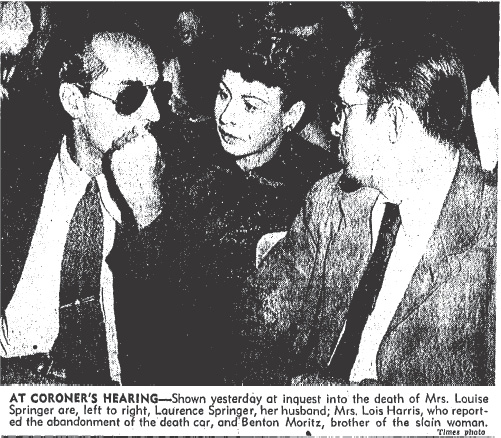
springer_coronerThe biggest manhunt since the murder of Elizabeth Short continued as cops tried to find the killer of hairstylist Louise Springer.

LAPD conjectured that either Louise Springer had been immediately stunned with a blunt instrument as she sat in her car at a Crenshaw Blvd. parking lot, or she had known the person who murdered her. The two possible theories were supported by the fact that Louise had apparently offered no resistance, nor had she cried out — and, tellingly, her brand new manicure was still pristine.

There were bruises on Louise’s right temple and the top of her head which, in the opinion of Dr. Frederick D. Newbarr, the autopsy surgeon, were hard enough to render her unconscious.

Mrs. Jewell Lorange, left, and Miss Germaine Le Gault presented possible clue to slaying of Mrs. Louise Springer in reporting "three men in black car."

Mrs. Jewell Lorange, left, and Miss Germaine Le Gault presented possible clue to slaying of Mrs. Louise Springer in reporting “three men in black car.”

Of the scant leads uncovered by detectives, an interesting piece of information emerged. Miss Germaine Le Gault and Mrs. Jewell Lorange, who lived directly across from where the death car was found, said that they saw three men “in a big, black car” spend two evenings prior to the murder parked less than 50 feet away from where Springer’s strangled body was found. Unfortunately, the lead never panned out.

More than a week had passed when suddenly the Springer case began to heat up with the arrest of two suspects: Leon Russell, car washer at a service station near the parking lot, and Claud Cox, a jobless Navy vet who had been arrested on a morals complaint made by a young Hollywood woman named Marion Brown. Brown, 18, told cops that Claud Cox, whom she said she knew slightly, took her to his room at 1611 N. Orange Drive and tried to molest her. Cox told cops that he got “a little friendly” but he flatly denied trying to harm the girl.
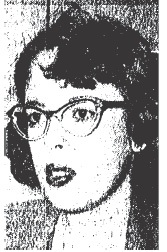
springer_marion brown2

Marion Brown, 18, said Roscoe Cox, released in Springer murder, tried to attack her.

As cops tracked down leads, Louise Springer’s husband and her 21 month old son mourned the wife and mother as she was laid to rest in a San Jose cemetery.

At least the crime lab was finally able to state conclusively that Louise Springer had not been slugged before she was garroted in her husband’s car. What had initially appeared to be bruises on Mrs. Springer’s head were actually post-mortem tissue changes — the result of the dead woman’s body resting face down for three days in the backseat of the car before being discovered. The evidence suggested that Springer had been murdered in the car, at the parking lot, as she listened to the radio.

Another suspect was arrested and cleared by LAPD homicide detectives.  The man was thirty-eight year old Guy Smith who was busted by L.A. Sheriff’s department deputies on a tip from a relative. Nobody can do you dirt like family. In any case, Smith had an alibi for the time of Louise’s murder; however, the law was investigating him in connection with other unsolved crimes, notably morals offenses.

As the case grew colder the cops began to cast around for a new motive in Louise’s murder. Maybe kidnapping and sexual assault weren’t the real motives; maybe someone had a grudge against her, or they were jealous of the attractive brunette.

springer_coxOne of the early suspects in Springer’s murder, Claude Cox, was arrested in September 1949, but the arrest had nothing to do with Louise Springer’s death. According to Mrs. Geneva Cowen, 35, she was walking along Hollywood Blvd. when she heard someone come up behind her. She turned and the man, Claude Cox, rushed up and hit her, hard. Cox said: “I’m going to kill you.” Cowen took a chance and started to run. Cox grabbed for her, but only succeeded in pulling her coat off.

Eventually the leads dried up and the Louise Springer murder, aka, the Green Twig Murder case, went cold.

Laurence and Louise Springer had been in L.A. for only six months before she was murdered, so the widower returned to Northern California to try to put some of his pain behind him.

The single major success in the case came when Dr. Mildred Mathias, UCLA botanist, was finally able to identify the twig that had been so cruelly inserted into Louise Springer’s vagina as belonging to a bottle tree. Dr. Mathias said that the twig had apparently been stripped from a larger branch sometime in the year prior to the crime.

Louise Springer’s murder remains unsolved.
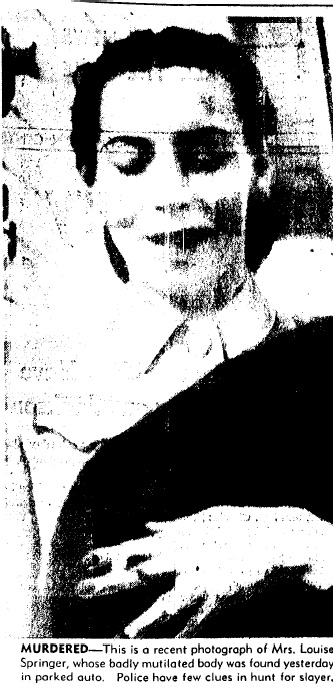
The Murder of Louise Springer: Part 1

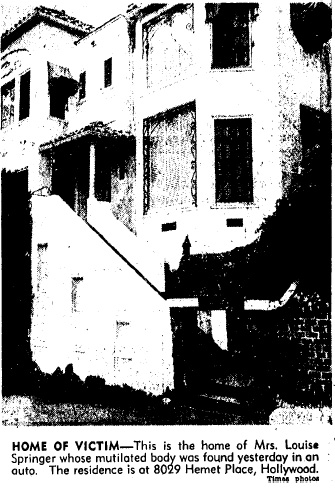
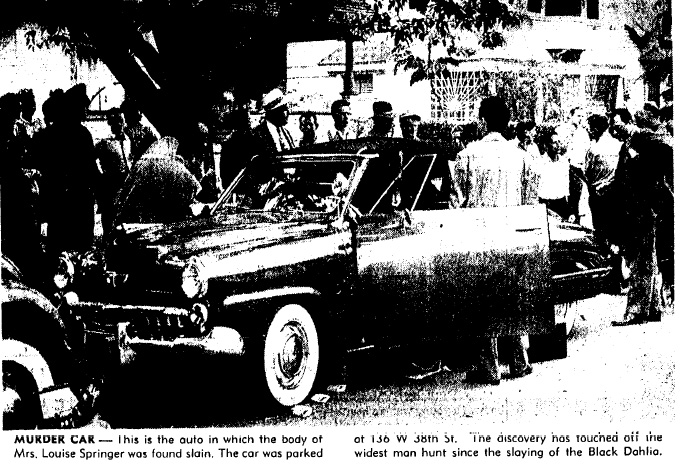
louise_portraitJune 16, 1949, the decomposing body of thirty-five year old Louise Springer, a beauty shop operator, was found huddled in the rear seat of her husband’s convertible automobile parked at 125 W. 38th Street. Springer had been garroted.

A length of clothesline was knotted around Springer’s neck, with two knots under her
left ear. Her face was swollen and nearly black. Her brown skirt and yellow suede
jacket had been twisted around her body, with her skirt tangled around her hips.

springer_houseA stick 14 inches in length and 1/2 inch thick had been violently driven into her vagina .

Laurence Springer had reported his wife missing about sixty hours before her body was discovered. Louise, a hairstylist, had been working until shortly before 9:00 p.m. on the night she disappeared. Laurence had arrived to pick her up from work and take her to their beautiful home in the Hollywood Hills.

He’d parked in a lot on Crenshaw across the street from the shopping center in which Louise worked. The couple walked to their 1948 convertible and Louise, who had spent hours on her feet, pulled off her shoes and put on a pair of slippers that she kept in the car. They were just about to head for home when Louise exclaimed: “Oh, I’ve forgotten my glasses.” Laurence told her to relax and listen to her favorite radio show while he went to retrieve her specs.

Laurence got Louise’s glasses, then stopped to buy a magazine and chat with a friend. He wasn’t gone for more than 10 or 15 minutes, but when he returned both Louise and the car were gone.springer_car

Laurence knew that something was wrong, she wouldn’t have driven off and left him. He looked around for a few minutes but he couldn’t find his wife. He called the cops at about 10:00 pm and a few moments later a prowl car met him at the parking lot. The officers looked around but they didn’t find anything either. Laurence accompanied the police to the University Division Station where he filed a missing persons report. He then went home to be with his 21 month old son.

The Springer’s housekeeper and nanny, forty-nine year old divorcee Elizabeth Thompson, nearly collapsed when she received the news of her employer’s disappearance. Thompson told police that the Springers were happily married and that as far as she knew they had no enemies. She said that the couple had sold the beauty shops they owned in Northern California, then moved south to L.A. They hadn’t been in town for very long before Louise was slain. spring_child

Thompson injected a note of mystery into the investigation when she said that she had received an obscene phone call from an unknown woman about three months prior to Louise’s disappearance. The caller asked several times for Thompson to identify herself, which she refused to do — then the caller made a lewd proposal and Thompson hung up on her. Cops didn’t believe that the phone call had anything to do with Louise’s disappearance, but during the initial stages of the investigation they couldn’t rule anything out.

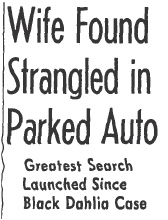
springer_headlineOne of the most disturbing aspects of the case was that the parking lot from which Louise Springer had been abducted was only about a block away from the lot where the body of Elizabeth Short had been discovered in January 1947!

Women were terrified by the thought that the Black Dahlia’s killer was once again hunting the streets of L.A. for victims. An enormous manhunt, the largest since Short’s murder, was soon underway.

Witnesses in the neighborhood where Louise’s body had been found came forward to say that they had seen a man in the murder car and watched him as he seemed to adjust something on the backseat – which is where Louise’s body had been found covered with a tarp. A man was seen exiting the car, and some people thought that he may have been wearing a military uniform.

springer_cluesPolice forensics investigators were having a difficult time trying to determine if Louise had been slugged before she was strangled, or if she’d been sexually assaulted. A relatively new test called the acid phosphatase test was used to try to determine if semen was present, but the test was inconclusive due to decomposition.

The main piece of physical evidence, the twig that was violently inserted into Louise’s vagina, was becoming a huge problem for investigators — it couldn’t be identified. Bonnie Templeton, curator of the botany department at the County Museum, had been called in to lend her expetise in identifying the twig. She said that it could have come from “four of five” species of trees or shrub.

It was beginning to look as if the LAPD was going to have another unsolved homicide of a woman on the books.

NEXT TIME: The investigation into the murder of Louis Springer continues.