A Mobster in Hollywood

The Mob Comes to Hollywood

Los Angeles never had a mob like those that ran the streets in Chicago, New York, Detroit or Kansas City. Corruption in the City of Angels was a top-down affair—overseen by politicians in City Hall. Local vice kings, Charlie Crawford, Albert Marco, and Bob Gans managed illegal liquor, gambling and prostitution and shared profits with the politicians. Crooked members of the Los Angeles police force supplied the muscle. As a cabal, some called “The City Hall Gang,” they had vice in the city sewed up with no room for outsiders.

(1928) – View of Los Angeles City Hall decorated with banners for its opening ceremony. Photo courtesy Water & Power.

Eastern mobsters attempted on several occasions to get a toehold in Los Angeles. Infamous Chicago mob boss, Al Capone, visited Southern California in December 1927. He traveled by train south to San Diego, and stopped in Orange County on his way back. When he returned to the Biltmore Hotel, LAPD kept a close watch on him. On December 13th, LAPD detective Edward “Roughhouse” Brown escorted him and his entourage to the Santa Fe station to board an eastbound train.

The only successful mob-backed racket to gain power in Los Angeles was through the International Alliance of Theatrical Stage Employees (IATSE). IATSE was weak, struggling to protect its members against powerful studio heads like Louis B. Mayer of Metro-Goldwyn-Mayer and Harry Warner of Warner Bros. The workers wanted fair pay and safe conditions, but they lacked the leverage to fight the studio bosses.

Premiere of “Morocco” at Grauman’s Chinese, 1930.

It was 1935, and the mob’s timing could not have been better. The Great Depression gripped America. Hollywood seemed safe at first. But then, theater attendance dropped. Studios cut wages. Workers grew angry and desperate. The mob realized competing with the entrenched local vice lords, with support from the mayor’s office and police, was a non-starter. However, they found a lucrative backdoor. Hollywood.

In 1935, the mob sent William “Willie” Bioff, a Chicago mob associate, as the West Coast representative of IATSE. He seemed to the workers like an answered prayer. He vowed to get them the money and working conditions they wanted.

A Vulnerable Industry

Bioff joined George Browne, an ambitious IATSE official. They realized the movie industry was vulnerable, and those vulnerabilities presented them with the perfect way to make money. If a single projectionist stopped working, a theater could not show a movie. If the stagehands walked off a set, filming stopped.

With Frank “The Enforcer” Nitti backing him, Browne had won the presidency of IATSE in 1934. He then appointed Bioff as his personal representative for West Coast operations.

The Price of Peace

Bioff did not care about union pride or worker rights. The first thing he did when he arrived in Los Angeles was to meet with the top studio executives. He gave them a choice. They could pay him, or he would call a strike that would shut down every movie studio in Hollywood.

Studio moguls knew that a strike meant losing thousands of dollars a day.

The extortion system was well-organized. Bioff demanded fifty thousand dollars a year from smaller studios and one hundred thousand dollars a year from the major studios. He collected the money in cash, often packed into brown paper bags or briefcases. For the studios, it was a cheap way to keep the cameras rolling.

To make sure the studio bosses knew he was serious, Bioff occasionally ordered small, sudden strikes. He would shut down a soundstage for a few hours as a demonstration of his power. The studio heads learned to pay on time.

While Bioff was getting rich, he had to keep the union members happy so they would not rebel. He used his power to win a major victory for them in 1936. He negotiated a huge wage increase and a closed-shop agreement. This meant that the studios could only hire IATSE members for technical jobs.

To the average stagehand making a few dollars a week, Bioff was a hero, the tough guy who stood up to the multi-millionaire studio bosses and won.

With the union firmly under his control, Bioff lived like a king in Southern California. He bought a massive estate in the San Fernando Valley. He raised prize cattle, drove luxury cars, and wore expensive jewelry.

He mingled with movie stars and studio executives. Even though everyone knew he was a gangster, he was a welcome guest at exclusive parties. Hollywood stars have always had a thing for bad guys. The frisson of proximity to danger, without the consequences, was intoxicating. Benjamin “Bugsy” Siegel enjoyed the same treatment when he moved to Los Angeles. He dined with stars and considered an acting career like his childhood friend from the old neighborhood, George Raft.

Bioff ruled the Hollywood labor scene with an iron fist, crushing any internal dissent. If a union member questioned where their dues were going, Bioff’s thugs would beat them up or kick them out of the union, which meant they could never work in Hollywood again.

The Pen and the Prosecutor

By the late 1930s, the first cracks in Bioff’s empire revealed themselves. Early signs of trouble came from within the labor movement itself. Other unions and independent worker groups grew tired of IATSE’s monopoly and Bioff’s thuggish methods.

A group of Hollywood actors, writers, and progressive workers began to look closely at the union’s finances. They noticed that millions of dollars in union dues were missing, and that Bioff seemed to be working closer with the studio bosses than with the workers.

The most damaging blow outside the studios came from the press. A crusading, syndicated journalist named Westbrook Pegler started a fierce, one-man media campaign against Bioff. Writing for the New York World-Telegram and other papers across the country, Pegler used his widely read column, Fair Enough, to dig into Bioff’s dark past.

Pegler discovered that before coming to California, Bioff was a low-level thug and pimp in Illinois. Most importantly, Pegler uncovered an old 1922 Chicago conviction against Bioff for pandering—operating a brothel and taking money from a prostitute. Bioff had served only a few days of his six-month sentence before skipping town.

Pegler famously mocked Bioff in print, calling him a “panderer” and a “cheap thug” who was holding the entire movie industry hostage.

Pegler’s explosive columns ran week after week, exposing how a fugitive criminal was living in a California mansion while running a major American labor union. The public outcry from Pegler’s work was so loud that California authorities could no longer look the other way.

Bioff was arrested and forced to return to Illinois to finish his old prison sentence. This bad publicity shattered Bioff’s image as a legitimate labor leader and gave federal investigators the perfect opening.

Federal Trial

A determined federal prosecutor named Boris Kostelanetz stepped in to build a major tax evasion and extortion case against Bioff and George Browne. Investigators meticulously traced the paper trail of the studio bribes. Federal agents convinced studio executives to testify about the secret payments.

In 1941, Willie Bioff and George Browne were put on trial for federal racketeering in a New York courtroom. The trial exposed the deep rot in Hollywood’s labor system. One of the most important witnesses was Nicholas Schenck, the powerful president of Loew’s Inc., the company that owned Metro-Goldwyn-Mayer (MGM).

Schenck sat in the witness chair and described his first meetings with Bioff. He told the jury that Bioff did not make requests; he made threats. Schenck testified that Bioff looked him in the eye and said, “Your business is a fragile one. A strike would ruin you.”

Schenck explained the exact mechanics of the payments to the court. The money had to be paid in cash, and no checks or receipts were allowed. To get the cash, studio executives had to falsify their own company expense records. They hid the bribe money under fake ledger entries like “publicity expenses” or “legal fees” to keep their accounting books clean.

Other studio executives, like Leo Spitz of RKO, testified about how Bioff showed off his power. Spitz told the court that if a payment was even a day late, Bioff would call a sudden strike on a movie set. The stagehands would drop their tools and walk off, costing the studio thousands of dollars an hour.

This testimony ruined the defense. Bioff’s lawyers tried to argue that the money was just a voluntary gift for helping keep labor peace. But the raw, detailed stories from the studio heads proved it was flat-out extortion.

The jury took less than two hours to find Bioff and Browne guilty. Bioff was sentenced to ten years in prison, while Browne received eight years.

Bioff Makes a Deal

Faced with a long prison sentence in a maximum-security penitentiary, Bioff chose to talk. He became a government witness and testified against his former masters in the Chicago Outfit.

Willie Bioff in front of Judge Fricke’s court.

In a sensational 1943 trial, Bioff took the stand and explained exactly how the mob controlled IATSE and extorted the Hollywood studios. His testimony led to the conviction of top Chicago gangsters, including Paul Ricca, Phil D’Andrea, and Frank Nitti. Nitti was deathly afraid of confined spaces. Knowing that a federal prison cell would elevate his claustrophobia to an intolerable level, he committed suicide rather than face prison because of Bioff’s betrayal.

Bioff’s cooperation earned him an early release from prison in 1945. He knew the mob would be looking for him, so he changed his name to William Nelson. He moved to Phoenix, Arizona. He lived a quiet, normal life. But he also took a calculated risk and worked in the casino business in Las Vegas. He relied on his old connections to stay afloat while trying to maintain a low profile.

The Battle of Black Friday

Bioff’s removal from IATSE led to a new, incredibly violent struggle known as the Hollywood Jurisdictional Strikes. This was a bitter war between IATSE and a more progressive union called the Conference of Studio Unions, or CSU, led by Herbert Sorrell. The CSU represented painters, carpenters, and decorators, and they accused IATSE of still being a puppet for the studio bosses.

The battle for control of Hollywood film crews reached a breaking point on October 5, 1945. This day became known as “Black Friday.” Over one thousand CSU strikers and their supporters formed a tight line across the entrance of the Warner Bros. studio in Burbank, aiming to block anyone from entering the lot to work.

Hollywood strike. Photo courtesy UCLA Special Collections.

When IATSE members and studio replacement workers arrived, a massive fight broke out. The studio guards and the Burbank police stepped in to break up the crowd, but things quickly got out of hand. Men fought with clubs, heavy iron pipes, chains, and brass knuckles.

The scene became chaotic. Studio guards on top of the Warner Bros. walls pumped tear gas into the crowd. They also turned high-pressure fire hoses on the strikers, knocking people down on the slick pavement. Striker sympathizers overturned cars in the street to block police vehicles from entering the fray.

By the end of the day, dozens of people were badly hurt. Over forty people had to go to the hospital with broken bones and deep cuts. The police arrested more than three hundred strikers over the course of the week. This violent riot shocked the public and forced the state government to step in.

The studios used the violence to label the CSU as dangerous radicals and communists. Apparently, the CSU was more terrifying to Hollywood than a group of out-of-town gangsters.  

The studio bosses helped IATSE win the labor war. By the end of the 1940s, the CSU was destroyed. IATSE secured its position as the dominant union for Hollywood film crews, a position it still holds today.

Bye-bye, Bioff

On November 4, 1955, Bioff’s past caught up with him. He walked out of his home in Phoenix and got into his pickup truck. When he turned the key in the ignition, a bomb wired to the starter exploded.

The blast destroyed the truck and killed Bioff instantly. It was a classic mob hit. Delayed punishment for his testimony a decade earlier. The mob did not forget or forgive. Nobody was ever charged in the case.

The story of William Bioff and IATSE remains one of the darkest chapters in the history of American labor and the entertainment industry. It showed how easily a union meant to protect working people could be captured by organized crime. It also shaped the future of Hollywood.

The systems of bargaining and the division of labor created during Bioff’s reign of extortion set the rules for how movies were made for decades to come. The stagehands and technicians finally got their strong union, but the cost was a legacy of violence, corruption, and fear that took Hollywood a generation to forget.

Dear Mr. Gable, Conclusion

In her effort to prove that Clark Gable fathered her daughter, Gwendolyn, Violet mounted a vigorous media campaign. If you believed her story, he was the man who seduced and abandoned her 14 years earlier in a sleepy English village.
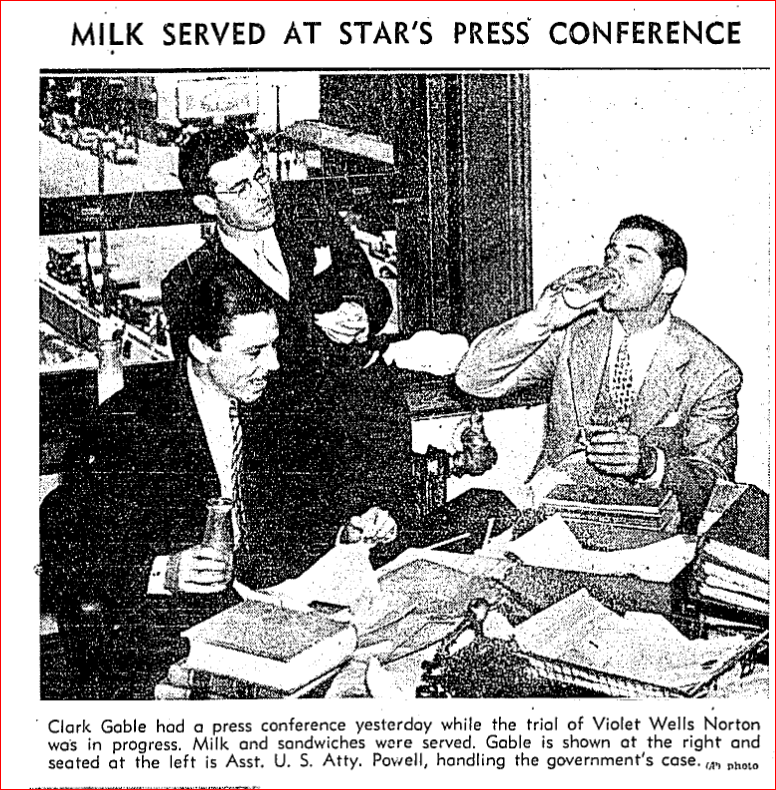
There was limited support for Violet’s fantastical tale. In fact, other than her immediate family (and even they weren’t enthusiastic), Violet’s only supporter was H. Newton, a Birmingham, England factory inspector.

In an interview with the London Daily Express, Newton confirmed that a man calling himself Frank Billings, who bore a striking resemblance to Gable, ran a poultry farm at Billericay “around 1918-1919”. The dates supplied by Newton were a few years earlier than Violet’s alleged affair.
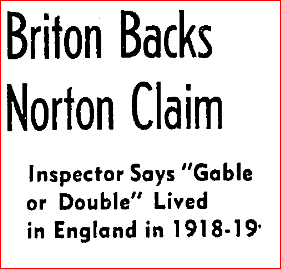
Newton studied a photo of Gable and said,

“That either is Frank Billings or his double, even to the trick of folding one hand over the other.  Yes, he has the same brow, nose, temples and twisted, cynical half-smile.”

Adding another layer of absurdity to the unfolding story was a penny postcard mailed from Tacoma, Washington. It read,

“Dear Sir—The lady is right—Frank Billings is the father of her child, but I am the man. Also am a perfect double for C.G.” 

The perfect double from Tacoma did not come forward.
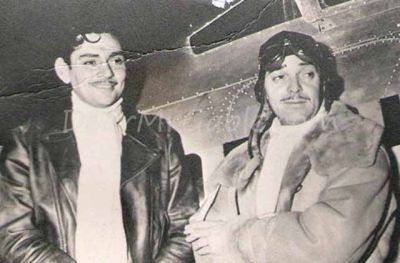
CLARK GABLE WITH HIS STUNT DOUBLE

Several of Gable’s friends, acquaintances, and a former wife received subpoenas to appear in court. Among those supoenaed was Jimmy Fidler, a radio personality and journalist. Violet wrote to Fidler offering to sell him “for a price” the story of her affair with Clark Gable, the man she knew as Frank Billings.

Violet shared with Fidler her version of how Gable got his screen name. She wrote:

“In Billericay, Essex, England where I was wooed and won by a man known as Frank Billings, but who I now believe to be Clark Gable, this man told me of his love. I later learned, through pictures and a story in a film fan magazine, that he had changed his name to Clark Gable.  It is my belief that he got his name in this way—our grocer, in Billericay was named Clark and he owned an estate he called The Gables.  Hence Clark Gables.”

Yes, Violet frequently referred to the actor as Gables and was apparently unaware of his birthname, William Clark Gable.

The letters to Fidler weren’t the only ones Violet wrote. She attempted to correspond with Mae West, but West’s publicist, Terrell De Lapp, intercepted the missive during a routine vetting of Miss West’s incoming mail.
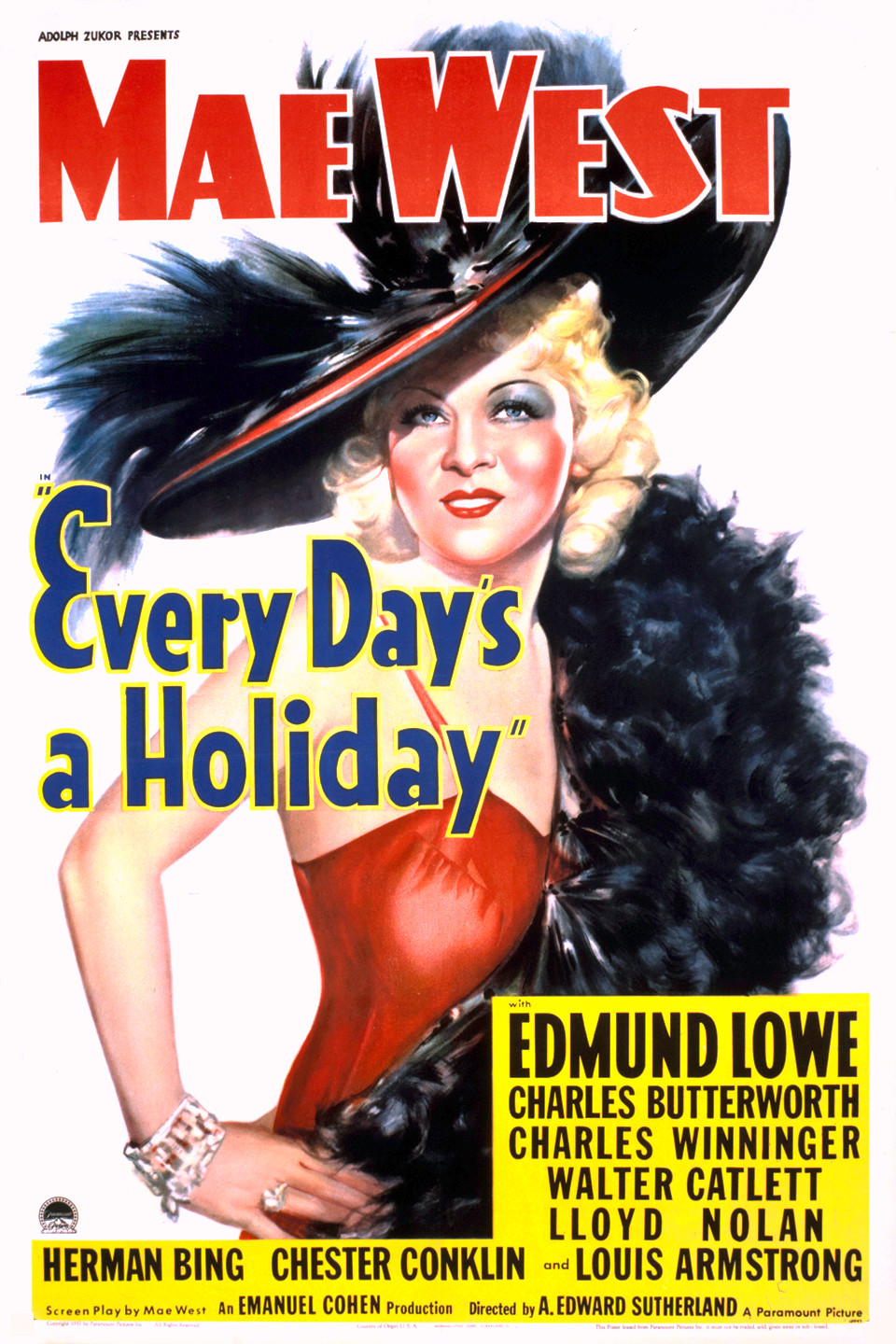
MAE WEST IN ‘EVERY DAY’S A HOLIDAY”–1937

The letter received at Paramount Studio in January 1936 read:

“Dear Mae West—How would you like to be fairy godmother to Clark Gable’s child.  Nothing could be more lovely than for you, Miss West, to be fairy godmother to my Gwendolyn, and put Clark Gable to shame.”

Despite Violet’s attempts to garner support from Fidler and West, and who knows how many others, Gable had no difficulty refuting her claims. He produced witnesses from the Pacific Northwest to prove that during the time he was allegedly impregnating his accuser, he was selling neckties and working as a lumberjack in Oregon. 

Gable’s first wife, Josephine Dillon, was steadfast in her defense of her former spouse.
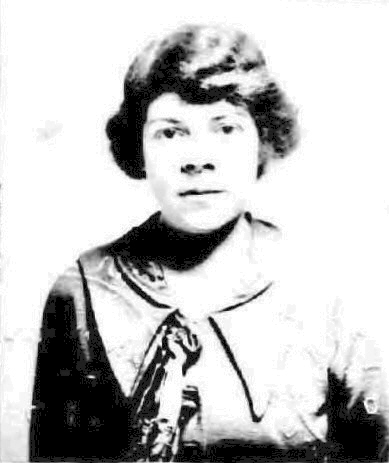
JOSEPHINE DILLON–CLARK GABLE’S FIRST WIFE c. 1919

“Clark and I were married in December 1924. But I knew him the year before in Portland, Oregon when he attended my dramatic classes.  To my knowledge, he has never been in England. It is sure he was not there in 1923 or 1924 when we were married, and, therefore, could not be the father of a 13-year-old girl born there at that time.”

Violet’s accusation was ludicrous, but on the plus side the trial afforded hundreds of women an opportunity to catch a glimpse of the man who would become The King of Hollywood. Secretaries and stenographers in the Federal Building held an impromptu reception for him. He autographed mementoes and chatted with them. They were in heaven.
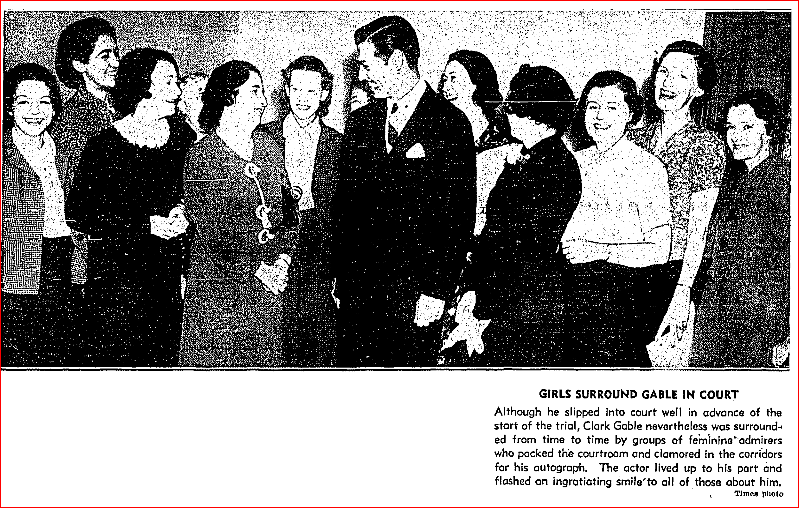
In the hallway prior to testifying, Gable chain smoked and appeared a little nervous. He told reporters:

“It’s my first court appearance. I don’t know what to expect.”

In court, Gable testified that he did not recognize the woman in court.

For her part, Violet remarked sotto voce to her attorney:

“That’s him.  I’d know him anywhere.”

Courtroom spectators, keen to see Gable face his alleged progeny, were disappointed when he wasn’t required to appear during her testimony.

Judge Cosgrave wasn’t well-pleased that Gwendolyn was subpoenaed to appear.

“I regret that this witness has to be called at all, and I insist that her examination be limited only to extremely necessary points bearing on the charges in the indictment.”
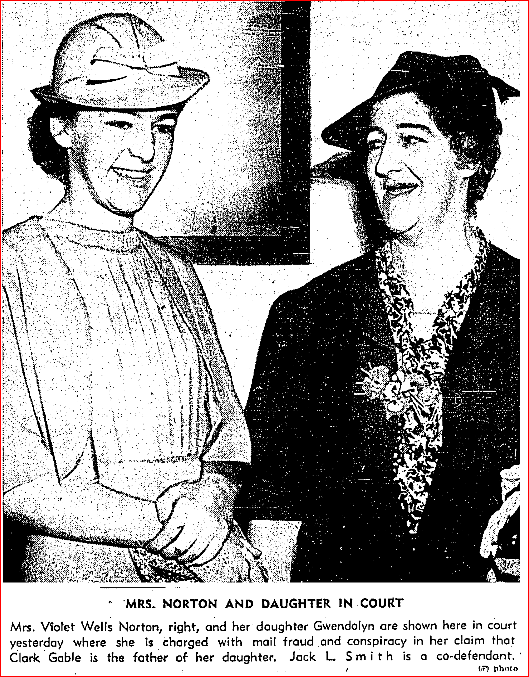
Gwendolyn had nothing substantive to a add to her mother’s scheme—the girl was Violet’s pawn.
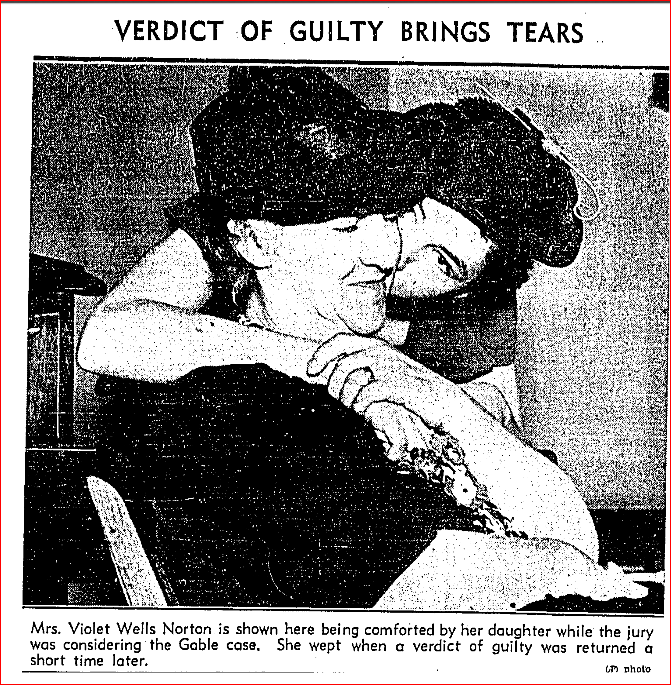
The jury began deliberations at 3:40 pm on April 23, 1937 and returned with their verdict at 5:20 pm.  They found Violet guilty of fraudulent usage of the mails.

As Gwendolyn attempted to console her distraught mother, reporters reached Gable by telephone. He said:
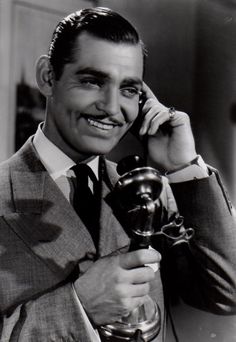
“Of necessity, the woman’s charges were false, in view of the fact that I have never been in England and had never seen her until the trial began.  It is unfortunate, of course, the she must come to grief in this manner, particularly because of her children.”

U.S. Attorney Powell, who prosecuted Violet, was not as understanding as Gable.

“This woman should be made an example, that men of Clark Gable’s type cannot be crucified in such a manner.”

Powell went on to describe Clark’s ascent to stardom:

“Clark Gable has pulled himself up by the bootstraps, out of an obscure background. He worked as a lumberjack, longshoreman, struggling actor, to achieve the ambition which drove him on to a $250,000-a-year salary.”

Attorney Morris Lavine, who would handle Violet’s appeals, defended her.

“She was simply calling to her sweetheart.  She was sincere,” he said.

It is doubtful that Morris Lavine believed a word Violet said, but he was an attorney known to go the extra mile for a client. Violet was lucky to have him as her appeals attorney. (Lavine’s life and career in Los Angeles is a topic I’ll cover in future posts. He was a fascinating man and the self-described “defender of the damned.”)

The appeal Lavine filed on Violet’s behalf was nothing short of brilliant. He contended that her letter did not fall within the statute concerning mail fraud.

The court agreed with Lavine and ruled in Violet’s favor in October 1937. They characterized Violet’s plan as “a scheme to coerce or extort and is a species of blackmail.”

If local authorities had filed on Violet for blackmail or extortion she would have done more time.
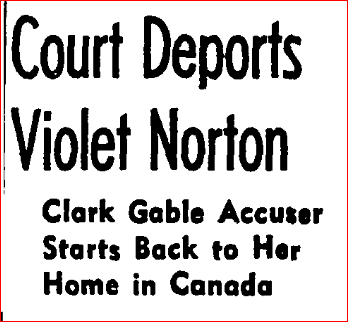
In February 1938, following the success of her appeal, Violet faced deportation. An action was filed on the grounds that she had overstayed her visa and that she committed a crime involving moral turpitude. Lavine told reporters that Violet would stay with a sister in Vancouver.

Gwendolyn did not accompany her mother to Canada. She was placed in a private school by a local religious organization and was required to remain there until June.

Was Violet a greedy blackmailer or a delusional dreamer? We’ll never know for sure.

Clark Gable received thousands of fan letters over the course of his decades long career. Violet’s letter was an unwelcome anomaly. The adoring letter written to him by Judy Garland in the movie Broadway Melody of 1938 was probably a more accurate depiction of the kinds of letters he received.
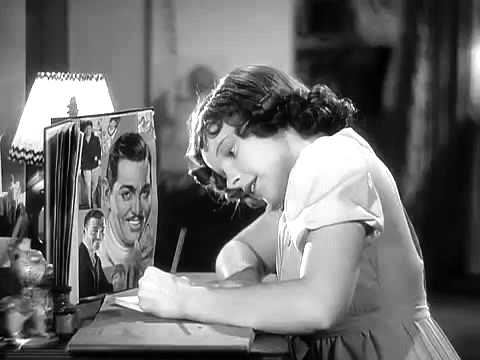
As Judy writes she sings, You Made Me Love You.” She performed the song earlier, in 1936, at Gable’s birthday party. It is one reason she got the part in the film which helped launch her career.