
August 19, 1936
It was a quiet Wednesday morning in the West Adams district. As a part of her day’s errands, Mrs. Mary Rau stood at the teller’s window of the Citizen’s National Trust & Savings Bank conducting routine business.
She didn’t hear anything until she looked up and saw everyone with their hands up in the air. Before she could grasp what what happening, a man’s voice said, “Don’t move.” Then he grabbed her under both arms and turned her around so he was completely behind her.
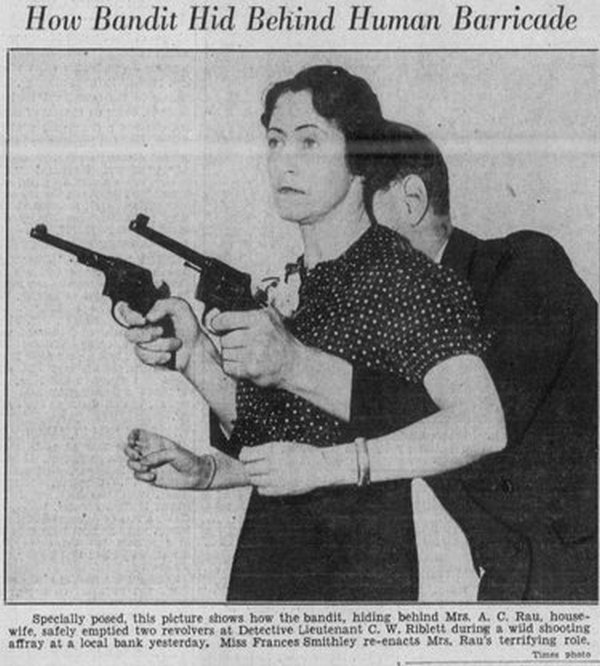
Standing behind a bullet-proof shield in the gallery of the bank was Los Angeles Police Detective Lieutenant C. W. Riblett.
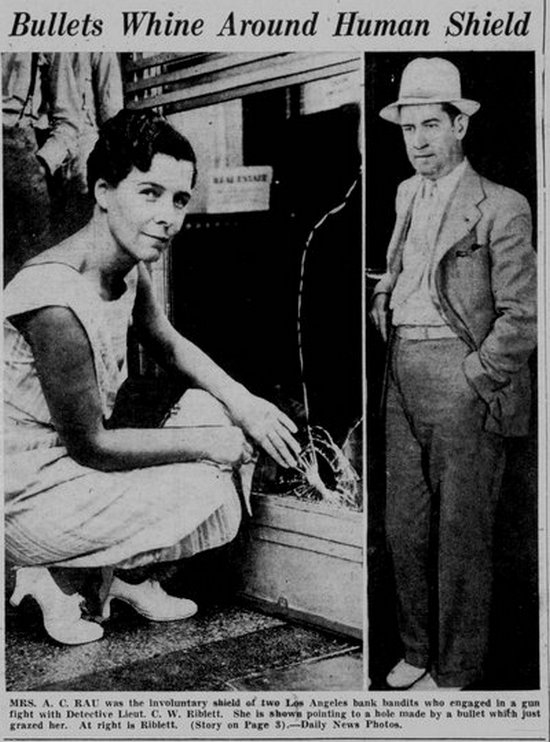
Riblett was there because he’d received a tip that the bank might be robbed. He watched as the bandit maneuvered Mrs. Rau toward the door. He held his fire for fear of hitting her.
Just outside the door of the bank the bandit released Mrs. Rau, and with his companion, who had escaped notice in the confusion, ran for a car. Riblett fired at the fleeing men, and they returned fire.
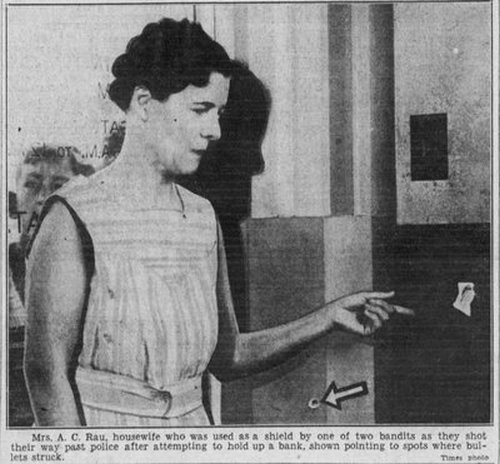
The bandits had parked their car behind a vehicle belonging to Lorry Monson, an employee of the Union Market across the street from the bank. Monson stood at the corner of West Washington and Westview as the gunfire continued.
At first the car wouldn’t start. When the engine finally turned over, they had to back up because of Monson’s car. It took them a moment, and Monson wrote the license number of the car on the wall of the building so he wouldn’t forget it.
The interior of the bank testified to the fury of the gun battle. All six shots fired by the robber scarred the masonry near the place where Riblett stood in the gallery. Riblett’s six shots from his .38-caliber service revolver struck on both sides of the door and hit a leather settee. One went through a panel of the glass door.
Neither of the bandits wore a mask. They were described as middle-aged. Each of them was dressed in light-colored suits. One of the men wore a light gray cap, and the other a felt hat. It was their physical descriptions that caught the attention of police. One of them was extremely tall, well over six-feet. The other man was much shorter and had a scar on the left side of his face. Police believed they were the “Mutt and Jeff” bandits who had been active in several bank robberies within the past year.
For those of you who may not be familiar with the Mutt and Jeff, they first appeared as the main characters in a pioneering American comic strip created by cartoonist Bud Fisher in 1907. The strip ran for 75 years.
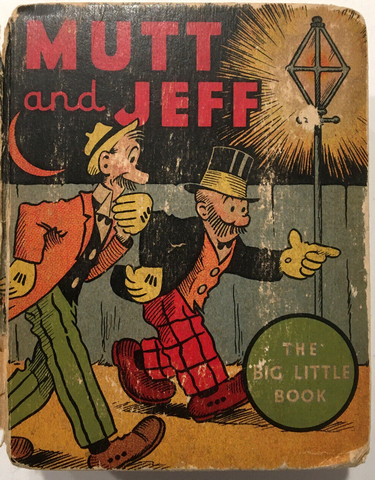
Mutt and Jeff: The Big Little Book (1936). The popular comic-strip duo provided a ready-made nickname for the unusually tall and short suspects sought in a Los Angeles bank robbery that August.
Augustus Mutt was tall, lanky, and fast-talking. His companion, Jeff, was short, stocky, bald, and mutton-chopped—the perfect foil to Mutt.
Their stark physical contrast became a popular American idiom for any mis-matched pair. It was their dynamic that inspired real-life comedy duos in vaudeville like Laurel and Hardy and Abbott and Costello.
The names Mutt and Jeff eventually found their way into police interrogation terminology. In Miranda v. Arizona (1966), Chief Justice Earl Warren discussed a technique described in police manuals as the “friendly-unfriendly,” or “Mutt and Jeff,” act. One investigator played the threatening, relentless interrogator, while the other posed as sympathetic and helpful. Today, most of us would recognize the routine as “good cop, bad cop.”
The Mutt and Jeff duo who robbed Citizen’s National Trust & Savings, and terrorized Mary Rau, abandoned the brown coupe at the corner of Highland Avenue and Harcourt Street.
Witnesses saw them exit the coupe and get into a small, dirty, green-colored sedan and speed away. A teletype went out for police to be on the lookout for the sedan. Riblett thought he may have wounded one of the bandits. But there was no report of a man seeking medical attention.
Police were given the order to shoot to kill if they encountered the pair; but the wanted men seemed to vanish. If the crooks were smart, they left Los Angeles.