
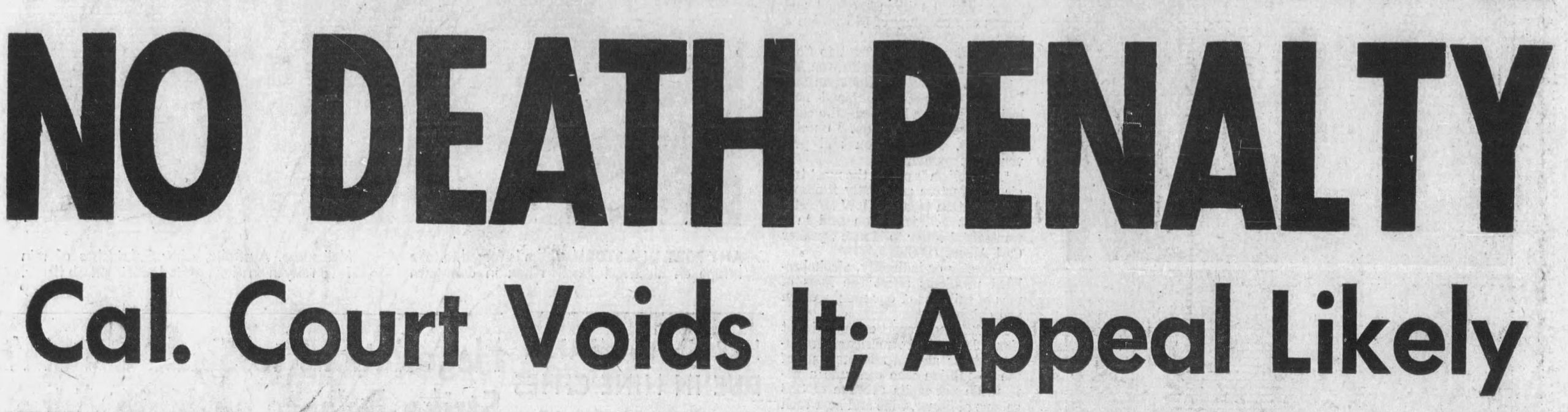
In February 1972, when the California Supreme Court ruled that capital punishment violated the state constitution’s ban on “cruel or unusual punishments,” it gave the 102 men and 5 women on death row a reason to hope. And something else they never dreamed they would have. A future. Their sentences became life with the possibility of parole.
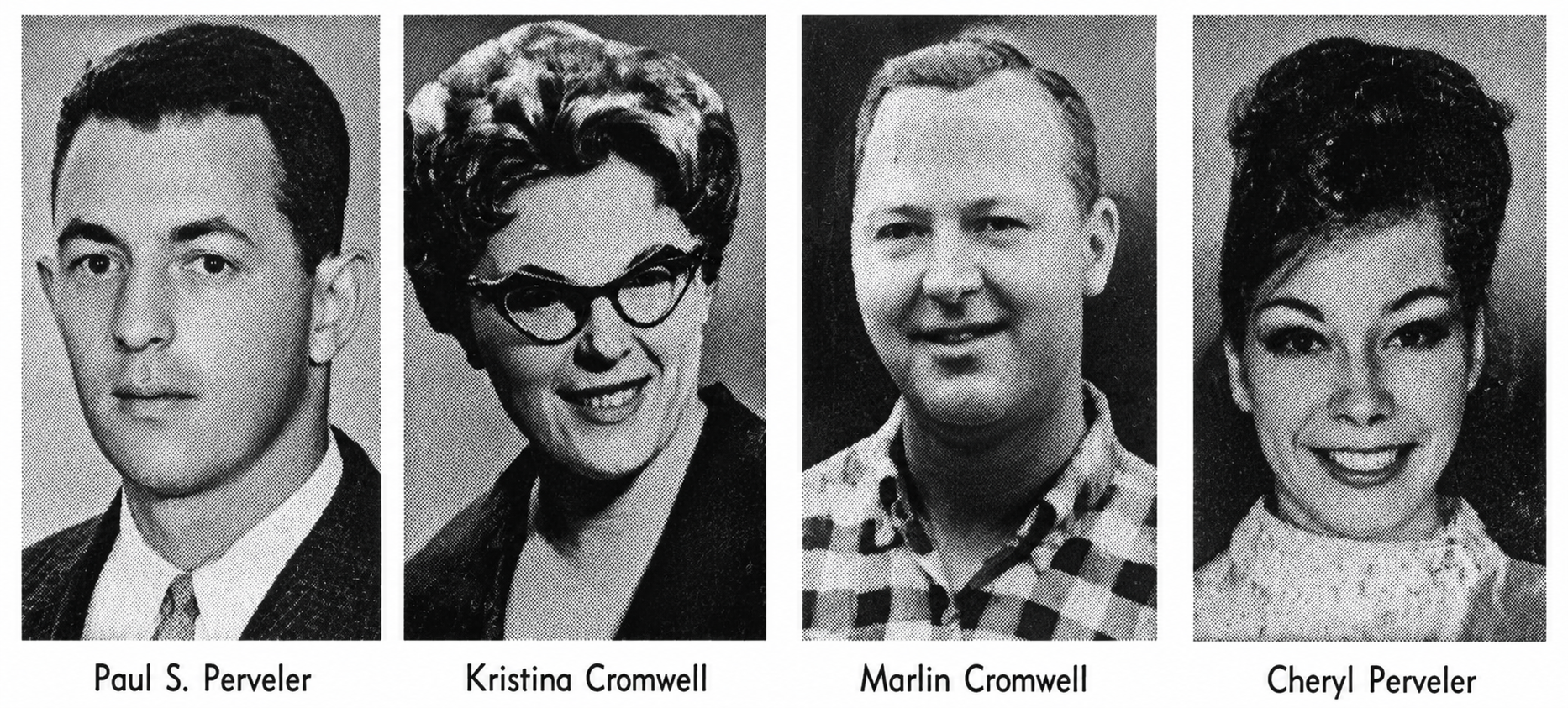
Paul S. Perveler was one of the lucky ones. Over the next several years, he was a model prisoner. In 1982, impressed with his institutional record, the Board of Prison Terms gave him a parole date of August 6, 1985. He’d spent a few years on death row, and over a decade in the general population. He longed to begin a life beyond the walls.
Outside the prison was someone who knew Paul’s history in a way the Board of Prison Terms never could. His former wife, Lela Halverson. Unlike the others whose lives Paul disrupted, Lela survived—and remembered.
Lela turned to Assemblyman Patrick Nolan for help. Nolan initiated a statewide petition drive to keep Paul incarcerated. He called Paul “a cold, calculating killer.”
Lela told reporters that after Paul’s conviction he told his minister that “someday, some way, he would get out of prison and kill me.” She believed him. Paul had remarried in prison, and his wife had made inquiries about Lela’s whereabouts—and that frightened her. But her fear wasn’t enough to silence her.
Public opinion is a powerful tool. Lela and Nolan announced the petition drive from the corner of McCarthy Drive and Caledonia Way in Glendale. Lela spoke about the significance of the location. She recalled that in June 1966, “I was coming home from a meeting and he got in front of my car. He started beating me inside the car, then he dragged me out and started pounding my head against the pavement.” Later that year, hit-and-run autos struck her twice. She didn’t believe in coincidence. She divorced Paul that same year.
In 1982, after news of Paul’s parole date broke, Lela spoke out, “I try not to dwell on it, but it’s always in the back of my mind. I have this great fear. It’s almost like going through that trial again, but this time it’s worse because I know of the brutality he is capable of. During the trial, I didn’t know everything.”
The reason for Lela’s fear lay in two murders Paul had committed years earlier.
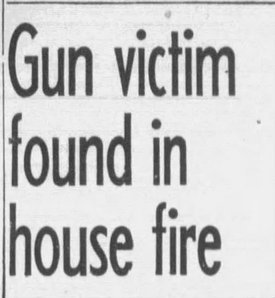
In early December 1966, the Los Angeles County Fire Department responded to a routine call at a home on the 2700 block of Ballard Street in El Sereno.
After they extinguished the blaze, they discovered the charred body of Marlin Cromwell sprawled on the couch in the living room. At first, it appeared he had died in the fire. A closer look revealed multiple gunshot wounds inflicted by a small-caliber gun. Kristina, accompanied by the couple’s four-year-old son, was visiting with friends in Twenty-Nine Palms when the murder occurred.
About midnight on April 20, 1968, Cheryl Perveler pulled her convertible Jaguar into the carport of the Burbank apartment where she lived with Paul. A few minutes later, neighbors reported hearing three gunshots. Apartment manager John E. Miller went out to the carport and found Cheryl in the driver’s seat unconscious and bleeding. An ambulance was called and rushed her to Burbank Hospital. They later transferred her to County General where she died without regaining consciousness. She had been married to Paul for about six weeks.
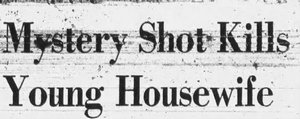
The sixteen-month gap between the murders obscured the relationship between the two crimes. Had the deaths occurred close together, investigators would likely have examined Paul and Kristina’s affair much sooner.
Paul might never have been caught if he had not confided in a co-worker at the Auto Club details of Marlin’s murder. It was a serious miscalculation. The co-worker went to the police.
It took about two weeks for detectives to unravel the murder plot. On May 1, 1968, the police jailed Paul and Kristina. Detectives booked both Paul and Kristina on suspicion of murder in the deaths of their spouses.
At the time of Paul and Kristina’s arrest, detectives told reporters that Paul’s ex-wife, Lela, was deliberately run down by a car in 1965 and was the target of a car which jumped a curb in 1966. Paul would have received $32,000 in double indemnity insurance if she had died.
Juries prefer a case with an understandable motive. Sometimes they don’t get one. But here the D.A. offered them a common one, and one they could comprehend—greed. According to the prosecution, Paul committed the murders so he and Kristina could cash in on two hefty double-indemnity life insurance policies.
In fact, Marlin’s policy paid Kristinia $75,000. She and Paul used most of the money to purchase another Burbank cocktail bar—Paul already owned one.
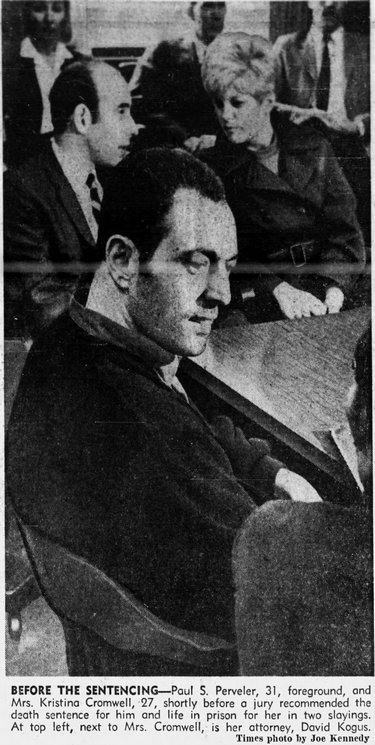
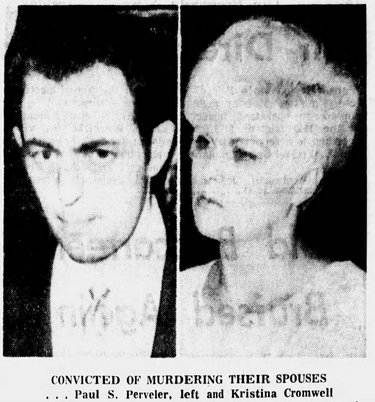
A jury convicted Kristina Cromwell for her role in the murders, and she served 7 years of a life sentence before being released in 1976.
Paul received the death penalty for the murders and for the attempted murder of Lela.

Paul’s death sentence gave Lela breathing room. The change in his sentence shattered her peace. Once free, he could make good on his pledge to kill her. Would she have to look over her shoulder for the rest of her life?
Lela continued to pressure the parole board. She requested a hearing, and in June 1983, she presented the board with 20,000 signatures from residents of Patrick Nolan’s district, where the murders occurred. As the only survivor of Paul’s murder for money plots, Lela revealed more about him than was in his prison file.
The parole board only saw his exemplary record, college education, self-awareness groups for prisoners, favorable psychiatric reports, praise from prison staffers, and a 1978 marriage that offered him new stability.
Paul opted out of the hearing, which gave Lela the perfect opportunity to speak. “I’m thrilled and delighted we’ve finally been heard and that we have a chance for justice.” She spoke of the severe beating at Paul’s hands. “He tried six times to kill me. I will never forget the feeling of the bones of my face crunching, the smashing of my head against the pavement and the taste of my own blood in my throat while he was choking me. I knew I was going to die.”
She said he had lain in wait for her before the attack and had doused himself with alcohol afterward so he could claim he attacked her in a drunken, jealous rage and that he wasn’t trying to kill her.
Kristina Cromwell confirmed Lela’s testimony and offered her own perspective into Paul’s plans. She described how he intended to commit the murders over a three-year period.
She said in 1965, Paul shot his father from a passing car on Baja Highway south of Tijuana. “We were going to overtake them on a road where there were cliffs, and he was going to shoot out of the back window.” A bullet struck Joseph Perveler on the right side of his nose. His father recovered and died later of other causes. The shooting was never reported to U.S. authorities.
Kristina told of Paul’s plot to murder Lela while on a Memorial Day outing in the San Gabriel Mountains and make it look like an accident.
She told the parole board that three other times Paul had struck Lela with his car.
Paul planned to kill Marlin while he and Kristina vacationed in Mexico in 1966, but she refused to cooperate and fled to Los Angeles. “He told me if he had caught me on the way back to the border, he would have killed me.” He said if she refused to cooperate in her husband’s murder again, he would kill her son.
Kristina revealed that she and Paul were going to kill Lela and described the plan. She was to wait in her car and honk the horn as Lela’s VW neared the house. Paul would emerge from his hiding place, attack Lela until she was unconscious, and stuff her body in the back seat. But after the attack, Paul ran to Kristinia in a panic. Kristina convinced him to pour alcohol on his clothes and tell police he’d been drinking.
Asked why she never reported Paul to the police. She said she loved him and did whatever he wanted.
The board was convinced by the women to rescind Paul’s parole. Lela said: “Our system worked as it should have worked. It’s just unfortunate that I had to go through all that I have.”
Paul showed little emotion as he heard the ruling. Asked how he felt, he said, “Tired, wiped out and gutted.”
At least for a time Lela could rest easy; but the fight would begin again in six months when his parole status would be reviewed.
Paul’s persistence in pursuit of a goal was evident from his continued attempts to kill anyone who stood between him and a large insurance payout.
Lela was persistent, too. But hers wasn’t destructive—it was restorative. She wanted the truth to become part of the permanent record.
Over the next decade, she had to summon her strength repeatedly to keep Paul behind bars.
Lela prevailed.
In 1992, in the landmark case Perveler v. Estelle (1992), the Ninth Circuit affirmed that California’s parole board acted within its legal rights when it rescinded Paul’s parole date based on newly uncovered evidence of his dangerous past. Paul would remain in prison.
For years, Paul Perveler tried to persuade parole authorities that they misunderstood him. In the end, it was Lela Halverson and Kristina Cromwell who persuaded them that indeed they had.
NOTE: My thanks to Blake Leung for introducing me to this case. He pointed me to an extraordinary story hidden in the archives.
Sources
This story was researched using contemporary newspapers, court records, parole proceedings, archival collections, and other primary and secondary sources.
Research Note
The historical record is never complete. This narrative reflects the best available evidence at the time of publication. Any errors or omissions are my own.