
Mrs. Betty Bersinger and her three-year-old daughter Anne walked south down Norton Avenue in Leimert Park, a still-growing Los Angeles suburb. They’d left their home at 3705 S. Norton to take a pair of shoes to be repaired.

Like much of postwar L.A., Norton was only half-formed. Wartime shortages had stalled housing construction, and the neighborhood was still catching up. It was January 15, 1947, around 10:30 a.m., when Betty and Anne approached a large vacant lot in the 3900 block of Norton. Something pale caught Betty’s eye in the weeds—about fifty feet from a fire hydrant and just a foot from the sidewalk.
It looked like a discarded mannequin. Or a woman, lying very still.
As they drew closer, Betty realized it was neither mannequin nor drunk. It was a woman—nude, pale, and cut in half.
She grabbed Anne and ran to the nearest home to call police.
Over the years, several reporters have elbowed their way into the legend, each claiming to be the first at the scene. One of the loudest was Will Fowler.
Fowler said he and photographer Felix Paegel of the Examiner were near Crenshaw Boulevard when a call came crackling over the shortwave. The report was bizarre: a naked woman, possibly drunk, sprawled in a vacant lot one block east of Crenshaw between 39th and Coliseum.
“A naked drunk dame passed out in a vacant lot. Right here in the neighborhood too. Let’s see what it’s all about.”
Paegel drove as Fowler watched for the woman. “There she is. It’s a body all right…” Fowler got out of the car and approached the body as Paegel pulled his Speed Graphic from the trunk. Fowler called out, “Jesus, Felix, this woman’s cut in half!”
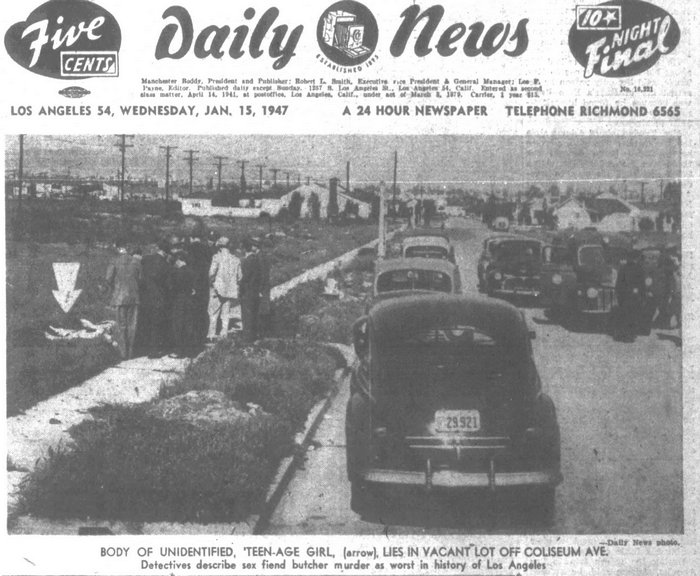
That was Fowler’s version, and he stuck to it. He even claimed to have closed the dead girl’s eyes.
But was any of it true?
Other accounts suggest a reporter from the Los Angeles Times was the first on the scene.
Another contender? In her autobiography, Newspaperwoman, Herald reporter Agness ‘Aggie’ Underwood, claimed to be the first.
After nearly eight decades does it matter? All those who saw the murdered girl that day saw the same horrifying sight. It left an indelible impression.

Aggie observed:
“It [the body] had been cut in half through the abdomen, under the ribs. The two sections were ten or twelve inches apart. The arms, bent at right angles at the elbows, were raised above the shoulders.
The legs were spread apart. There were bruises and cuts on the forehead and the face, which had been beaten severely. The hair was blood-matted. Front teeth were missing. Both cheeks were slashed from the corners of the lips almost to the ears. The liver hung out of the torso, and the entire lower section of the body had been hacked, gouged, and unprintably desecrated. It showed sadism at its most frenzied.”
The coroner recorded the victim as Jane Doe #1 for 1947.
Two seasoned LAPD detectives, Harry Hansen and Finis Brown, took charge of the investigation. During the first twenty-four hours, officers pulled in over 150 men for questioning. The city’s most brutal murder had just begun its long descent into legend.
The most promising of the early suspects was twenty-three-year-old transient, Cecil French. He was busted for molesting women at a downtown bus depot.
Police were alarmed when they discovered French had pulled the back seat out of his car. Had he concealed a body there? Police Chemist Ray Pinker found no blood or any other physical evidence of a bloody murder in French’s car. Investigators dropped from him the list of hot suspects.
In her initial coverage for the Herald, Underwood referred to the case as the “Werewolf” slaying because of the savagery of the mutilations inflicted on the unknown woman. The werewolf tag would identify the case until a better one came along—the Black Dahlia.
NEXT TIME: Jane Doe #1 gets a name—and a past.
REFERENCES:
Fowler, Will (1991). Reporters: Memoirs of a Young Newspaperman.
Gilmore, John (2001). Severed: The True Story of the Black Dahlia Murder.
Harnisch, Larry. A Slaying Cloaked in Mystery and Myths. Los Angeles Times. January 6, 1997.
Underwood, Agness (1949). Newspaperwoman.
Wagner, Rob Leicester (2000). The Rise and Fall of Los Angeles Newspapers, 1920-1962.