Not every prison pet lives up to the example set by Mr. Jingles, the hyperintelligent field mouse in Stephen King’s The Green Mile. In the novel, Mr. Jingles becomes the companion of inmate Eduard Delacroix, performing tricks and bringing moments of wonder to prisoners and guards alike. The small mouse represents hope, joy, and the possibility of miracles.
The film adaptation is set in 1935, in a fictional Southern prison. Across the country that same year, a real prison pet roamed the old block at Folsom Prison: a cat named Rusty.
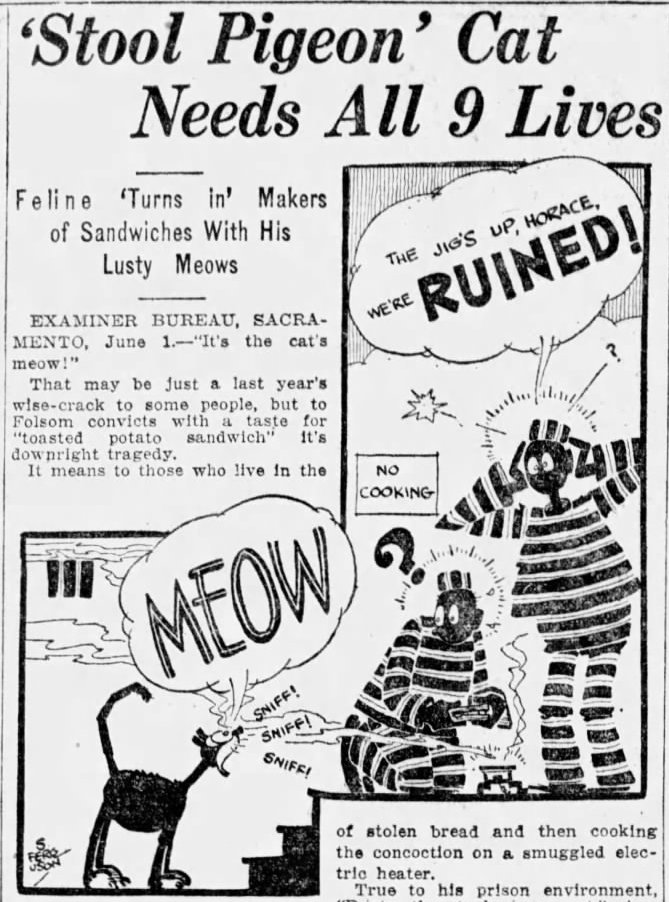
Born at Folsom in 1922, Rusty quickly endeared himself to guards with his ability to sniff out contraband food in prisoners’ cells. At the time, all food preparation was strictly forbidden. If an inmate were discovered roasting a potato or heating a sandwich on a smuggled device, he could be sent to solitary confinement.
Rusty made enforcement easier.
On the trail of forbidden treats, creeping low to the ground, the end of his tail twitching slightly, Rusty stalked the aptly named catwalk until he caught the scent of food. Once he had the location, he planted himself in front of an offender’s cell and meowed loudly until a guard arrived. Like today’s police dogs trained to detect bombs or narcotics, Rusty rarely failed. If guards found Rusty in front of a cell, they knew they had a righteous bust.
A decade or more into Rusty’s career as a professional snitch, guards found a kitten they believed to be his son. They named him Blue.
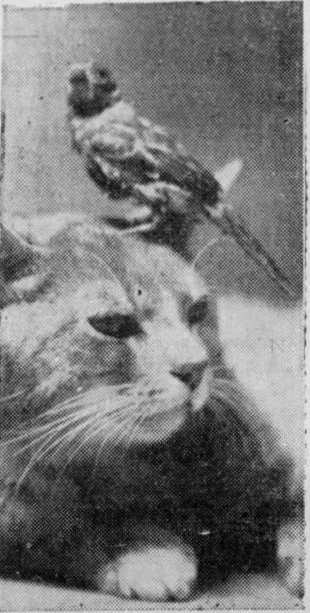
Soon afterward, guards discovered a tiny finch perched atop a wall, alone in a nest and apparently abandoned by its mother. They named the foundling Chirp. Guards nursed Blue and Chirp during their convalescence, and the pair quickly bonded. After that, no one ever saw one without the other. They ate together, and often, while Blue napped in front of Warden Court Smith’s office, Chirp perched comfortably on his head.
Blue showed none of his father’s aptitude as a snitch. He seemed content to wander the prison with a bird on his head.
Occasionally, Rusty, Blue, and Chirp made the news. Then, in 1937, Rusty suffered a stroke. He survived but was forced to retire. He spent his final months in well-earned leisure.
On January 28, 1938, after sixteen years of faithful service, Rusty passed away. Clerk Joseph H. Doherty of the warden’s staff eulogized the departed cat:
“He would go to a cell door and sit there if he detected the odor of food until a guard came. He couldn’t be bribed either. He wouldn’t have a thing to do with anybody in convict clothes.”
Befitting his stature, prison guards planned to bury Rusty in a bed of flowers on a nearby hillside.