Part 2: The Lower 13th Murder Case

The case against Robert E. Folkes unfolded against a tense backdrop of wartime fear, racial prejudice, and rising public paranoia. The press inflamed the tensions, describing Folkes as a “zoot-suit wearing negro,” a phrase loaded with menace, meant to reduce him to a caricature and paint him as capable of slashing the throat of 21-year-old newlywed Martha James.

District Attorney L. Orth Sisemore questioned the Black trainmen on board when the train stopped in Klamath Falls, Oregon. Southern Pacific Railroad detectives zeroed in on Folkes. Somewhere between Klamath Falls and Dunsmuir, California, on the night of January 22-23, they pulled him into a men’s lavatory, stripped him, and interrogated him through the night. They released him only for his shifts in the dining car. They treated the sleep-deprived and humiliated man as the prime suspect, even though they did not arrest him.

Not everyone on the train believed in Folkes’ guilt. The conductor stated Folkes couldn’t have committed the murder. According to him, the configuration of the diner and Folkes’ workload made it impossible. He pointed instead to another passenger—Harold Wilson, a white Marine who had occupied the berth above Martha’s. Given his proximity to the victim, Wilson should have been a suspect. Instead, they treated him as a material witness and quietly removed him from suspicion.

When the train arrived in Los Angeles on January 23rd, LAPD detectives took Folkes into custody. He was sleep-deprived, unrepresented, and vulnerable. They bounced him between Central Jail and Police Headquarters, questioned him without legal counsel. LAPD officers phoned Linn County District Attorney Harlow Weinrick in Oregon to report that Folkes had cracked.

But in every official statement before the supposed confession, Folkes had denied guilt. He did not sign or review the alleged confession. The investigators did not record it; the lawyer did not witness it; it seemed coerced.

LAPD’s interrogation practices at the time weren’t just aggressive — they were dangerous. Coercion took many forms: physical abuse (beatings), psychological pressure (threats against family, exploiting a suspect’s fear of mob violence or racial prejudice), or improper inducements (offering alcohol, sexual access, or other rewards). Days earlier, the department faced scrutiny after Stanley Bebee, a 44-year-old accountant, died following a brutal beating in custody for public intoxication. The jury acquitted the officers. However, the case highlighted  the LAPD’s violent methods.

Although the Folkes investigation showed no proven evidence of bribery or case-fixing, the environment surrounding his interrogation was badly compromised. Some interrogators used coercive tactics, custody chains were blurred, and courtroom conduct varied from irregular to unethical. It is easy to conclude that the LAPD mistreated Folkes while he was in custody.

There was no physical evidence linking Folkes to the crime. No eyewitness identified him. But the so-called confession was enough for an arrest. Initially, Folkes refused to waive extradition to Oregon. But during arraignment before Judge Byron Walters, he relented and agreed to return north for trial.

On the night of January 29, 1943, accompanied by Sheriff Clay Kirk of Linn County and two Southern Pacific special agents, Folkes boarded a train for Albany.

His trial began in April. The jury of eight women and four men was unusual. In Oregon, women could serve only if they filed a written declaration, making their presence more striking. Their makeup may have influenced how testimony was weighed.

The state’s only link between Folkes and the murder was the testimony of Harold Wilson—the Marine who had been in the berth above Martha. His description of the suspect was vague: “a swarthy man in a brown pinstriped suit.” He never identified Folkes. And witnesses saw Folkes in the kitchen, dressed in his work clothes, minutes after the murder occurred. The police never found a brown pin-striped suit.

Though the defense objected, the court admitted two alleged confessions into evidence. Many red flags riddled both confessions. On April 16, LAPD Lieutenant E. A. Tetrick testified Folkes gave an oral confession after officers brought him a pint of whiskey and let him visit his common-law wife, Jesse. Circuit Judge J.G. Lewelling called the practice “reprehensible,” though he insisted Folkes was sober and in “full possession of his faculties.”

Dr. Paul De River—LAPD’s controversial police psychiatrist—later infamous in the Black Dahlia case, testified that he spoke with Folkes after the confession. According to De River, Folkes “may have had a drink or two,” but was not intoxicated. No one asked how he had reached that conclusion. De River also reported no physical injuries on Folkes’ body and described him as “in good physical condition.”

Robert E. Lee Folkes consults with his defense attorney, Leroy Lomax, left, as his friend and adviser William Pollard, right, looks on. (Image: Oregon Journal)

On cross-examination, Folkes’ attorney, Leroy Lomax, asked if De River had referred to Folkes as an exhibitionist. De River replied, “I might have said that.”

The defense rested its case on April 20, 1943.

The jury began deliberations but returned to the judge saying they couldn’t reach a verdict. He ordered them to continue and provided army cots for them to sleep on inside the courthouse. After thirty hours of deadlock and courtroom drama, the jury filed in at 3:13 p.m. on April 22. Their verdict: guilty of first-degree murder. Death was mandatory.

“I know it was a fair and impartial trial,” Folkes said afterward. “I’m sorry the jury thought I did it, as I didn’t, and I’m sorry my mother and Jesse had to go through this.”

In a letter to his mother, Clara, he was more candid:

“I was not convicted on evidence. I was convicted through prejudice.”

Folkes added: “I truly believe that I could take any one of those jurymen that convicted me, or even the judge who heard the case, and on the same grounds, either one of those people could be placed in front of a Negro jury and convicted. Of course, this incident will never happen, but I assure you it is amazing what prejudice can do.”

On November 5, 1944, a group of Los Angeles clubwomen formed the Robert Folkes Defense Club and pledged to raise $2,000 to bring his case to the U.S. Supreme Court. The court declined to hear the appeal on November 23.

Lomax worked tirelessly, appealing to the Governor of Oregon to commute the sentence to life. The governor refused.

On January 5, 1945, at 9:13 a.m., Robert E. Folkes died in Oregon’s gas chamber for a crime he insisted he did not commit.

NEXT TIME: In the conclusion of “The Lower 13th Murder Case”, we’ll examine the case more closely—and ask whether wartime prejudice condemned an innocent man.

HO, HO, HOmicide: Holiday Noir–Christmas Holiday [1944]

Welcome! The lobby of the Deranged L.A. Crimes theater is open. Grab a bucket of popcorn, some Milk Duds and a Coke and find a seat. We are celebrating the holidays with holiday themed noir movies.

Tonight’s feature is CHRISTMAS HOLIDAY, starring Deanna Durbin and Gene Kelly.

TCM says:

After receiving his commission on Christmas Eve, Lt. Charles Mason learns that Mona, his longtime girl friend, has married another man. When his plane from North Carolina to San Francisco is forced by bad weather to land in New Orleans, the heartbroken Charles meets alcoholic reporter Simon Fenimore, who takes him to a brothel run by Valerie De Merode. There Charles is introduced to hostess/singer Jackie Lamont, and agrees to take her to a midnight mass. After the church services, the two go to a diner, where Jackie tells Charles that her real name is Abigail and that she is the wife of convicted murderer Robert Manette.

Film Noir Friday: Christmas Holiday [1944]


Welcome! The lobby of the Deranged L.A. Crime theater is open! Grab a bucket of popcorn, some Milk Duds and a Coke and find a seat. The holidays have a dark side, and to prove it tonight’s feature is CHRISTMAS HOLIDAY starring Deanna Durbin and Gene Kelly.

Enjoy the movie!

TCM says:

After receiving his commission on Christmas Eve, Lt. Charles Mason learns that Mona, his longtime girl friend, has married another man. When his plane from North Carolina to San Francisco is forced by bad weather to land in New Orleans, the heartbroken Charles meets alcoholic reporter Simon Fenimore, who takes him to a brothel run by Valerie De Merode. There Charles is introduced to hostess/singer Jackie Lamont, and agrees to take her to a midnight mass. After the church services, the two go to a diner, where Jackie tells Charles that her real name is Abigail and that she is the wife of convicted murderer Robert Manette. At the diner, and the next morning in his hotel room, Abigail tells Charles the story of her relationship with Robert.


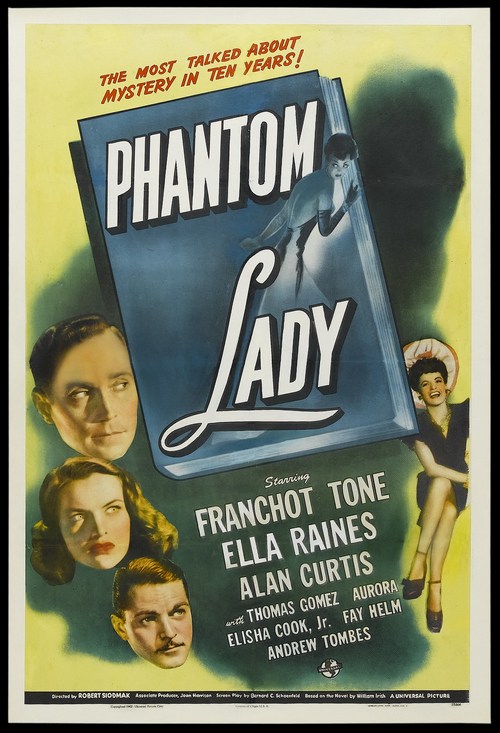
Film Noir Friday: Phantom Lady [1944]

  PHANTOMLADY2

Welcome!  The lobby of the Deranged L.A. Crimes theater is open. Grab a bucket of popcorn, some Milk Duds and a Coke and find a seat.

Tonight’s feature is PHANTOM LADY [1944] based on a novel by Cornell Woolrich and written under his pseudonym, William Irish. The film was directed by Robert Siodmak and starred Franchot Tone, Ella Raines and Alan Curtis.

Enjoy the film!

TCM says:

At Anselmo’s bar in New York, Scott Henderson sits dejectedly next to an equally despondent woman wearing a distinctive hat. Scott offers the woman tickets to a musical show that he cannot use, but she is not interested until Scott asks if she would like to accompany him to the show. Impulsively she agrees, on the condition that they do not exchange any personal information and just enjoy the evening together. At the show, Scott and the woman sit near the front, where the woman attracts the eye of the orchestra drummer and singer Estela Monteiro, who is furious that the woman’s hat matches her own. After the show, Scott escorts the woman back to the bar and they part amicably. Upon returning to his apartment, Scott is greeted by by police Inspector Burgess, who informs him that Scott’s wife Marcela has been strangled to death with one of Scott’s ties.

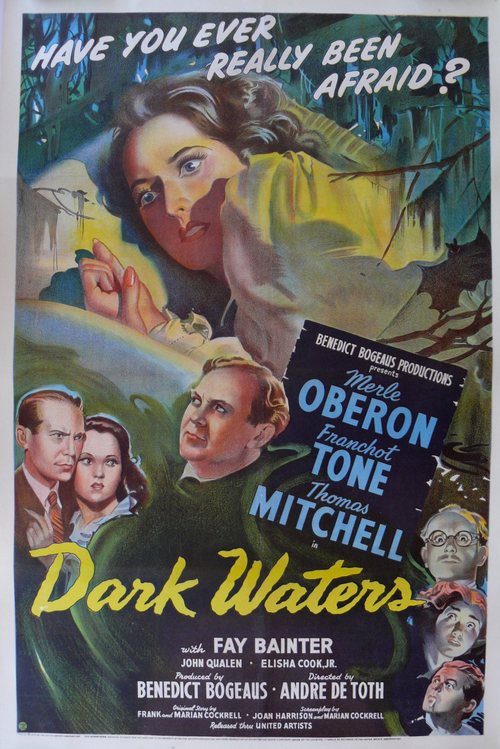
Film Noir Friday: Dark Waters [1944]

 dark waters 1944

Welcome!  The lobby of the Deranged L.A. Crimes theater is open. Grab a bucket of popcorn, some Milk Duds and a Coke and find a seat.

Tonight’s feature is DARK WATERS starring Merle Oberon and Franchot Tone. Directed by Andre DeToth.

Enjoy the film!

TCM says:

When the ship that is carrying Leslie Calvin and her wealthy parents from Batavia to America sinks, Leslie, one of only four survivors, is haunted by the death of her parents.  Just before she is to be released fro the New Orleans hospital in which she is recuperating, Leslie writes a letter to her only living relative, her mother’s sister, Emily Lamont, whom she has never met.  Emily writes back from Belleville, Louisiana, explaining that she and her husband Norbert are residing at the ancestral plantation there and inviting Leslie to stay with them. Leslie travels to Belleville, but when no one appears to meet her at the train station, the neurotic Leslie faints from the heat.

Is Leslie unstable or really in danger?


http://youtu.be/J09wbMo_-YY

Film Noir Matinee: Christmas Holiday [1944]

christmas_holiday

Not everyone celebrates the holidays with fruitcake and a cup of egg nog. Here at Deranged L.A. Crimes we prefer to celebrate with noir; which is why we’ve opened the Deranged L.A. Crimes theater for a special screening.

Grab a bucket of popcorn, some Milk Duds and a Coke and find a seat. Our feature is CHRISTMAS HOLIDAY directed by Robert Siodmak and starring Deanna Durbin, Gene Kelly and Richard Whorf.

And many thanks to Devlin for mentioning this film to me — it’s perfect for the Hellidays, er, Holidays!

TCM says:

After receiving his commission on Christmas Eve, Lt. Charles Mason learns that Mona, his longtime girl friend, has married another man. When his plane from North Carolina to San Francisco is forced by bad weather to land in New Orleans, the heartbroken Charles meets alcoholic reporter Simon Fenimore, who takes him to a brothel run by Valerie De Merode. There Charles is introduced to hostess/singer Jackie Lamont, and agrees to take her to a midnight mass. After the church services, the two go to a diner, where Jackie tells Charles that her real name is Abigail and that she is the wife of convicted murderer Robert Manette. At the diner, and the next morning in his hotel room, Abigail tells Charles the story of her relationship with Robert…


http://youtu.be/5UFSZay18go

Dead Woman Walking: Louise Peete, Part 4

peete freedLouise Peete spent approximately 18 years in prison before her release in 1939. Did she kick up her heels in joy when walked out of Tehachapi? Not at all She was angry and bitter and let the world know it by handing out a written statement to the reporters who had come out to Tehachapi to cover her release. Her statement read:

“Twenty-one years ago I pleaded not guilty to murder. I still plead not guilty. After having served 18 1/2 years in bondage for a crime I did not commit, I would appreciate the opportunity to reestablish myself without further publicity. I appreciate the parole and shall not violate the faith placed in me.”

Among Louise’s boosters were Miss Monohan, superintendent of Tehachapi Women’s Prison, and Mrs. Emily Latham, Louise’s probation officer. Neither of them doubted Louise’s sincerity. As could have been expected, Louise had put on a very convincing act in a  performance that lasted for eighteen years!

Not everyone was a member of the Louise Peete cheering section. In fact the Los Angeles Times printed an opinion on the case:paroling peete
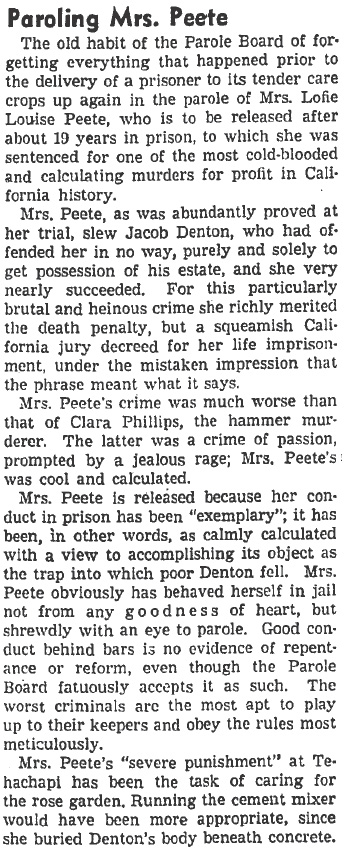
Louise left prison behind her and faded into obscurity; that is until December 1944 when she was once again in the headlines for another murder!
parole board shockedThe body of a woman, believed to be Mrs. Margaret Logan, 60, of 713 Hampden Place, Pacific Palisades, was found in a shallow backyard grave. Logan had employed Louise as a nurse/companion

It was “deja vu all over again”.

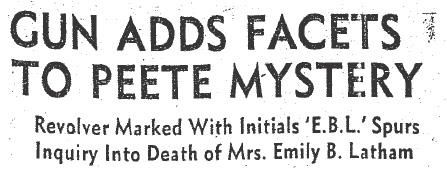
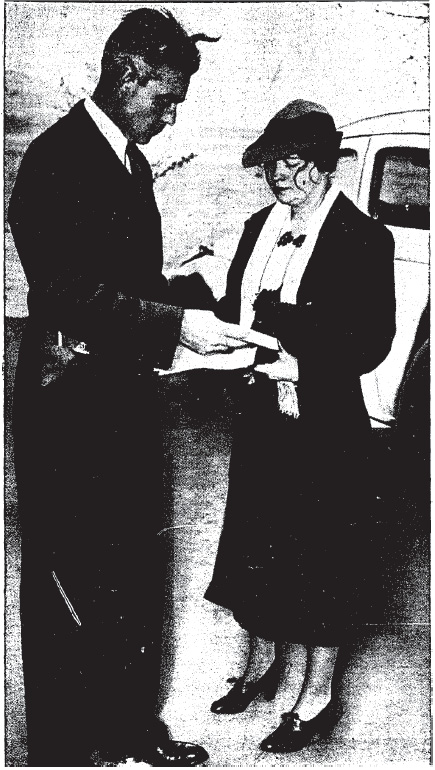
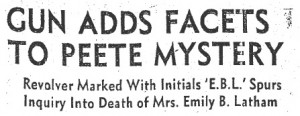
Louise assumed her familiar role as the outraged innocent, but there was a mountain of evidence against her. Ray Pinker, head of the police crime lab, examined the physical evidence. In this case the most damning piece of evidence was a nickel-plated .32 caliber revolver, rusty and covered with congealed blood. The weapon was found in a dresser drawer in the the dead woman’s home. The revolver was engraved with the initials E.B.L. and had once belonged to Emily B. Latham — Louise’s parole officer! Latham had employed Louise as a nurse and companion. Unfortunately, Latham wasn’t available to be questioned — she was dead. The cops were understandably concerned. Louise’s employers had a way of expiring under suspicious circumstances. However, it was later determined that Latham had died of natural causes.gun adds to mystery
Further examination and tests concluded that Margaret Logan’s death had been caused by a gunshot and a brutal beating. Evidently while she was incapacitated Margaret had been hammered to death with the butt of a gun.
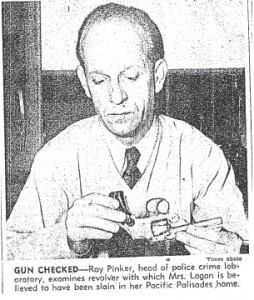
ray pinkerCould 63 year old Louise have been capable of the crime and the cover-up on her own? She certainly could have shot and bludgeoned Logan by herself, but dragging the corpse out to the backyard and digging even a shallow grave may have been physically taxing. It’s possible that Louise may have had an assistant.

Just a few months before Logan’s murder Louise had married again. She had been living and working under the name of Lou Anne Lee, and because her husband was from out of state he knew nothing of her notorious past.

Louise’s husband was Lee Borden Judson, and unfortunately for her he was a man with a conscience. Judson found himself charged with “possessing guilty knowledge as a principal” in Logan’s slaying and the Coroner’s Jury recommended that both he and Louise be held for trial. Louise took the 5th at the Coroner’s Inquest, and then desperately attempted to mitigate Judson’s statements which were incriminating to say the least.

Judson described how, on the day of the murder, Louise had left their Glendale home to visit the Logans. She told him that she might be late getting home. About 9:45 that night Louise phoned to say she was going to stay overnight with the Logans. Judson wasn’t happy about the arrangement because Louise had told him that Mr. Logan was mentally unbalanced and sometimes became violent.

According to Judson, the next day when he arrived at the Logan’s he was met outside by Louise. She was dressed in an old pair of slacks and appeared distraught, as if she’d been crying. When he asked her what was wrong Louise spun one of her more imaginative tales; and that’s saying something. Judson stated that Louise had told him that: “Mr. Logan had jumped on Mrs. Logan and had bit her on the neck and cheek…and that Mr. Logan had bitten off the end of Mrs. Logan’s nose.” Judson then asked Louise if she had saved the part of the nose that was bitten off, but she told him that she hadn’t.

Judson testified that he entered the Logan’s residence to find a very large spot of blood on the living room rug, and he found Mr. Logan pacing around the house like Lady MacBeth saying: “I’ve got some blood on my hands–where did I get it?”

Louise took charge of the situation and tried to calm Mr. Logan by telling him that his wife was fine, that she was “away on some real estate deal”.

On the day following the discovery of the blood on the carpet, Judson said that he and Louise took Logan to the psychopathic parole office of the County Lunacy Commission and had the man committed.
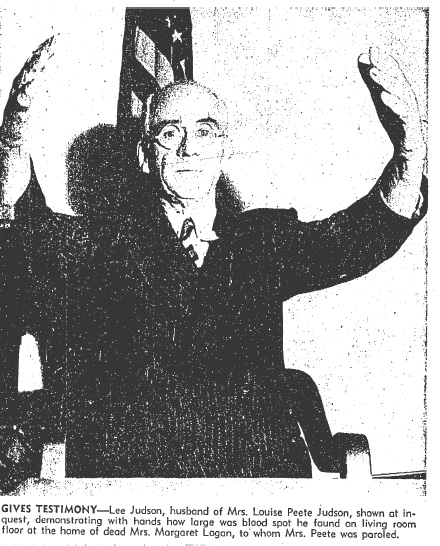
judson blood

What Judson didn’t know was that Louise had masqueraded as Logan’s sister in order to have him committed. Louise was undoubtedly relieved when, during her trial, Mr. Logan died in the psychiatric hospital.

Judson probably had no idea that the blood spot on the carpet had anything to do with a murder. Louise told him, and anyone else who asked, that Mrs. Logan was in a sanitarium undergoing plastic surgery to repair the facial injuries she’d suffered in the asserted insane attack by Mr. Logan!

The story was a variation of the the tale Louise had told about Jacob Denton two decades earlier. You’ll recall she told people that he was away being fitted for, and learning to use, prosthetic limbs as the result of an attack he’d suffered at the hands of a sword wielding Spanish speaking woman.judson sobs
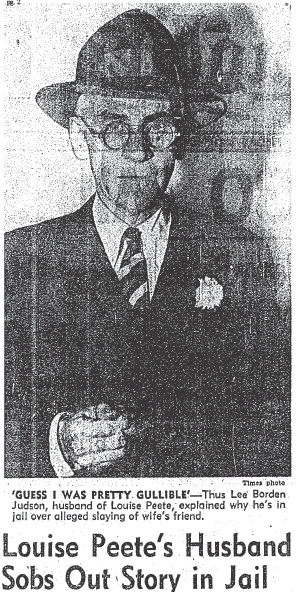
Judson was becoming a major liability for Louise. He testified that he’d seen her sign a check for $2500 on Mrs. Logan’s behalf. The reason Louise gave Judson for signing the check was that Mrs. Logan’s right arm was paralyzed! Even though, as her husband, he wasn’t able to testify against her, everything he said in his own defense brought her closer to the gas chamber.

In a bizarre side note, while Louise was cooling her heels in the County Jail her cellmate Mrs. Constance Renner (no relation to me that I’m aware of) attempted suicide by taking an overdose of sedatives she’d been given to calm her nerves. Louise heard Renner’s labored breathing and struck a match to see what was going on. She saw foam on Renner’s lips and alerted the matron, thus saving the woman’s life. The cell was later searched because five of the sedative tablets were unaccounted for. You’ll never guess where they were found — Louise had stashed them in her hair! She said she hidden them so that she could give them to the jail chief later, but it’s obvious that she was keeping them just in case she needed an exit strategy.
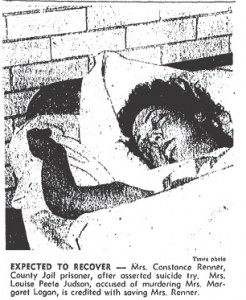
renner suicide attemptThings were going from bad to worse for Louise. The State of California contended that her marriage to Judson wasn’t legal.; then they dropped the charges against him and cut him loose. Judson was greeted by his son and daughter following his release and he should have been on his way to happier times but instead, less than twenty-four hours after he was freed, Lee Judson went over to the Broadway-Spring Arcade Building and hurled himself down a stairwell to his death. Whether Judson’s guilty knowledge of Louise’s actions included him actually assisting her in the burial of Margaret Logan’s remains we’ll never know. He was a decent man and it likely that the shame of sharing a life, if only for a few months, with a killer was too much for him to bear.judson leaps
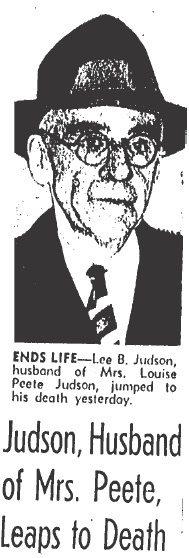
Louise took the news with a great deal of weeping and drama, but declined to attend Judson’s funeral saying “I prefer to remember him as he was”.

Louise was once again facing a murder charge on her own.

NEXT TIME: Louise meets her fate.