The Society Bootlegger Murder — Conclusion

Blanche Remington — Earle Remington’s sister.

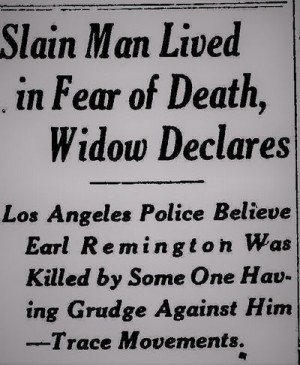
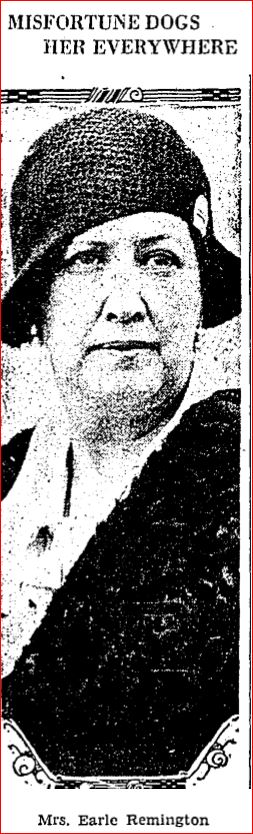
Blanche Remington and her attorney Samuel H. French paid the District Attorney’s office a visit on April 28, 1923.  Blanche was terrified.  She told District Attorney Thomas Woolwine and Deputy District Attorney Asa Keyes that she was being shadowed by as many as four persons. She had first noticed her stalkers trailing her in an automobile immediately following Earle’s murder. Since then she could feel strange eyes on her no matter where she was.

During her meeting with Woolwine and Keyes, Blanche revealed what she knew of her brother’s finances in the few years prior to his death. According to Blanche, she had lent Earle money for various enterprises for many years.  Unfortunately, Blanche was familiar with Earle’s legal business dealings, but knew nothing about his bootlegging side line.  Woolwine told reporters, “Miss Remington arranged the conference through her attorney.  She believed that she might be able to help us in our investigation, but she has told me nothing that can be used in apprehending Remington’s slayer.”

Was Woolwine telling the truth about Blanche’s ignorance of her brother’s bootlegging scheme?  Or was he equivocating in the hope that it would prevent her from being targeted by people who might fear her disclosures?  Reporters turned up at Blanche’s home at 1365 ½ West Twentieth Street in attempt to get more information, but the frightened woman refused to divulge any details.

Three weeks following Blanche’s meeting with the District Attorney, prohibition agents and the Long Beach Police raided a major bootlegging outfit.  Eight men were arrested, two of whom were millionaires thanks to the Eighteenth Amendment.  The raid resulted in the seizure of 160 cases of whiskey, two trucks, four automobiles and a Japanese fishing launch. The authorities thought they could make a connection between the bootleggers and Earle’s murder.  Earle had allegedly conducted business with Claude V. Dudrey, one of the men being held on charges stemming from the raid.  Claude didn’t deny his association with Earle.  He admitted under questioning that he had attempted to get the lease on a building Earle was preparing to vacate.  He also admitted to having sold seven cases of booze to Earle.  But he adamantly denied any involvement in the murder.

There were reports of high-jacking, shootings and even piracy on the high seas linked to several members of the bootlegging ring but there was nothing to suggest that any of the men had been involved in Earle’s murder.

On April 30, 1923, after months of frustration and dead ends, the Los Angeles Times reported that a young woman, who remained nameless in the report, came forward with a story that everyone hoped would resolve the case. Unfortunately, the woman had not approached police with her tale. She had allegedly confessed to local defense attorney S.S. Hahn.  Hahn merely played the messenger. He met with Assistant District Attorney Asa Keyes and repeated what he had been told.
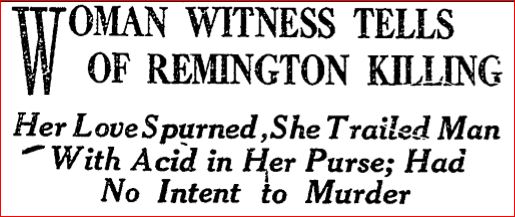
According to Hahn, the woman (whom Hahn described as an attractive 28-year-old brunette) said she and Earle had been lovers for more than eighteen months, but his interest in her began to wane.  She tried unsuccessfully to hold on to him. The woman told Hahn: “I loved Remington and expected him to marry me.  I first began to share his love more than a year and a half ago.  I had been married.  I knew he was married, but he promised that he would obtain a divorce and marry me.  For a year we were happy. He and I lived together for a time at the beach at Venice.  Then gradually his love seemed to cool.  He missed his appointments with me and I say less and Less of him.”

There was more:

“At first I suspected and then I knew that there were other women in his life.  It became more and more difficult for me to see him and finally I realized that he was out of my life.  I wanted to talk to him, but was unable to meet him.  Time after time I sought an interview with him at his office without success.  Then, on the day of the shooting I trailed him.  I saw him meet the other woman.  I followed them.  They had dinner together in a restaurant.  I waited outside while they dined and followed them to the Athletic Club (Los Angeles Athletic Club), where I lost track of them.  That day I carried with me a bottle of acid with which I planned to forever disfigure both of them.  After losing trace of them I got in touch with a man I knew I could trust and asked him to help me.  He brought another man with him.  With them I drove to the Remington home and waited for Earle.  I wanted to talk with him.”

According to the mystery woman she never got the chance to talk to Earle again.  She said she waited in the car for her two men friends to bring Earle to her.  She saw Earle drive up and then there was a scuffle. The evening quiet was shattered by two gunshots and the woman’s screams.

From the murder scene the woman said she was driven by the killers to her aunt’s home where she lived for the first few weeks following the murder.  The woman confessed details of Earle’s murder to her aunt.  She didn’t share details of the murder with her friends, but everyone she knew shielded and aided her.  But, if S.S. Hahn was to be believed, the woman was so conscience stricken that she was ultimately compelled to seek the attorney’s counsel.

S.S. Hahn told reporters, “The woman came to me as a client and said she was wanted for the slaying of Earle Remington.  She said she would disclose the details of the murder if the District Attorney’s office would assure her she would be allowed liberty on bail pending the trial.  She was nervous, hysterical and exhausted.”

The D.A. wasn’t prepared to make the deal and S.S. Hahn refused to name his client if they couldn’t reach an agreement.

The Remington case stalled again in early May.  LAPD Captain Home said, “we are no nearer a solution of the mystery than we were two months ago.”
Two months turned into two years, then twenty. It has now been nearly 95 years since Earle was murdered in the driveway of his home.  Yet, there was a brief glimmer of hope when a WWI veteran, Lawrence Aber, confessed. His reason?  He said he was angry at Earle for selling liquor to veterans. It didn’t take long for the police to realize that Aber had lied. He wasn’t being malicious, he suffered from severe mental issues and he was in a hospital at the time of the slaying.

For several years following her husband’s death, Peggy Remington suffered a series of tragedies. She lost three brothers to various ailments including paralysis and Bright’s Disease.  And most of her money vanished due to “sharp practices of asserted friends.”  She was undeterred.  “It means I am going to work; I am going to be hostess of a country club at Rye, N.Y.” She smiled at reporters and said, “Oh, I’ll get along.”

Despite the dozens of suspects identified early in the investigation, detectives never got the break they needed to catch the killer(s).

It is always hard for me to reconcile myself to the fact that someone got away with murder.  In this case there were so many suspects it was dizzying.

So, I’m curious.  Who do you think murdered Earle?  Bootleggers?  Former business partners? An ex-lover?  Feel free to weigh in.
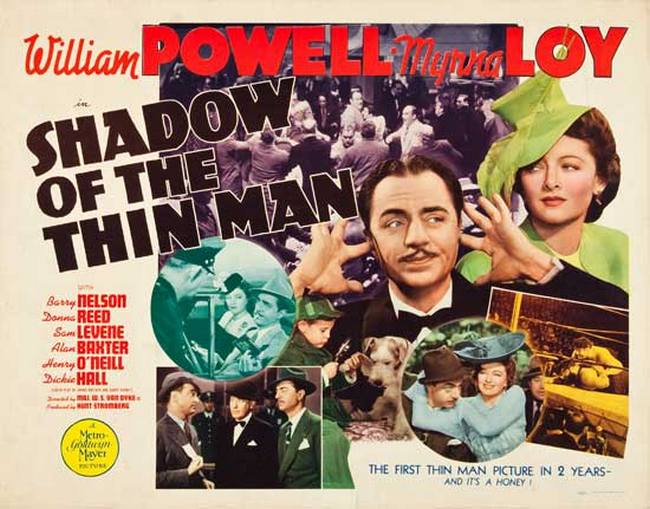


Film Noir Friday: Shadow of the Thin Man [1941]

shadow-of-the-thin-man-half-sheet-a-small

Welcome! The lobby of the Deranged L.A. Crimes theater is open. Grab a bucket of popcorn, some Milk Duds and a Coke and find a seat. Today’s feature is SHADOW OF THE THIN MAN starring Myrna Loy, William Powell, Donna Reed, Barry Nelson and Asta (his real name was Skippy).

Imagine my delight when I found this on YouTube today.  The person(s) providing the film say they couldn’t find a copyright for it.  I believe they may be mistaken — so watch this immediately!  The Thin Man series always makes me smile, and this particular entry in the series is one I absolutely adore (especially Myrna’s hat!)

If you miss this showing for any reason you’ll be pleased to know that TCM is showing it on December 31st.

Enjoy the movie!

TCM says:

In San Francisco, former private detective Nick Charles enjoys a peaceful retirement with his attractive wife Nora, their young son Nick, Jr., and their wire-haired terrier, Asta. One afternoon, when Nick and Nora go to the races, they learn from Nick’s old friend, Lieutenant Abrams, that a jockey named Gomez has just been fatally shot. In the jockey room, Nick’s police and reporter friends think that he is on the case, but he insists that his detective days are over, even when one of the jockeys piques his curiosity by saying that Gomez was killed because he refused to throw a race.

https://youtu.be/JRbj7urKAqU

Film Noir Friday — Sunday Matinee: Kiss of Death [1947]

kiss_of_death_ver4_xlg

Welcome! The lobby of the Deranged L.A. Crimes theater is open. Grab a bucket of popcorn, some Milk Duds and a Coke and find a seat. Today’s feature is KISS OF DEATH starring Richard Widmark, Victor Mature and Coleen Gray.  This is one of my favorites.

Enjoy the movie!

TCM says:

On Christmas Eve, down-on-his-luck Nick Bianco, an ex-convict, and his three cohorts rob a jewelry store located on the top floor of a New York skyscraper. Before they can exit the building, however, the proprietor sets off his alarm, and Nick is apprehended by the police. Later, Assistant District Attorney Louis D’Angelo tries to persuade Nick, who has two young daughters and a wife, to name his accomplices in exchange for a light sentence. Sure that his lawyer, Earl Howser, and cohorts will look after his family while he is incarcerated, Nick refuses and is given a twenty-year sentence.

The Society Bootlegger Murder, Part 3

liquor stashAimee Torriani’s self-proclaimed psychic abilities were underwhelming. She put forward the same theory that Earle’s brother-in-law had suggested — that the killer was a veteran of the world war. According to Aimee the mystery vet’s motive was simple, he respected Peggy Remington for her work with veterans and felt her husband was doing her dirt with his constant string of affairs.
Aimee also offered her opinion on the Remington’s relationship. “Peggy and Earle loved each other with a love which was so possessive that it was destructive.” Aimee went on to say, “I was surprised when Earle told me, more than two weeks ago when I met him downtown by chance, that an estrangement might occur. I have been away from Los Angeles a lot and have only seem him infrequently since I cam here to enter pictures almost three years ago.” Aimee had known Earle since she was a child, but she said, “I never knew Mrs. Remington well. She used to ask a number of my girl friends to assist her in giving benefit affairs for disabled war veterans, but I never was able to take part in any of the functions arranged by her.”

When she was asked about the parties Earle attended in the company of women other than his wife, Aimee said, “I have never been on any parties with Earle.” And she reiterated that Earle was “…never more than a big brother to me.”

The investigation into Earle’s murder became more complicated with every interview. Far from shining a psychic light on the slaying, Aimee had succeeded only in casting more doubt on the widow.

Chief of Police L.D. Oakes contacted Oakland authorities for information regarding the August 13, 1922 murder of “Deacon” Edward M. Shouse, a Bay Area bootleg king. Shouse may have been slain in retaliation for dropping a dime on a rival. Shouse had allegedly tipped off government officials to a landing at Monterey of a large cargo of illegal whiskey, and as a result someone was out a lot of money. Maybe the unknown someone was angry enough to kill. They tried, but Oakland PD and LAPD couldn’t make a connection between the deaths of the two bootleggers.

The strain of the her husband’s murder and subsequent investigation were so stressful that Peggy collapsed and was ordered to bed by her doctor.

Captain Home and Detective Sergeant Cline questioned Peggy in her sick bed and this time she was more forthcoming.

Peggy hoped that people would not judge Earle too harshly. She said, “He started (bootlegging) in a frantic effort to recuperate his fortunes. That was a long time ago. I begged him to quit. At first he said it was impossible. Recently, however, he promied he would get out of the terrible business. But—he didn’t.”

According to Peggy, Earle’s personality changed as he became more involved in bootlegging.  And it wasn’t a change for the better. Peggy didn’t like his new friends. “And they were so different. In the mornings they would call at the front door, perhaps. Then a few would seek to gain admittance at the rear door of the house. Trucks would drive up to the house and unload the terrible stuff. An again a truck would be driven into the driveway to take whiskey away. i was compelled to give up entertaining. I couldn’t bear to bring my friends into the house. The odor of liquor was noticeable in every room. It was just one long nightmare.”

Most of the men who turned up at the Remington’s home were strangers to Peggy. She told investigators Home and Cline, “The telephone would ring. They would ask for Earle. A long conversation concerning ‘prices,’ ‘deliveries’ and ‘grades’ would follow. Sometimes Earle would get angry and following the calls say terrible things about the party with whom he had just conversed. I never made it any of my business to ascertain the identity of the party in question. All I wanted was his promise to quit the thing.”

Earle’s new friends did not bring out the best in him. Peggy said that Earle began drinking heavily. She said, “His business affairs were in a chaotic condition and this, combined with the dangers and worries involved in his activities as a bootlegger made him drink.” Earle also became obsessed with money. Peggy felt Earle lost sight of everything in his life but his desire for money.

On the day of his death, Peggy overheard Earle talking on the telephone. He was agitated and so angry that Peggy was convinced if the caller had been in the house there would have been a fist fight. Earle swore at the unknown caller and when he hung up he continued to rage for hours. If Earle had a falling out with a bootlegging partner or rival the situation could have escalated from verbal threats to murder.

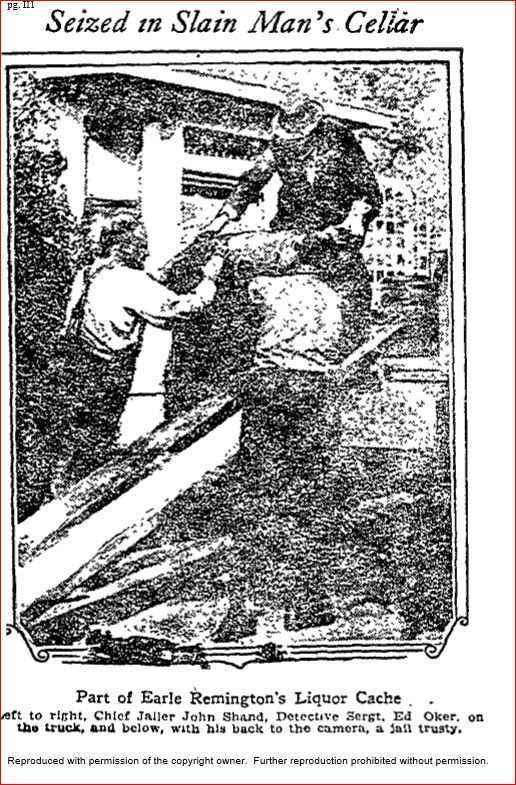
Detectives pulled on multiple threads hoping to unravel the tangled case, but it was slow going. A search of Earle’s personal papers revealed the names of scores of people to whom he had sold liquor.

Dr. Wagner, the autopsy surgeon, threw the detectives another curve when he said that an X-ray showed that the second wound in Remington’s heart was not caused by a dagger but was caused by a freak discharge of the shotgun, or by some other weapon that had not been identified.

Detectives were frustrated and tired of running on the hamster wheel that the case had become; but quitting wasn’t an option so they kept digging.

Earle’s will caused police to take another hard look at Peggy.  He hadn’t been destitute as had been thought — his estate was estimated to be in excess of $150K (equivalent to $2.1M in today’s dollars). That kind of money is one hell of an incentive to commit murder.

Peggy may have been a good suspect, but cops were still inclined to believe that Earle had died as a result of a dispute with another bootlegger. That theory gained credibility when, about a week after Earle’s murder, police learned that during the three months prior to his death he had been in fear of his life. Earle had reached out to some of his business associates telling them that he had gotten himself into a jam and might be killed. Unfortunately, Earle was tight-lipped about who wanted him dead.

The prognosis for a solution to Earle’s slaying improved when Earle’s sister paid a visit to the District Attorney to tell him that she was being watched and followed.  Whoever was behind the mystery surveillance could be responsible for Earle’s murder.

Next time: The conclusion of the Society Bootlegger Murder.


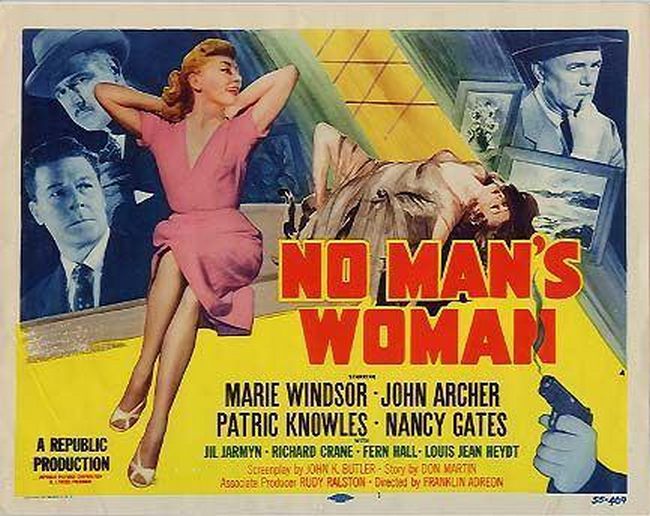
Film Noir Friday — Saturday Matinee: No Man’s Woman [1955]

no_man_s_woman

Welcome! The lobby of the Deranged L.A. Crimes theater is open. Grab a bucket of popcorn, some Milk Duds and a Coke and find a seat. Today’s feature is NO MAN’S WOMAN starring Marie Windsor, John Archer, Patric Knowles and Nancy Gates.

Enjoy the movie!

TCM says:

In Beverly Hills, California, gold digger Carolyn Grant has been estranged from husband Harlow Grant for two years. When Harlow falls in love with Louise Nelson, Carolyn refuses to grant him a divorce, unless he gives her a large percentage of his chemical company plus $300,000. Knowing that Harlow does not have that much, she suggests that he sell his father Philip’s half of the company, which Philip spent his life building. Harlow is unsuccessful in talking Carolyn into a reasonable settlement.

https://youtu.be/-S8KptvXwMQ

The Society Bootlegger Murder, Part 2

Earle Remington

Earle Remington had made a name for himself locally, and nationally, as an aviator and businessman.  On the surface it appeared that he wasn’t the sort of man to get himself murdered. He was more likely to be injured tripping over a Persian rug at one of the exclusive clubs he frequented. But once police investigators began to scratch the surface they found that Earle was leading a double life — one that may have marked him for murder.

Peggy Remington had spoken with attorney Jerry Geisler about two weeks before Earle’s death. She wanted the attorney to represent her in a divorce. Peggy allegedly told Geisler that not only was Earle having an affair, he was selling bootleg booze. A jealous husband or an angry illicit business partner may well have cause to kill.

The widow had a couple of compelling motives to murder Earle. His infidelity was one. Another, and perhaps even stronger motive, was life insurance.  Earle had a policy in the amount of $27,500 (equivalent to $300k in current dollars).  Ten thousand dollars were to go to his sister, and the remainder would go to Peggy.  Peggy wouldn’t need to kill Earle herself, she could have hired someone to do it for her.

Peggy Remington

Peggy Remington

Where would a well-to-do society matron find an assassin? Her friends and acquaintances weren’t, like some of Earle’s, to be found on the shady side of the law.

Ironically, it was Peggy’s good works that would have put her in touch with a possible gene pool of killers.  She worked with veterans of WWI, some of whom were not only physically but psychologically damaged. Peggy knew dozens of men who knew how to use a weapon, but would any one of them be unstable enough to go through with a murder-for-hire?

The suggestion that the stab wound in Earle’s chest had been made not by a dagger but by a bayonet or a trench knife lent credibility to the theory that a vet, either on his own or enlisted by Peggy, had done the deed.  Peggy wanted out of the marriage – but how far was she willing to go?

Captain George Home

Captain George Home

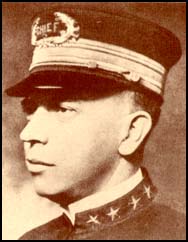
Two veteran LAPD officers, Captain George Home and Detective Sergeant Herman Cline, headed the murder investigation. Captain Home had nearly 20 years on the job, and he briefly served as Chief of Police in 1919 and 1920. Detective Cline worked many high-profile cases – most notably he had been involved in the investigation into the mysterious slaying of film director William Desmond Taylor in 1922.

Milster’s was not an uncommon theory. From the end of WWI until the beginning of WWII, many criminal acts were rightly, and wrongly, attributed to veterans. If vets behaved badly it may have been because they suffered from shell-shock, the original term for what, decades later, became known as Post-Traumatic-Stress-Disorder (PTSD). Milster was satisfied that his sister had nothing to do with Earle’s death — but detectives weren’t so sure. They were convinced that Peggy was withholding information. Despite evidence to the contrary, particularly from her own attorney, Peggy continued to deny knowing anything about Earle’s secret life of infidelity and bootleg booze.

Earle kept a little red book containing the names, addresses and telephone numbers of many women. Detectives hoped that the book would lead them to Earle’s killer. All Peggy would say is that for at least two weeks prior to the murder Earle appeared to be in fear of his life. She told police that he never revealed to her the reasons for his unease.

society bootlegger_3_cropLess than a week into the investigation police discovered that Earle was the victim of extortion — a blackmail scheme run by a man and woman.  The woman had allegedly seduced Earle then told him it would cost him big time for her to keep her mouth shut about their affair.
In 1933 crime novelist and chronicler of Los Angeles noir, Raymond Chandler, published his first piece of crime fiction entitled “Blackmailers Don’t Shoot”.  Chandler was on to something.  Why would blackmailers kill the golden goose? They might kill him if he finally refused to pay.

Evidently, Earle had been hemorrhaging money and when the blackmailers tried to tap him again, he told them they were out of luck. Were they made angry enough to kill?

Police identified the couple, but they weren’t sharing that information with the press.  What they said was that they had heard from informants that the night before the murder the blackmailers were at a party in a cabaret on the outskirts of Chinatown. Earle was there with another man and three women.  The blackmailers hadn’t been seen since. Or had they?  Neighbors of Earle’s saw a couple necking in a coupe near the murder scene.  They also witnessed another coupe, driven by a woman, drive up to the Remington home followed moments later by a touring car in which there were two men.  Both automobiles circled the block several times before disappearing. And nobody seemed to know where the amorous couple had gone. Were Earle’s killers doing reconnaissance before they struck?

As if the case wasn’t complicated enough Aimee Torriani, an actress and acquaintance of the Remingtons, came forward. Aimee told detectives that two weeks before his death she had bumped into Earle at a downtown club.  Aimee said that Earle had confided in her that his marriage to Peggy was in serious trouble. Earle had seemed nervous.

Aimee told police that she had special insight into the Remington’s marriage because not only had she known Earle since she was ten years old, she was a psychic.

NEXT TIME:  Will psychic revelations help the cops solve Earle’s murder?  And is the murder of Oakland society bootlegger, Edward Shouse, connected to Earle’s death?


Film Noir Friday: The Miami Story [1954]

miami story poster

Welcome! The lobby of the Deranged L.A. Crimes theater is open. Grab a bucket of popcorn, some Milk Duds and a Coke and find a seat. Tonight’s feature is THE MIAMI STORY starring Barry Sullivan, Luther Adler, John Baer and Adele Jergens.

Before the main feature I’ve added a special short subject, courtesy of the Los Angeles County Sheriff’s Department. Please don’t try these shooting stunts at home!

Enjoy the movie!

TCM says:

In post-World War II America, a rise in gangster activity prompts the formation of an investigative committee by the U.S. Senate, forcing many criminals to flee to the safety of the tourist-filled and ineffectually policed Miami. When two Cuban gangsters are gunned down upon arrival at Miami’s airport by gangster boss Tony Brill’s right-hand man, Ted Delacorte, and police chief Martin Belman is unable to secure an indictment, journalist Charles Earnshaw summons several prominent Miami businessmen for assistance. The men are dubious about stopping Brill’s ruthless criminal machine, until attorney Frank Alton suggests a plan.


https://youtu.be/ddMprH1IBCQ

The Society Bootlegger Murder, Part 1

Isabel Betts was awakened at about 11:30 p.m. on a chilly February night in 1923 by the barking of her Llewellyn setter, Rex. Isabel pulled on her dressing gown, gathered it around her and walked slowly and quietly to the closed porch in the front of her house where Rex slept. Rex was so agitated that he pushed open a door to the yard ran off in pursuit of something or someone.  Had Rex caught the scent of a nocturnal animal visitor or, worse, a human intruder?  She immediately dismissed the idea that Rex was barking at her next-door neighbor, Earle Remington. Rex was familiar with Earle and never paid the neighbor’s late-night comings and goings any mind. Cautiously, Isabel searched the perimeter of her home and found nothing.  Relieved, Isabel started back for the house. Suddenly she heard a loud sound. She froze for a moment, but then thought she recognized it as the backfire of a passing car and took a breath.  Isabel called for Rex and went back inside.

At 6 a.m., February 17, 1923, Isabel Betts was again awakened by Rex, but this time she knew the cause.  Charity Dawson, the Remington’s maid, was standing in the driveway of 1409 South St. Andrews Place screaming and sobbing.  Prone on the driveway was the body of aviation pioneer and electrical engineer, Earle Remington

Charity’s screams had awakened Virginia “Peggy” L. Miller Stone Remington. She rushed outside to determine the cause of the shrieks and saw Earle’s body on the driveway. Someone called the police.

crime scene society bootleggerWhen LAPD detectives arrived they immediately recognized the name of the victim. Earle was well known in Los Angeles for his involvement in aviation and for his work as an engineer; Earle designed security systems for banks.  What wasn’t common knowledge was Earle’s other job, the purchase and distribution of bootleg booze.
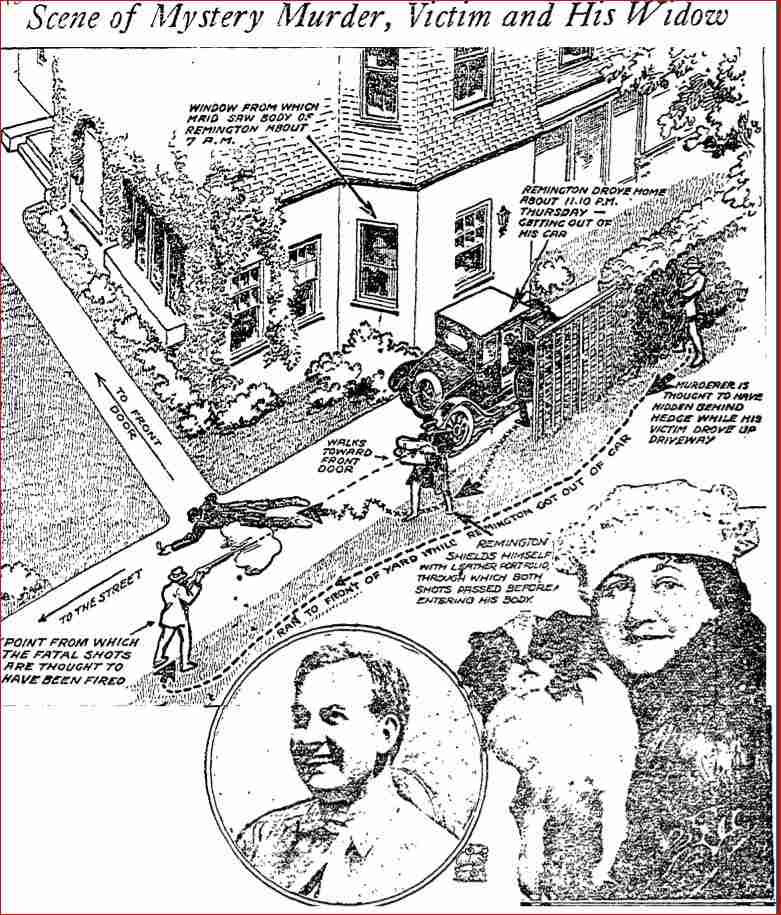
When the police arrived at the scene began to construct a plausible scenario for the crime. According to them the murder went down like this:  Earle pulled his small couple into the driveway of his home and exited on the passenger side, then he walked around the back of the vehicle.  One, possibly two, killers materialized from behind a hedge.  Did Earle recognize them?  Did they speak to one another?  Nobody heard anything except for the sound that several near neighbors described as a car backfiring. The sound wasn’t made by a car, it was made instead by a double-barreled, sixteen gauge shotgun.  Earle must have watched his assailant raise the weapon to fire because he reflexively clutched his large briefcase to his chest. The briefcase proved to be worthless as armor. One shot penetrated Earle’s chest just above his heart. The blood trail showed that the wounded man staggered toward the house.  He didn’t make it.  He was likely dead before he hit the ground.

It wasn’t until the autopsy that the coroner determined that Earle had not only been shot, he has been stabbed with a bayonet.

No doubt about it, someone wanted Earle dead.

Detectives immediately turned their attention to Earle’s wife of six years.

Peggy had recently consulted with attorney Jerry Geisler about representing her in a divorce. A private investigator had confirmed Peggy’s suspicions that Earle was having an affair and she wanted out of the marriage.  Peggy knew about the affair with a married woman, but did she know that Earle was juggling several extra-marital relationships at the same time? Was Peggy angry, or broken-hearted enough, to kill?  What about the other women in his life?  Earle had promised one of them that he would divorce Peggy and then marry her.  The woman believed him, until she found out that Earle was cheating on her too.

The angry husband or boyfriend of one of Earle’s dalliances may have decided to remove his rival forever.

The suspect pool expanded when investigators took a hard look at Earle’s finances and found that his partners in the Day and Night Electric Protection Company and Night Safe Deposit Company, fellow aviators Frank Champion and Earl Daugherty, may have been in financial difficulty and blamed Earle.  An employee, Harry Miller, thought that Champion and Daugherty were responsible for the crime, but refused to provide details.

Finally, there were Earle’s bootlegger acquaintances. Earle didn’t deal in small quantities of booze, in fact he had recently bought 100 cases of the stuff. In the illegal liquor trade Earle would rub elbows with career criminals and others who wouldn’t hesitate to end a dispute with a bullet. Had Earle double-crossed one of his sources?  And what about Earle’s double barrel shotgun?  It had been stolen from his office a few weeks prior to the murder.  Could it be the murder weapon?

There were far more questions than answers.  Detectives had their work cut out for them.

NEXT TIME:  The investigation into Earle Remington’s murder continues.


Film Noir Friday, on Saturday: Wiretapper [1955]

wiretapper_1955

Welcome! The lobby of the Deranged L.A. Crimes theater is open. Grab a bucket of popcorn, some Milk Duds and a Coke and find a seat. Tonight’s feature is WIRETAPPER starring Bill Williams and Georgia Lee.

Mark Twain succinctly summed up my love of true crime with this wonderful quote: “Truth is stranger than fiction, but it is because fiction is obliged to stick to possibilities; truth isn’t.”  This film is based on a true story with an ending that could only happen in real life.  Jim Vaus was associated with Los Angeles mobster Mickey Cohen, but his life took many unexpected turns–which explains why you see Reverend Billy Graham in the poster.  If you are interested in learning more about Jim Vaus you may want to read MY FATHER WAS A GANGSTER by Will Vaus — it’s available on Kindle!

Enjoy the movie!

TCM says:

During World War II, Jim Vaus, an army electronics specialist, is serving a prison sentence for having stolen equipment from the army. Because Jim has arranged for released prisoners to mail letters he has written to his girl friend, Alice, Alice thinks that he is still on active duty. When the war ends, the prison chaplain informs Jim that the President has reviewed his, and others’ cases, and that he is to be released. The chaplain, aware of Jim’s letters to Alice, strongly advises him to tell her about his past. However, when Jim returns to Los Angeles, he buys a captain’s uniform and some medals, then goes to visit Alice, her mother and younger sister Helen and lies that he has just finished active service.


Movie Ticket Giveaway: SUBURBICON

suburbicon_poster

Thanks to Paramount Pictures, I have four pairs of tickets to give away for the movie SUBURBICON.  The passes will be good for an advance screening on Tuesday, October 24th at the Landmark Theater at the Westside Pavillion (10850 W Pico Blvd, Los Angeles, CA 90064) at 7:00 pm. Winners will need to arrive by 6:30 pm to pick up their tickets and should proceed directly to the table in the theater lobby — no need to wait in the general admission line.

The way to win a pair of tickets is simply to submit your name to jrenner@derangedlacrimes.com and  reference “SUBURBICON TICKETS” in the subject line. 

Submit your information by 6 pm Pacific Time on Friday, October 20, 2017 for a random drawing. Winners will be announced on Saturday, October 21, 2017. 

GOOD LUCK!

Here is a description of the film:

Suburbicon is a peaceful, idyllic, suburban community with affordable homes and manicured lawns — the perfect place to raise a family, and in the summer of 1959, the Lodge family is doing just that. But the tranquil surface masks a disturbing reality, as husband and father Gardner Lodge must navigate the town’s dark underbelly of betrayal, deceit and violence.