Welcome! The lobby of the Deranged L.A. Crimes theater is open. Grab a bucket of popcorn, some Milk Duds and a Coke and find a seat.
I am following-up my tribute to the L.A. County Sheriff’s Department Homicide Bureau, aka the Bulldogs, with the 1995 film, HEAT. Why? Because one of the Bulldogs has a small role in the movie. Look for retired Sheriff’s homicide detective, Rey Verdugo, as Vegas cop.
Bulldogs. Is there nothing they can’t do?
IMDB says:
Master criminal Neil McCauley (Robert De Niro) is trying to control the rogue actions of one of his men, while also planning one last big heist before retiring. Meanwhile, Lieutenant Hanna (Al Pacino) attempts to track down McCauley as he deals with the chaos in his own life, including the infidelity of his wife (Diane Venora) and the mental health of his stepdaughter (Natalie Portman). McCauley and Hanna discover a mutual respect, even as they try to thwart each other’s plans.
Heat is based on the true story of Neil McCauley, a calculating criminal and ex-Alcatraz inmate who was tracked down by Detective Chuck Adamson in 1964.
Founded in 1921, the Bureau’s celebration should have taken place last year but, like so many things, they put it on hold. It was worth the wait.
Nearly 500 people gathered at Pacific Palms Resort in the City of Industry to honor past and present detectives. I am honored to know a few of them personally.
During the 6+ years, I have volunteered with LASD’s museum, I’ve met, and worked with, a few of the department’s retired homicide investigators. Most notably, Frank Salerno and Gil Carrillo. You know them from the Night Stalker case in the mid-1980s.
GIL CARRILLO & FRANK SALERNO
They are among the most famous of the Bulldogs, but each of the investigators I’ve met is truly outstanding. I’ve learned that being a homicide investigator is a calling. It’s not a j-o-b. It takes intelligence, skill, and heart to deal with the cases that cross their desks daily.
Bulldog Attitude
A person I admire and respect is Ray Lugo. Ray has been a homicide detective for over 20 years.
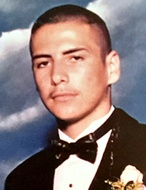
JESSE AGUILAR
An example of Ray’s bulldog attitude is the investigation into the 2006 murder of Iraq war veteran, 24-year-old Jesse Aguilar, found shot to death inside the trunk of his car, which was found on fire on Oct. 26, 2006, in the Los Angeles Riverbed near Paramount Boulevard in South Gate.
It took a decade to solve the case, and over twelve years before the killers went to trial. and to prison.
Jesse’s mother, Nancy, said,
“It’s been a relief that there’s going to be accountability. I want to look into the killers’ eyes. I want to see them.”
She said this about Ray Lugo,
“God sent Ray (Lugo) for this case because he never quits.”
RAY LUGO
It does not matter if they are working a case that is hours old, or decades old, they have the same determination to find a solution.
Bow WOW–A Brief History of the Bulldogs
How did the Sheriff’s Homicide Bureau earn their nickname?
In a December 18, 1977 Los Angeles Times article by Myrna Oliver and Bill Farr.
Under the headline “Sheriff’s ‘Bulldogs’ Hang in Where LAPD Doesn’t,” a veteran prosecutor is quoted, “You want to know why the Sheriff’s conviction rate is so much higher in homicide, not just last year, but for several years? It is because the guys from the Sheriff’s Homicide Bureau are a bunch of bulldogs. From the time they are called to the murder scene, until we prosecutors get the case through the courts, they never let go and I mean on every murder case, not just the high publicity cases. They are routinely tenacious, and the investigator assigned to the case sticks with it until the end. There is no shuttling cases to somebody else like at LAPD. With the Sheriff’s people, if you need follow-up done, they are marvelous; they are super. They even give you their home phone number in volunteering to help out.”
In the same article, a defense attorney had this to say, “I can tell you that almost every defense attorney I’ve ever talked to would rather try a murder case LAPD than against the Sheriff’s people. The Sheriffs are just tougher.”
L.A.’s First Serial Killer & The Birth of the Bureau
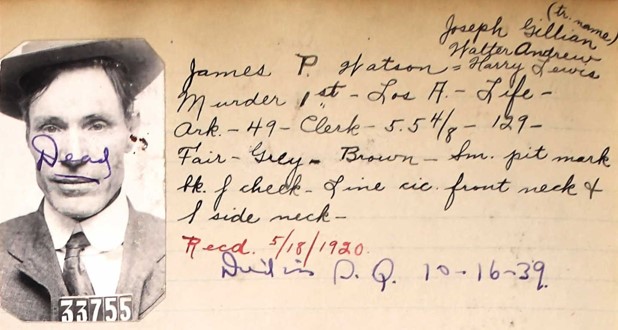
It is interesting to note that the birth of the bureau directly results from the city’s first bona fide serial killer, James Bluebeard Watson.
Kathryn Wombacher, an unmarried seamstress, took a chance on love when she answered an ad in a local Spokane, Washington newspaper in 1919. The ad’s author, Walter Andrew, described himself as a man in his 30s—sensitive and caring, with good habits, a decent income, and a desire to marry. Kathryn immediately answered the ad. Their meeting went well and they married in November 1919.
It thrilled Kathryn to move with her new husband to Hollywood. There was a constellation of stars living in the area. She wondered if she would meet Charlie Chaplin or Mary Pickford.
Even more exciting than moving to Hollywood was the knowledge that she married a government secret agent. Walter’s work lost some of its luster for Kathryn when his absences from home became longer and more frequent. She suspected her new husband of infidelity.
She hired a private detective and together they uncovered Walter’s secret. His real name was James Watson. He was a bigamist, and a multiple murderer with no connection to the secret service. He killed at least 25 of his wives across the western U.S. and Canada.
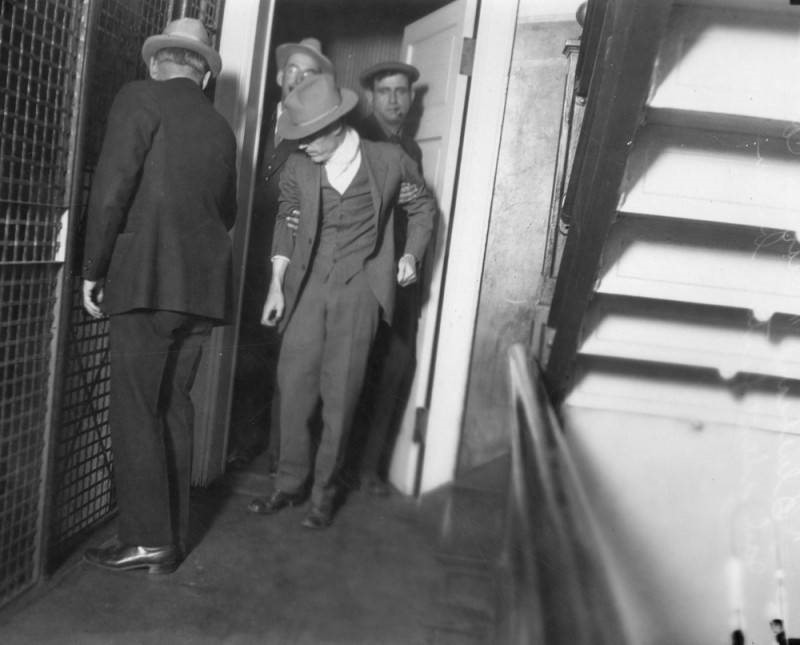
BLUEBEARD WATSON ESCORTED TO CELL
There was no homicide bureau then. Sheriff Traeger investigated on his own. It was not a one-person job. At the successful end of the investigation, in 1921, Chief of the Criminal Division, Harry Wright, insisted that Sheriff Traeger create the Homicide Detail. That was the first step toward the modern bureau.
Going Forward
In the decades since the Bluebeard Watson case, Sheriff’s homicide bureau has tackled some of the most difficult, and bizarre, murders in the county’s history; and they continue to do amazing work.
Advancements in science have provided detectives with valuable tools, but no matter what the science, it will always take a detective’s insight and skill to put together a case.
Speaking with Mike Fratantoni, the Sheriff’s museum curator, we agreed that each generation of homicide detectives passes the torch to those who follow. It is a tradition of which the department is justifiably proud.
I research a lot of heinous crimes for this blog. But, sometimes, I tumble down a research rabbit hole and find a character who captures my imagination; then I follow them through their time in Los Angeles.
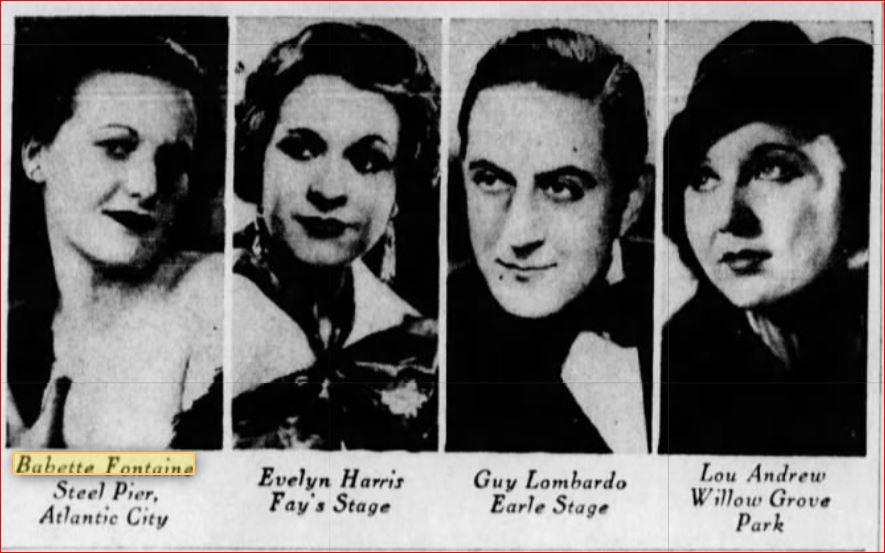
Each person is a thread in the fabric of the city. Which is how I came to Babette Fontaine. I tugged on a random thread. I saw an article about her and was fascinated. I would describe Babette as an entrepreneur who shared qualities with other transplants to Los Angeles during the 1930s and 1940s. Growing up in rural America, and coming of age during the Great Depression, Babette had nothing handed to her.
Conservative perceptions of women at the time dictated the employment available to them. Even programs in President Roosevelt’s New Deal restricted women.
They could not join the Civilian Conservation Corps, and other programs put them into housekeeping jobs. I imagine, as the daughter of a Kentucky miner, Babette preferred not to be stuck in front of a stove or behind a desk. She became a burlesque performer instead and traveled the east coast for a few years as a dancer.
I love women who defy the conventions and expections of their time. Babette was a rebel.
By the 1930s, American burlesque shows were unrecognizable from their 16th century English literary antecedents. Burlesque during the Great Depression was a training ground for many great comedians and actors whose careers took off in mainstream movies and television during the 1940s and 1950s. Dozens of legendary strippers, Sally Rand, Gypsy Rose Lee, and my favorite, Betty “Ball of Fire” Rowland, began their careers in the 1930s.
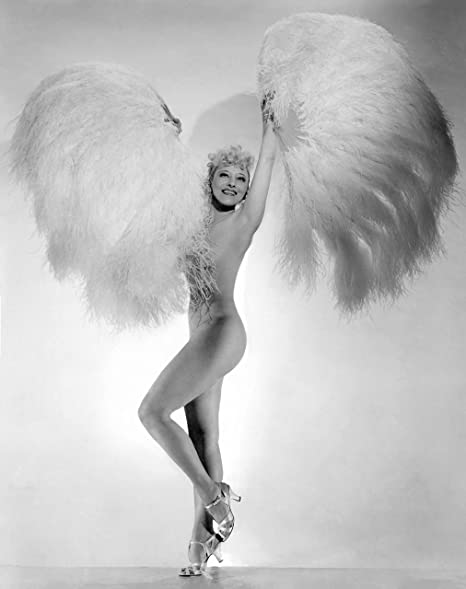
Chicago police arrested Sally Rand four times in a single day at the 1933 World’s Fair for her fan dance. Feathers, bubbles, and snakes became props for inspired dancers. Other dancers came up with their own signature acts.
SALLY RAND
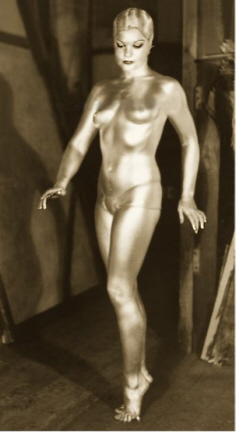
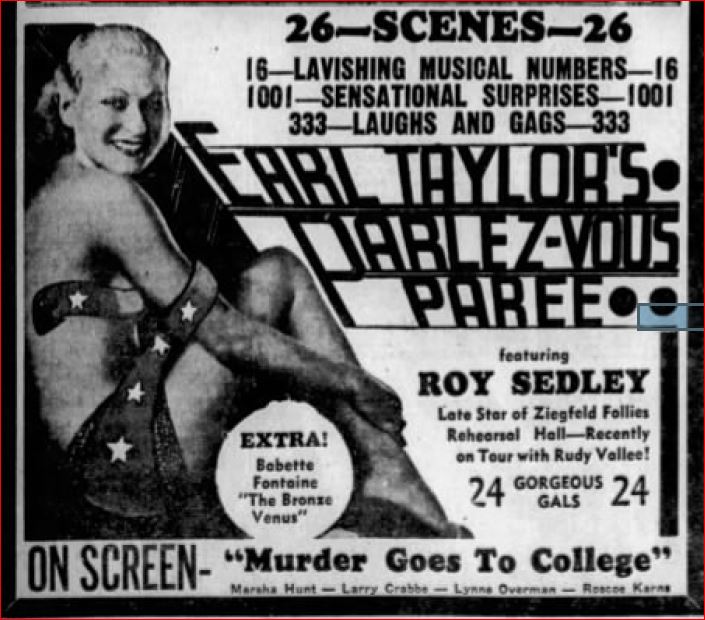
In 1936, Babette Fontaine painted her body bronze in imitation of a statue, and became known professionally as the Bronze Venus. The gimmick made her a featured player in Parlez Vous Paree, a burlesque revue produced by Earl Taylor. Babette wasn’t the only woman to claim the Bronze Venus moniker.
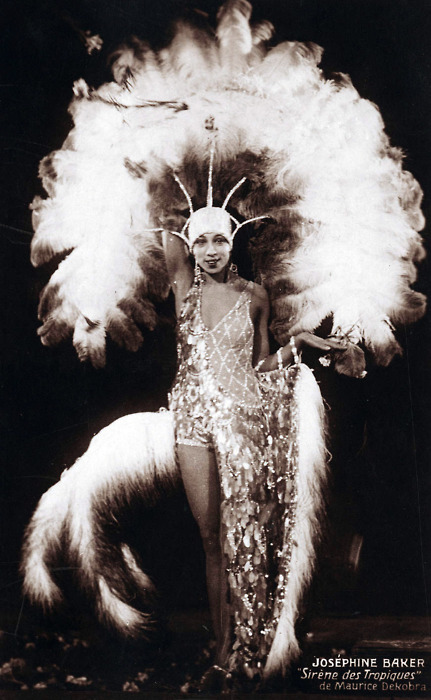
JOSEPHINE BAKER, A TRUE BRONZE VENUS
Beginning in the 1920s, black mega-star Josephine Baker was called Bronze Venus. Baker didn’t need paint to glow like a work of art. Others to advertise themselves as Bronze Venus were Ha Cha San, Bobby Lynn, Collette, and La Tonda.
HA CHA SAN
Born to Burns and Maude Mccarty in rural Kentucky in 1916, Babette’s birth name may have been Dorothy. While Dorothy is an ideal name for a schoolteacher or housewife; Babette Fontaine looks better on a theater marquee.
The Parlez-Vous Paree show debuted in September 1936. It was a large production and featured scores of entertainers. They billed one as a stooge-like comedian. I wonder. Did he throw pies or chuckle nyuk, nyuk, nyuk?
A few months following the opening of the show, Babette’s name is prominently displayed in ads. The last mention of her is in November 1938.
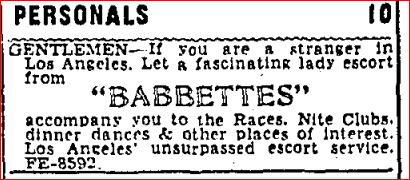
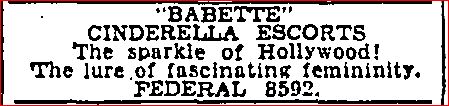
Between November 1938 and January 1940, Babette vanished from show business. Then, suddenly, she resurfaced in multiple newspapers in a wire service interview. They described her as the head of a Los Angeles escort service.
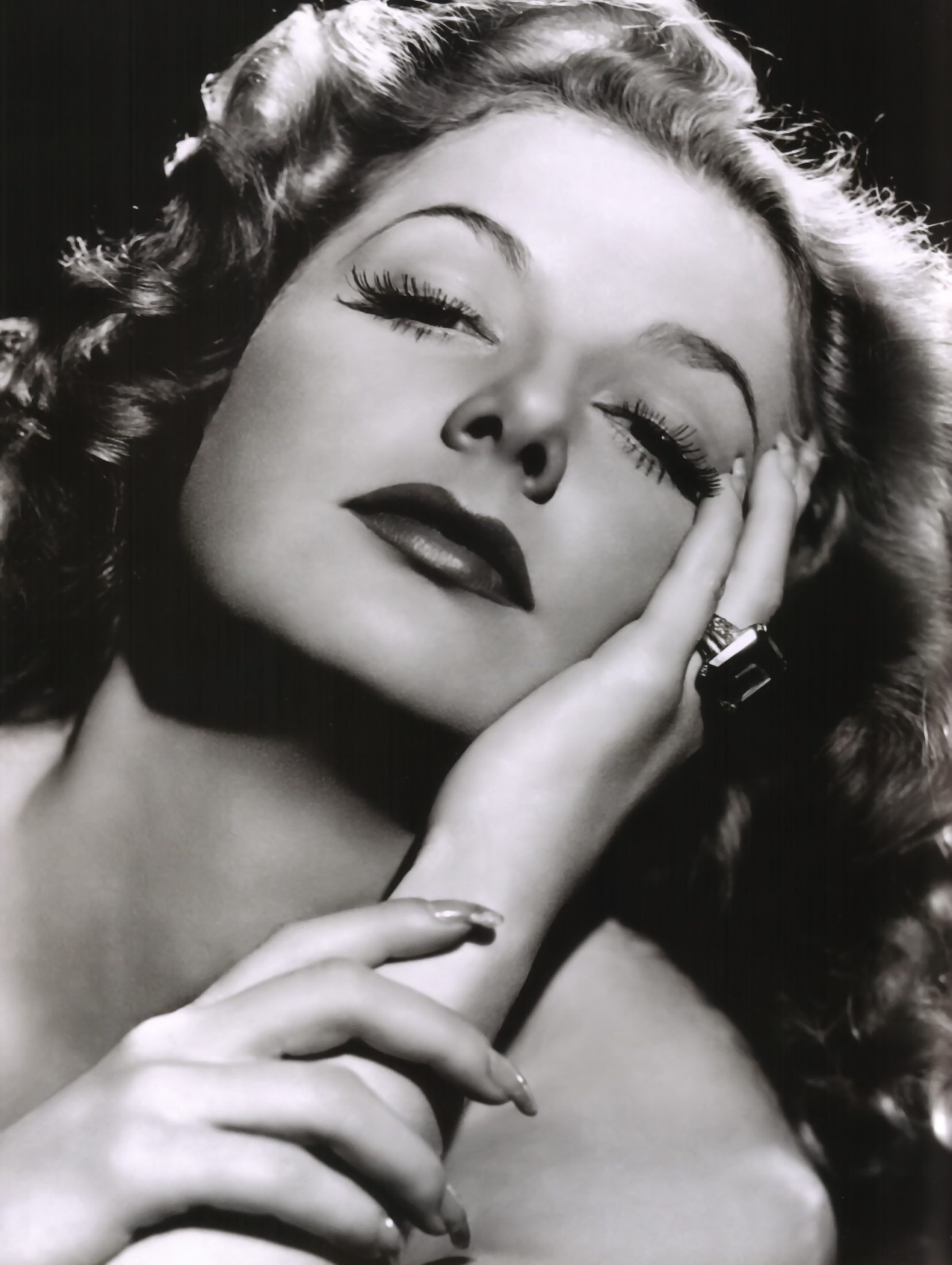
Asked, “What would you pay for a date with your favorite movie star?” Babette had a ready answer. She said that if, by some miracle, she could deliver the “oomph girl” Ann Sheridan as a dinner partner to a lonely gent on New Year’s Eve, she would expect to get $1500. To put that into perspective, the 2022 equivalent amount is $30,585.00! If the lonely gentlemen would accept a second-best companion, Babette said she would offer either Dorothy Lamour, Hedy Lamarr, or Claudette Colbert for $750.
ANN SHERIDAN
Babette gave Greta Garbo a thumbs down as date material. Why? Because
she felt that men would be frightened of her.
GRETA GARBO
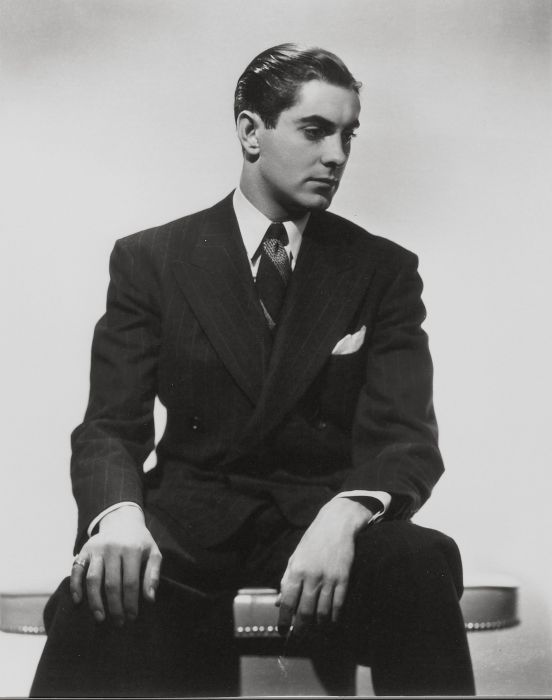
What if a woman needed an escort? Babette named Tyrone Power as the perfect date. Clark Gable, not so much. She said, “I am afraid he is a little too much of the aggressive type.”
TYRONNE POWER
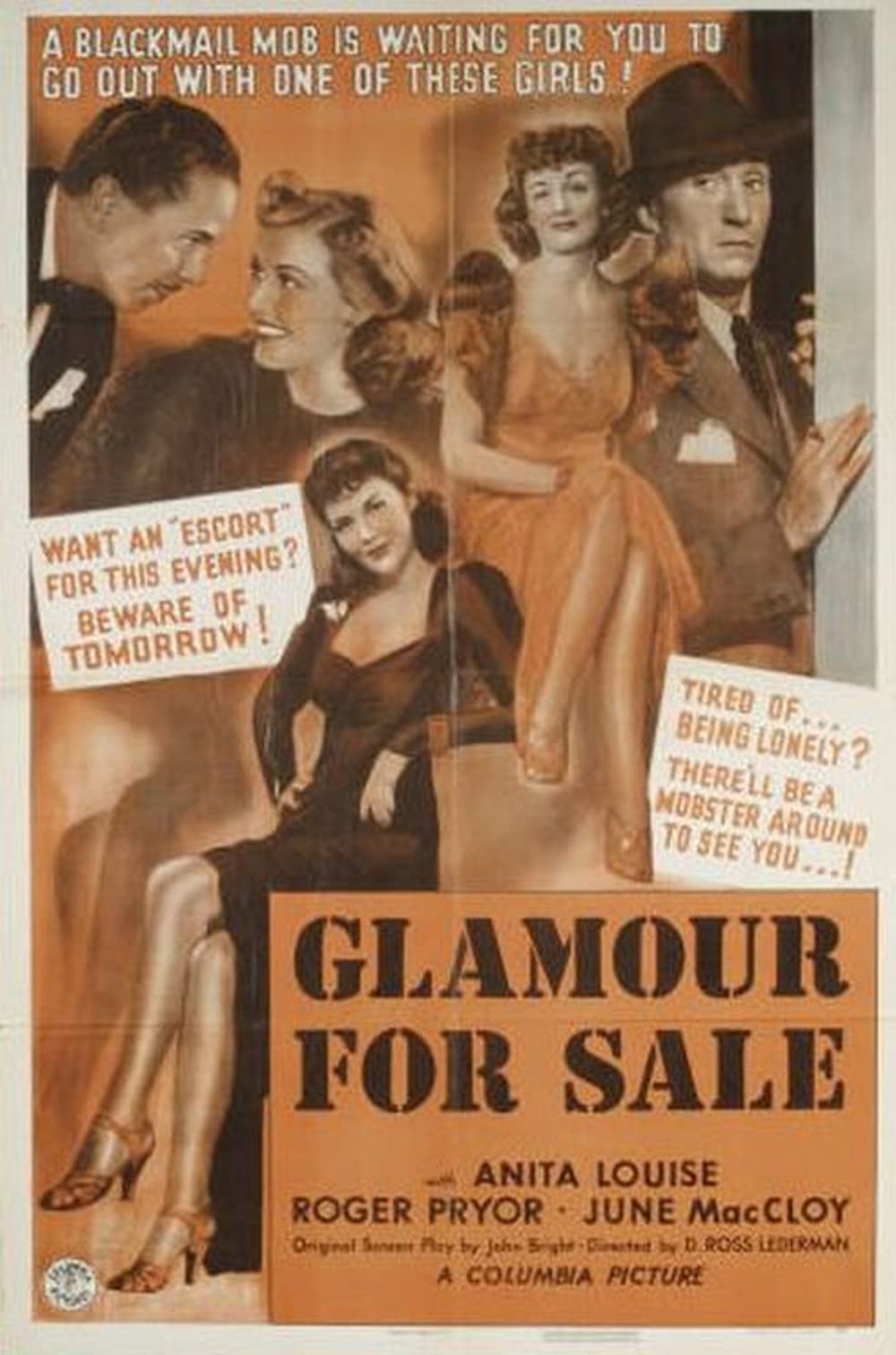
In April 1941, a few months after Babette rated various Hollywood stars as potential dates for hire, she appeared in newspapers again. Operating an escort agency out of 726 South Wilton Place, she filed an injunction against Columbia Pictures Corp. The company planned to produce a film called “Glamour for Sale”.
And why should the film concern Babette? Because it depicted the escort business as shady, specializing in extortion, blackmail and other criminal activities. Babette took umbrage. She said she had operated an escort bureau in Los Angeles for two years and had never engaged in anything illegal. She worried her reputation would suffer if they released the film.
Babette withdrew her suit in September when producers at Columbia said that they would also show legitimate escort businesses in “Glamour for Sale.”
In a move similar to Babette’s lawsuit, in late 1941, burlesque star Betty Rowland sued Samuel Goldwyn Productions for using her well-known stage name, “Ball of Fire” as the title for his upcoming film starring Barbara Stanwyck and Gary Cooper.
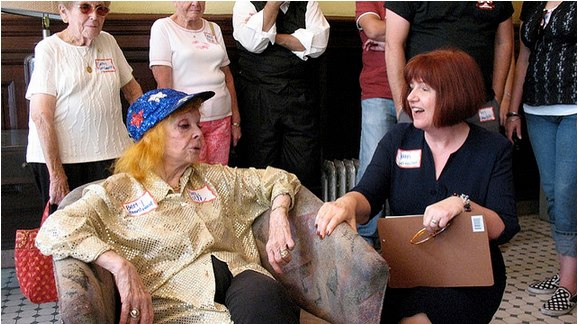
I AM SO LUCKY TO HAVE CHATTED WITH THE GREAT BETTY “BALL OF FIRE” ROWLAND. TO SEE BETTY IN ACTION, CLICK ON THE ABOVE PHOTO.
Several years ago, I asked Betty about her lawsuit. She winked and told me that the publicity was good for her and for the classic screwball comedy.
https://youtu.be/Ollhu06O9gk
BARBARA STANWYCK’S “BALL OF FIRE” COSTUME IS A KNOCK-OFF OF ONE OF BETTY’S.
[Note: I’m pleased to report that as far as I know, as of this writing, Betty “Ball of Fire” Rowland is alive and well at 106! I hope she lives forever.]
Following the recall of Mayor Frank Shaw and the dismantling of his criminal empire in 1938, Los Angeles cracked down on vice. Regulations followed. One of the new regulations required escort bureaus to be licensed. Legislating morality is nigh impossible, but that never stopped a city, county, or a nation from trying.
A man seeking an escort sometimes expects more for his money than arm candy. If the woman is willing, they might make a deal without the agency’s knowledge. Of course, a crooked agency would encourage such arrangements and take a cut.
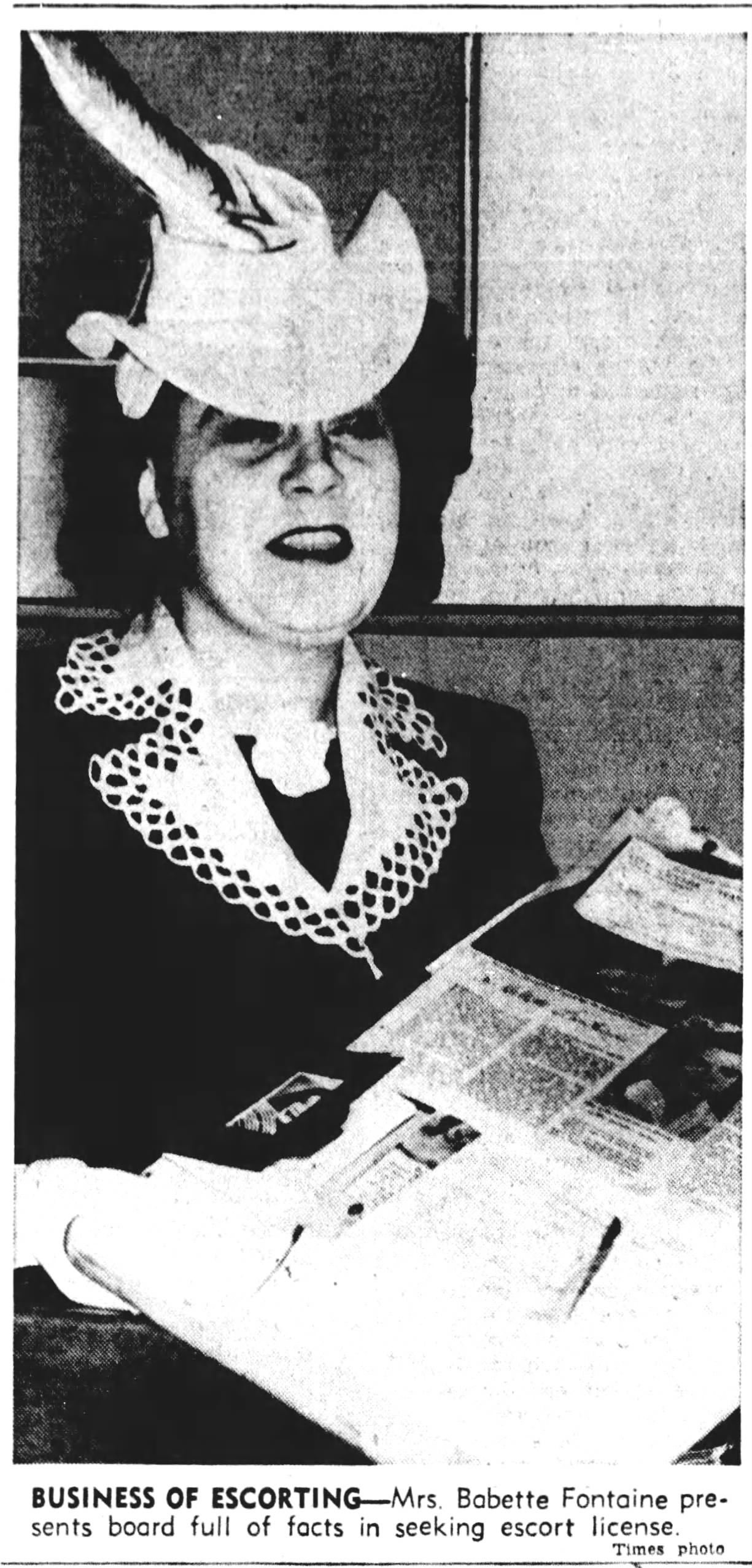
When Babette applied for a license in May 1941, she endured a grilling by the Police Commission. They wanted to know how much income tax she paid, what the girls charged and what she charged the girls.
According to Babette, she selected girls of good moral character, however, they were on “their own” after being introduced to the client. To me, that sounds like ass-covering 101. She said she charged the client $5. She then suggested to the client that he tip his date $5.
Babette claimed none of her girls ever had been arrested, and the only complaints she received about them came from police vice squad officers posing as clients. Sergeant John Stewart of the Central vice squad told a different story about one of Babette’s escorts. He and a few of his men operated an investigation out of the Biltmore and arrested one of the girls for “offering.”
Stewart, questioned about amounts paid to the escorts, said some demanded $50 from undercover investigators, others wanted $100 or more. A far cry from the five bucks Babette quoted.
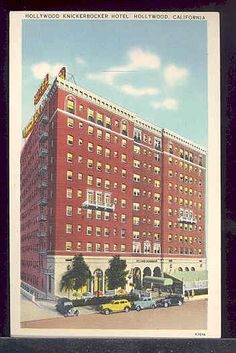
Babette needed to prove she knew nothing of her escort offering undercover vice investigators a service not on the bureau’s official menu. She provided an alibi. She claimed she was out of town, or out of the office, when the girl was arrested. She played the sympathy card. The stress of the vice investigation caused her to suffer a breakdown. She fled to Dallas, Texas, for her nerves. Then she spent three days at the Hollywood Knickerbocker to further recuperate.
She produced receipts, which showed she was away when the girl was busted at the Biltmore. Babette also claimed a rival agency planted the girl to get her into trouble with the police.
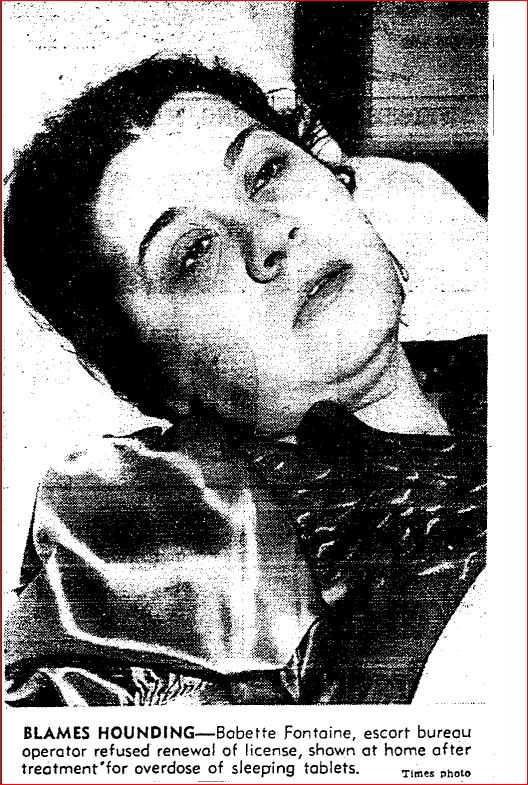
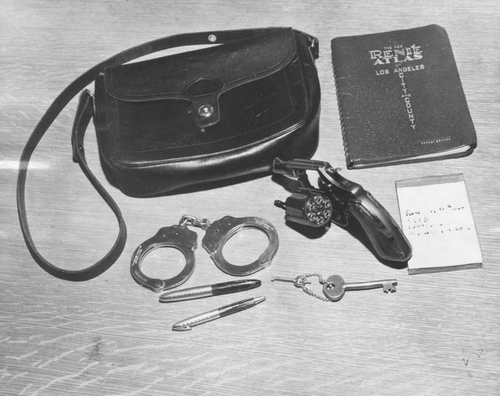
The day after her license hearing, where she learned they postponed the renewal, Babette overdosed on sleeping pills in her car in a service station at Wilshire Boulevard and Detroit Street. She left a note, “Cards stacked—no use.” In her handbag she left a typewritten summary of her testimony to the Police Commission.
Babette claimed the police hounded her for not “playing nice,” and one vice cop in particular, who she nicknamed the “boogeyman”, followed her girls and clients, and prevented her from operating her business.
By July, Babette received the bad news. Her request for a license was denied. Babette’s attorney filed an appeal.
The drama kicked up a notch when, in February 1942, Babette claimed two men kidnapped and beat her.
She said two men followed her as she drove away from her home at 9038 Rosewood Avenue, Beverly Hills. Several blocks later, the men forced her car to the curb. A masked man got into her car and told her to follow his directions or “get a bullet in your back.”
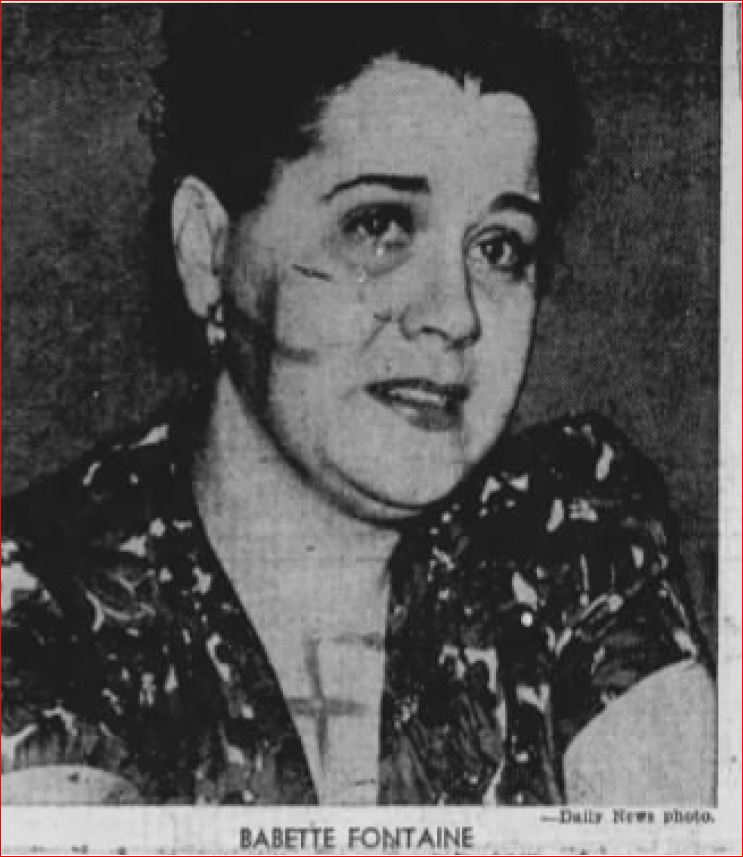
She drove to 135th and San Pedro, where the men forced her from the car into a vacant lot. The thugs told her to “get out of town”, punched her on the jaw and knocked her out. When she revived, she had a gag in her mouth– her wrists and ankles tied. She struggled for an hour before freeing herself. Once freed, she walked into the street and flagged a passing motorist who took her to the Compton Police Station. Police reported Babette’s abductors had used her red lipstick to mark her forehead, cheeks and breasts with crosses. The significance of the red crosses is a mystery.
Babette had a flair for self-promotion. Was her kidnapping real? Without a description of her assailants, the police had nothing to investigate.
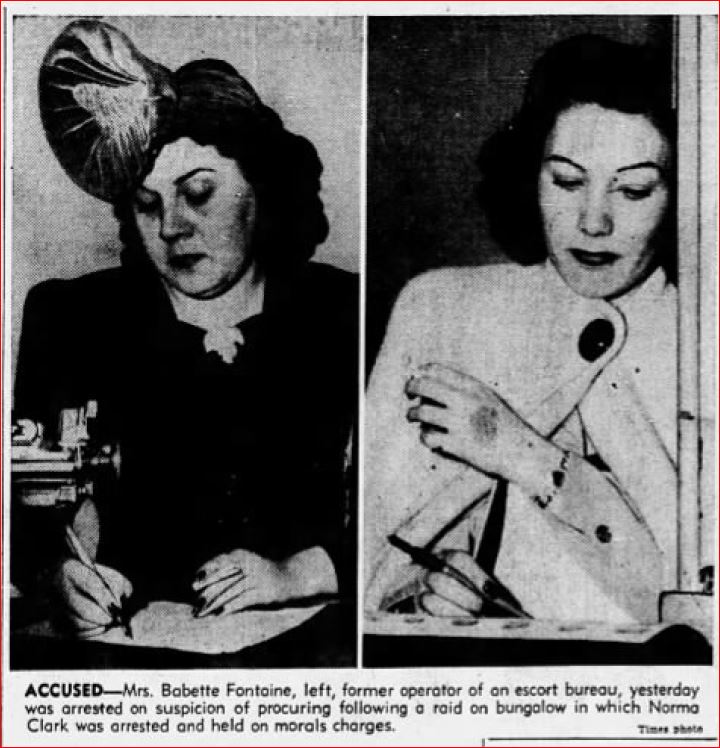
In early April, vice cops arrested Babette on morals charges in her home at 1769 S. Crescent Heights Boulevard. Arrested with her were Norma Clark and Harry Barker. Cops took the trio to Lincoln Heights Jail. They charged Babette with procuring and set her bail at $500. They charged Barker and Clark with resorting, and bail was set at $150 each.
Neighbors complained about suspicious goings-on at the bungalow and police staked it out for two nights before making the arrests.
Once her bail was posted, Babette made a beeline to her sister Colleen’s place at 2500 S. Hobart, where she was arrested while packing for a trip to Reno.
At first, Babette refused to appear in court. Then she changed her mind. She pleaded guilty to a misdemeanor procuring charge, and they immediately committed to jail for a medical exam (likely to screen for STDs) pending a probation hearing and sentencing. No word on how that turned out for her.
The Los Angeles Times offered a brief rundown of Babette’s escapades, beginning in 1941 and ending with her March 1943 arrest in Glendale after being found wandering along Brand Boulevard at 3:00 a.m. wearing only a white nightgown with gold trimmings.
This bizarre report ends the newspaper trail for Babette Fontaine—a fascinating and enterprising temporary Angeleno.
BROADWAY HOTEL, PORTLAND, OREGON
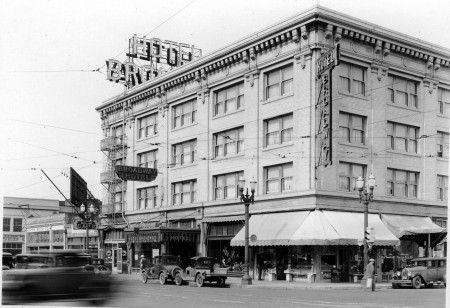
The last information I have for Babette is a marriage certificate. In Clark County, Washington, on January 28, 1946, Babette married Will Hayes—seventeen years her senior. Both gave as their address as the Broadway Hotel in Portland, Oregon.
Where they went and what they did as a couple following their marriage, I wish I knew. I hope Babette landed on her feet.
In early March 1927, twenty-year-old Tony Santi arrived at the Burbank Police Department to report an assault on his girlfriend, a fifteen-year-old Burbank high school girl, Mary Garard.
BURBANK POLICE
Tony sat in the station and related a bizarre tale to officers. Two weeks earlier, the couple drove out to a cabin in Kagel Canyon in the hills west of Roscoe. They wanted to prepare it for a party later that day. Tony said the cabin had no running water, so he went out to a stream to fill their bucket. He told Mary he would be gone for about fifteen minutes.
When he returned, he found Mary bound and gagged. He released her, and she told him what had happened. She said shortly after he left to get water, two men, reeking of alcohol, turned up at the cabin door. They asked her if she was alone and she told them no. She said her boyfriend was due to return any minute. Then, without warning, the men grabbed her arms. They bound her and stuffed a rag into her mouth to stifle her screams. They dragged her to a cot. One man produced a knife and, as Mary struggled, he cut into the flesh of her left shoulder the letters NR. The men said, “We are Night Riders. Let this be a lesson to you.”
Mary’s parents knew nothing about the assault until they arrived home from a trip to Colorado a few days later. Tony told police he was making the report against the wishes of Mary and her parents. They wanted the matter dropped.
Because the attack occurred in Los Angeles County territory, Burbank police referred the case to Captain William Bright of the Sheriff’s Department. Captain Bright told reporters that because Mary and her parents were unwilling to pursue the matter, he had no choice but to drop the investigation.
On the heels of Captain Bright’s announcement, Mary and her mother arrived at the Sheriff’s Department ready to swear out a complaint against the perpetrators of what newspapers referred to has a branding. Bright requested a John Doe warrant.
On the day following the Garard’s change of heart in the case, Mary and Tony appeared again in Captain Bright’s office. This time, they told him a different story.
The entire branding incident was a hoax perpetrated by the young lovers. As a minor, Mary required her parents’ consent to marry. They refused. Mary and Tony then concocted the branding scheme so her parents would see the wisdom of granting her a full-time protector. Sheriffs arrested Tony for assault and held Mary as a witness. Tony appeared in Judge MacCoy’s court to answer for two statutory charges. They fixed his bail at $1000.
It took until July to unravel Mary’s and Tony’s lies, but investigators finally sorted it out. In Superior Judge Elliot Craig’s court, Tony pleaded guilty to one of two counts charging a serious offense. (I think we can read between the lines and assume that Tony and Mary had intercourse.)
Mary confessed it was she who carved NR into her left shoulder to convince her parents to allow her to marry. Mutilating yourself is not the best way to show maturity. Her parents were wise to turn her down.
Mary and Tony went to an extraordinary amount of trouble to be together. So, what became of them? A superficial search of ancestry.com shows they married after all in December 1927, and may have divorced in the late 1930s. The course of true love never did run smooth.
Too often we recall the names of killers, but not their victims. Today, on what should be her 83rd birthday, I am highlighting Judy Dull.
JUDY DULL
Judith Ann “Judy” Van Horn Dull turned nineteen on June 23, 1957. She had a 14-month-old daughter, Susan, and a soon-to-be ex-husband, Robert, who intended to keep custody of their little girl. A decent lawyer costs money, and Judy needed as much cash as she could scrape together for the coming battle.
Judy lived at the El Mirador apartments at the corner of North Sweetzer and Fountain Avenues in West Hollywood.
EL MIRADOR
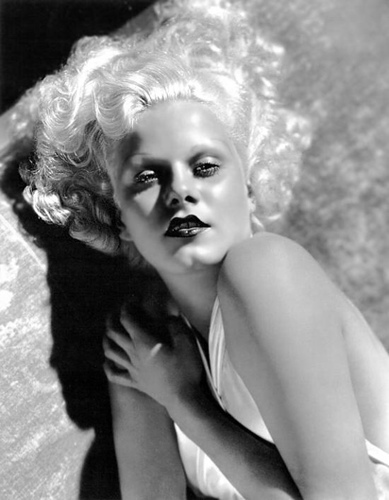
Most of the young women who inhabited the El Mirador during the summer of 1957 were still in diapers when the building’s most famous resident, actress Jean Harlow, died at age 26 in June 1937.
JEAN HARLOW
At least the building had a Hollywood provenance, which may have given the new crop of wannabes hope for the future.
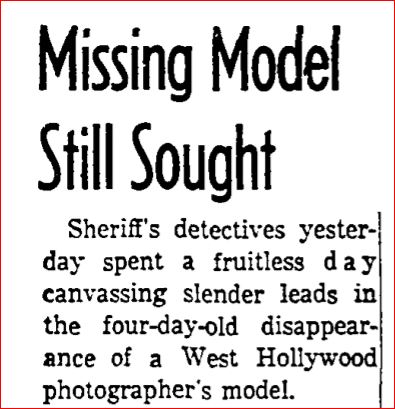
Judy’s need for a quick buck prevented the usual Hollywood rounds to agents or cattle calls to appear as an extra in the latest western. The best and quickest way for an attractive blonde like Judy to make money was as a model. Modeling gigs ran the gamut from legitimate work for catalogs and harmless cheesecake photos to pornography.
Judy’s roommates, eighteen-year-old Betty Ruth Carver and twenty-two-year-old Lynn Lykels, were models, too. All three were in demand and they looked out for each other, trading gigs to keep the money flowing.
On August 1, 1957, Judy took a job that Lynn had to pass on. At 2 pm, when the photographer, a guy named Johnny Glenn, a geeky-looking guy with bat ears and horn-rimmed glasses, showed up to collect Judy for the job, she was reluctant to go with him. He overcame her reluctance by offering her $20/hour for a two-hour shoot. How could she say no?
At Judy’s request, Johnny left his telephone number with one of her roommates.
Johnny and Judy walked out of the El Mirador.
It was the last time anybody saw her alive.
NOTE: Harvey Glatman murdered Judy and two other women, Ruth Mercado and Shirley Bridgeford. There was not enough evidence to try him for Judy’s murder, but he was found guilty of murdering Mercado and Bridgeford. Glatman died in the gas chamber at San Quentin on September 18, 1959.
Frank’s chances for an acquittal are dismal, but then his attorney mounts a defense, blaming Lois for the beating that nearly killed her.
Attorney H.A.J. Wolch drops a bombshell in court when he reads excerpts from a June 29, 1931 letter written by Lois and sent to Frank’s wife, Ione
“Dearest Ione:
“You are probably wondering why I should write to you, are you not? I don’t exactly know myself.”
“Honestly ‘Yonnie,’ I didn’t know you cared so much until I read a certain letter. No one could write a letter like that without plenty of reason.
“I’m sure Frank loves me. If I wasn’t, I wouldn’t hesitate a moment to send him back to you, ‘Yonnie.’ You yourself know how it is to be uncertain, but I’m not anymore.”
“I’m afraid you’ll think that the real reason for my writing this letter is to gloat over him. No, I wouldn’t do that. I just couldn’t I just want you to know how I feel about this thing. I want to tell you how I love Frank.”
“I can’t hate you, not even if I try and I have tried…”
“I hope I have not said anything that can be taken any way but the right way. I don’t want to hurt you and I don’t want Frank to hurt you.”
Wolch questions Lois about her relationship with Frank during the six months prior to the attempt on her life. She professes her love for Frank and admits writing to Ione. She also admits to dating other boys. The subtext of the cross-examination is clear—Lois is easy.
In her testimony, Lois confirms her meeting with Frank on February 18, 1931. She says they discuss “getting a doctor,” but abortion is illegal in 1931 and the danger of permanent disability or death is a consequence the expectant mother faces alone.
Ten days later, Lois said, Frank tells her they have an appointment with a doctor. The doctor could be anyone from a licensed physician to a drunken quack working out of a dirty backroom office.
On March 4, they meet for the last time. Frank attacks her.
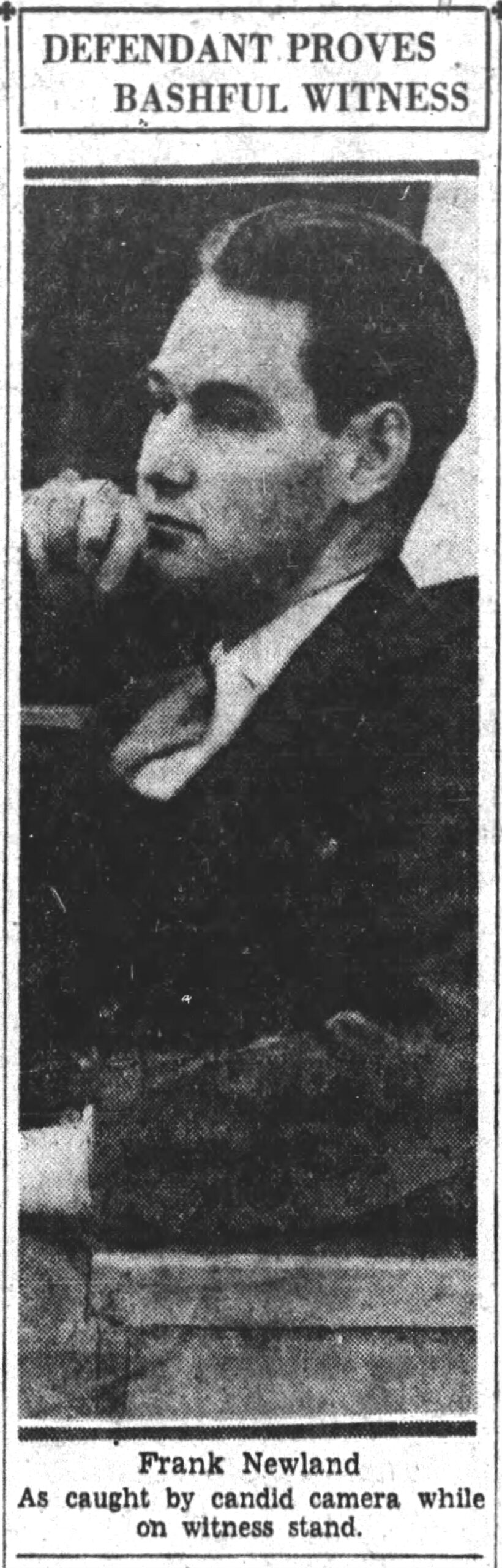
Frank takes the stand in his own defense and relates a self-serving account of the crime.
“When she told me she was going to my wife, little baby and my parents, and tell them I was responsible for her condition, well, I just flew off the handle, picked up a stick, hit her three or four times over the head, struck her on the jaw with my fist and left her there.”
The railroad tie he used to batter Lois is hardly “a stick”, and when he says he “left her there” he neglects to say he threw her into an abandoned well and expected her to die.
Wolch kept the kid gloves on during his examination of his client. Frank said he met Lois and Ione at about the same time. Lois lived in Pomona, and Ione in Glendora. He saw each of them about twice a week.
“What was your feeling for both Ione and Lois?
“I cared for Ione very much. I liked Lois, too. In September I made up my mind. I loved Ione…, so we went to Las Vegas and got married. We came home that night to my folks and the next day I took her to Glendora.”
Wolch asks Frank when he next meets with Lois. Frank says, “The following night.”
He describes Lois’ reaction to his marriage.
“Lois was heartbroken and deeply moved over my marriage to Ione. She asked me to get a divorce.”
Frank chuckles, then continues.
“Already she wanted me to get a divorce and marry her. I told her I couldn’t even think of it.”
Frank refuses to consider divorcing Ione; however, he continues to see Lois. They meet frequently from the time of his marriage until December, when they get together only once.
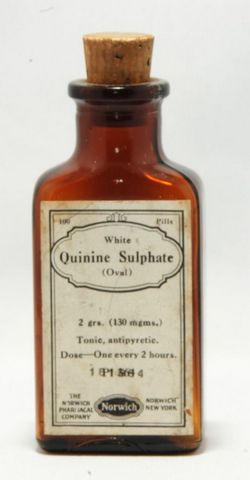
When they resume their affair in January, Lois asks Frank to get her some quinine. Quinine in large doses may induce an abortion, but it is not a sure thing. A pregnant woman who takes quinine risks renal failure. Babies who survive quinine exposure in the womb can be born deaf or suffer other side-effects. Both mother and child can die because of taking quinine.
Frank blew off Lois’ request to get the abortifacient, claiming he does not know what she wants with the over-the-counter drug.
According to Frank, Lois asked for quinine again in early February. This time he asked her why.
“I asked her what she wanted it for and she said she was expecting a baby, ad something had to be done. I said I was sorry and asked her who was responsible, and she didn’t answer. Again, she asked me to divorce Ione and marry her, and again I told her I wouldn’t consider it.”
Frank describes his March 4th meeting with Lois.
“I met her on March 4, about 6:30 p.m. We drove around a bit. I told her I couldn’t get a doctor. Finally, we parked the car on the outskirts of Pomona. She said she was going to blame me. Something had to be done or she would make trouble. I loved my wife very much, and the baby had just come. I had entirely overcome the conflict of the earlier months. I loved Ione, not Lois.”
When testimony concluded in early May, the jury faced conflicting versions of the March 4 attack.
Lois’ version, corroborated by her injuries, is gut-wrenching. The prosecution calls the attack “deliberate and brutal.”
Frank’s defense portrays Lois as a scheming home wrecker—no better than she ought to be.
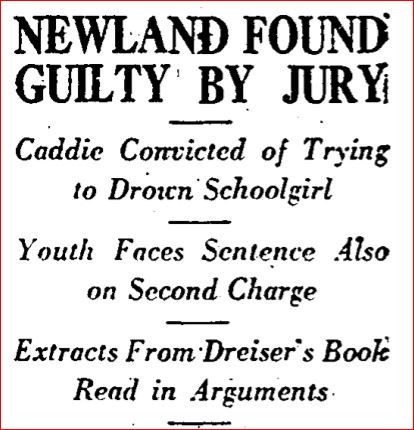
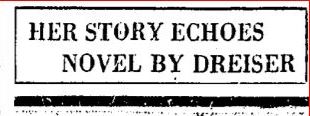
In the last hours of the trial, Deputy District Attorney Cooper points out parallels between the case against Frank and the incidents in Theodore Dreiser’s novel, An American Tragedy. Cooper reads extracts from the book.
The jury finds Frank guilty of attempted murder and statutory rape.
Before passing sentence, Judge Bowron has a few words for Frank:
“You are fortunate in that you are not here for the purpose of receiving the extreme penalty. The evidence and circumstances show that you planned to do away with Lois Wade because she was about to become a mother.”
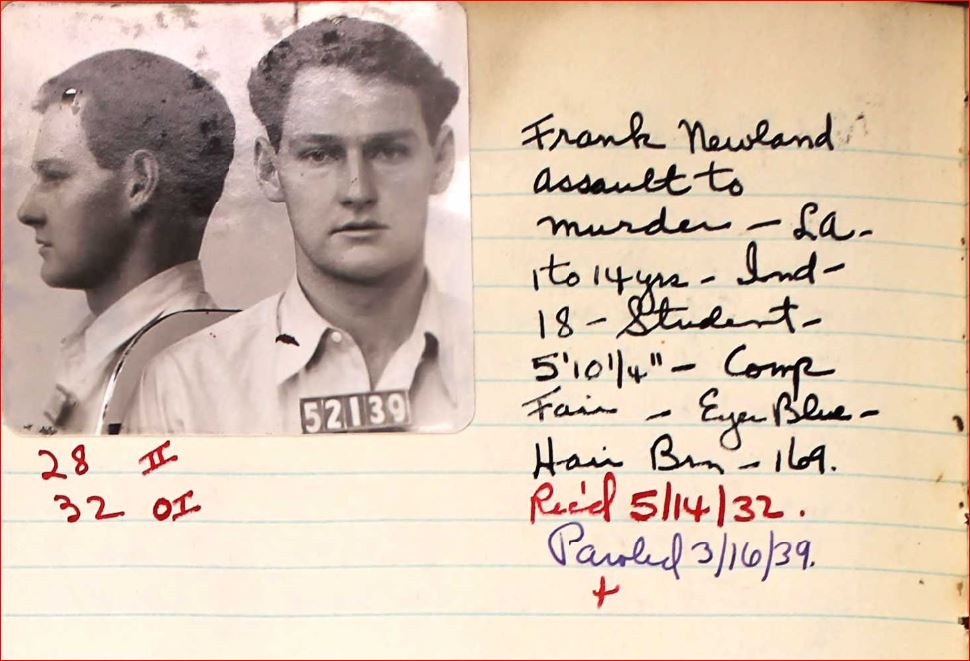
Frank gets one to fourteen years in prison.
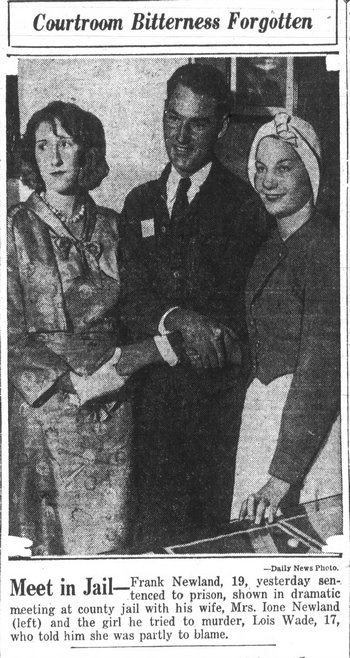
In a strange twist, probably orchestrated by a quick thinking reporter or a newspaper city editor, Frank, Ione, and Lois meet in jail a few hours before the prison train leaves for San Quentin. A photo shows the threesome holding hands and, supposedly, putting the past behind them.
Edgar Allan Poe’s The Mystery of Marie Roget, is cited as the first murder mystery based on details of an actual crime. I am skeptical of firsts, but if Poe’s story is not the first, it is an early entry. It appeared in Snowden’s Ladies’ Companion in three installments, November and December 1842 and February 1843.
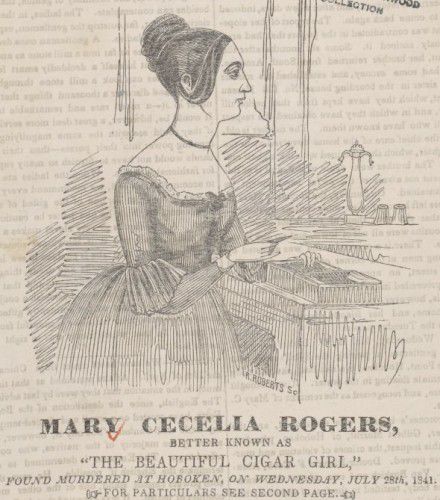
Behind Poe’s tale of Marie Roget is the murder of Mary Cecilia Rogers.
Rogers, a tobacco shop employee, became known as the Beautiful Cigar Girl. She disappears on October 4, 1848, and local papers report her elopement with a naval officer. She returns later, sans husband.
She disappears again on July 25, 1841. Friends see her at the corner of Theatre Alley, where she meets a man. They walk off together toward Barclay Street, ostensibly for an excursion to Hoboken.
Three days later, H.G. Luther and two other men in a sailboat pass by Sybil’s Cave near Castle Point, Hoboken. Floating in the water they see the body of a young woman. They drag it to shore and contact police.
According to the New York Tribune, Rogers is “horribly outraged and murdered”. Questions regarding Rogers’ death remain. It is alleged she ended up in the river following a failed abortion. The scenario is credible, in part, because her boyfriend committed suicide and left a note suggesting his involvement in her death.
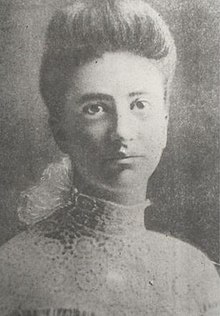
GRACE BROWN
I love it when a novel is based on a true crime. One of my favorites is An American Tragedy by Theodore Dreiser. Dreiser draws inspiration from a murder in the Adirondacks.
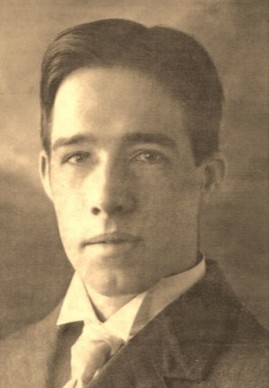
In 1905, Chester Gillette takes a job as a manager in an uncle’s skirt factory in Cortland, New York. It is there he meets factory worker, Grace Brown. They begin an affair and she becomes pregnant.
Chester is neither interested in being a husband, nor in being a father. He takes Grace on a trip to the Adirondack Mountains in upstate New York. Using the alias, Carl Graham, Chester rents a hotel room, and a rowboat.
Grace believes the hotel is where they will spend their honeymoon following a visit to the local justice of the peace. In anticipation of her new life with Chester, Grace packs all of her belongings in a single suitcase.
Chester’s suitcase is small. He is not beginning a life with Grace.
On July 11, the couple takes a rowboat out into the middle of Big Moose Lake. There is no marriage proposal. No wedding ring. He beats her over the head with his tennis racquet and pushes her overboard to drown.
On July 13, 1906, The Sun reports the tragic drowning of a couple in Big Moose Lake. Grace’s body floats to the surface the next day. The body of her companion, Carl Graham, is missing.
Fearing he is dead, police search for Carl. They soon learn the true identity of Grace’s companion. He is alive, well, and his name is not Carl. Police arrest Chester. He denies responsibility for Grace’s death. He insists she committed suicide. The bad news for Chester is none of the physical evidence supports his version of events.
CHESTER GILLETTE
The jury shows no mercy—they find him guilty and sentence him to death.
On March 30, 1908, they execute Chester in the electric chair at Auburn Prison in Auburn, New York.
LOIS WADE
March 4, 1932.
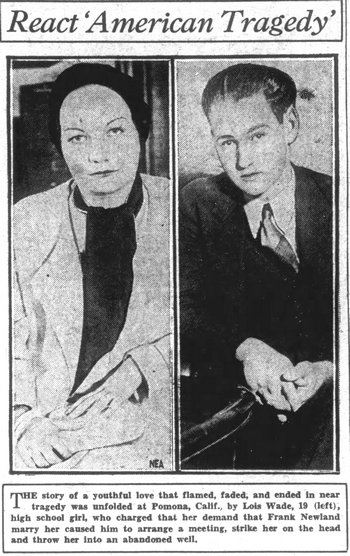
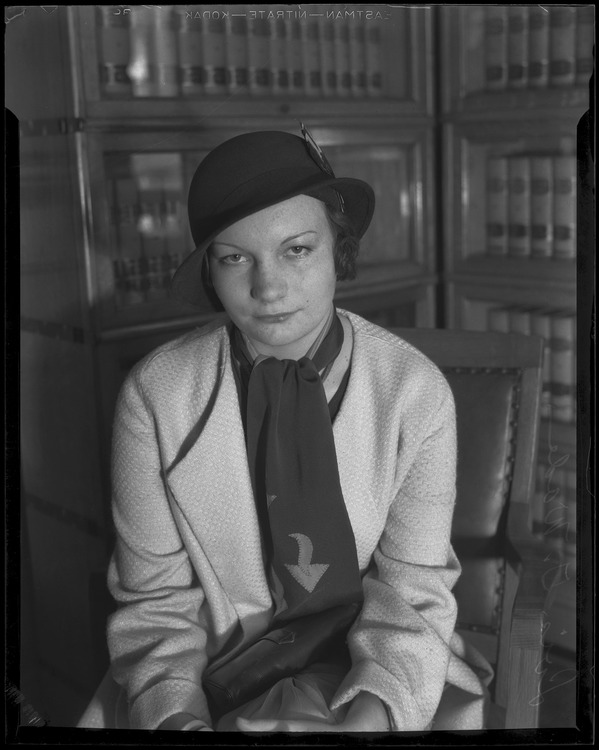
Soaked to the skin, bleeding from the head, and covered in bruises, seventeen-year-old Lois Wade stumbles into the road near Mountain Meadows Country Club in Pomona. A Good Samaritan takes her to Pomona Valley Hospital.
The hospital calls the Sheriff’s department, and deputies arrive to take Lois’ statement. She tells them a terrifying story.
She is is walking from downtown Pomona to her parent’s home at 349 East Pasadena Avenue, when a stranger pulls up alongside her and offers her a ride. She accepts, but rather than taking her home, the man stops his car on Walnut Avenue near an abandoned well and beats her.
Lois’ attacker forces her into the well and shoves her down witht a pole when she attempts to climb out. When Lois vanishes from his view, the man gets in his car and drives away.
The motiveless attack makes little sense, and deputies question Lois’ account. The next day, she revises her story.
Her attacker is not a stranger as she originally claims; he is her nineteen-year-old married lover, Frank Newland.
Deputies Killion and Lynch arrest Frank at his home at 918 South San Antonio Street, Pomona. They book him on a charge of assault with intent to commit murder. Frank denies the attack.
As Lois lay in serious condition in the hospital, the D.A. revises charges against him to include statutory rape. Because of the severity of Lois’ wounds and her inability to appear in court, Judge White resumes Frank’s hearing at Lois’ hospital bedside.
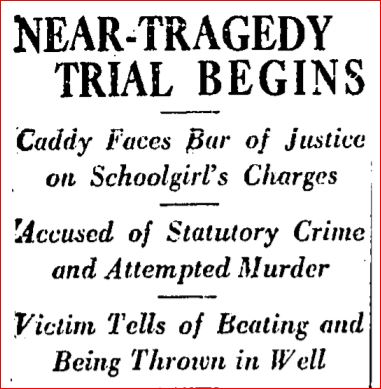
Within a month of the attempt on Lois’ life, Frank goes to trial. Local newspapers pick up on the similarities between Frank and Lois and the characters in Theodore Dreiser’s An American Tragedy.
Future Los Angeles mayor, Fletcher Bowron, sits on the bench. Public interest in the trial is high and draws an enormous crowd—the largest since the 1929 rape trial of theater mogul Alexander Pantages.
The trial begins on April 28; Lois takes the stand, and the courtroom hangs on her every word.
LOIS WADE
Lois is low-key and demure as she testifies to her ordeal.
“By prearrangement we met on a corner in Pomona. We went in his roadster to the Mountain Meadows Country Club, where he drove off the road and stopped the car. We sat in the car for a half-hour; yes, we kissed and loved. He then suggested that we walk over to an old windmill and abandoned well nearby.”
“We looked in the well and then suddenly he turned around and struck me over the head with a club. I fell to the ground. He struck me eight or ten times more and kicked me several times.”
Frank grabs Lois by the feet and drags her, struggling and screaming ten feet to the well. No match for Frank, he overpowers her and throws her in the well.
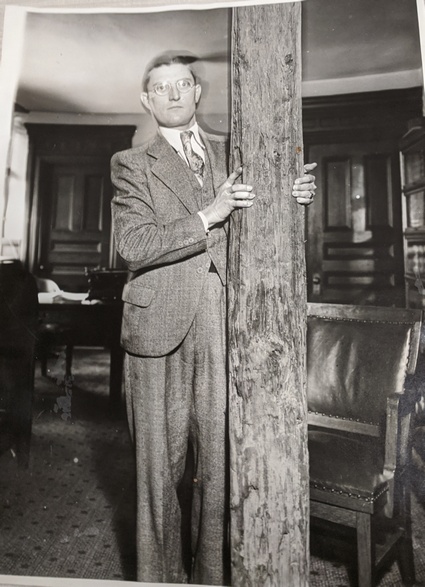
Lois lands in twenty-five-feet of water. She bobs to the top, and fights for her life. Frank uses a railroad tie to shove Lois under water. A photo of Deputy W.L. Killon, puts the size of the weapon into perspective.
DEPUTY KILLION POSES WITH RAILROAD TIE USED TO BATTER LOIS WADE
Convinced Lois is dead, Frank gets into his car and drives away.
Lois claws herself up the wall of the well. She crawls over the edge, tumbles onto the ground, then rises and lurches into the street to summon help. A man stops his car to render aid. Amazingly, Lois’ Good Samaritan is a doctor.
Dr. Roy E. St. Clair testifies to finding Lois in the road.
“I was driving to Pomona on the Mountain Meadows Road about 8:30 p.m. last March 4 when I heard a cry and the lights on my car picked up the figure of Miss Wade standing with her right arm out-stretched. I backed up my machine, and she came to the door and said ‘Take me to a doctor.’”
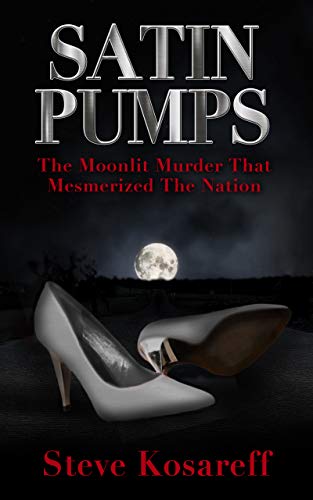
In Satin Pumps: The Moonlit Murder that Mesmerized the Nation (WildBlue Press, $13.49), screenwriter and author Steve Kosareff offers a unique perspective on one of Southern California’s most riveting domestic murders.
Mid-century is at its zenith in 1959. The era is a pink and turquoise mix of future and past as decades old orange groves and strawberry fields give way to miles of modern tract homes in newly minted suburbs. The rows of cloned houses are an artifact of the explosion of growth in the area following WWII. During the summer, the neighborhoods smell like pool chlorine, backyard barbeques and Coppertone suntan lotion.
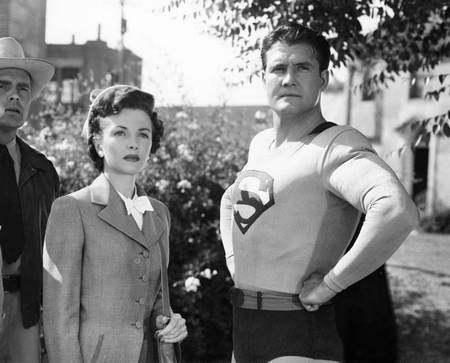
The reported suicide of television star George Reeves, known for his role as Superman, by gunshot, on June 16, 1959, obsesses his young admirers. Kids deal with the untimely passing of their superhero by making tasteless jokes to hide their discomfort. The following month, on July 18, the kids’ parents become obsessed with a different gunshot tragedy, the murder of thirty-six-year-old Barbara.
Phyllis Coates and George Reeves
Barbara and her husband, Bernard “Bernie” Finch, live the Southern California dream. He is a successful surgeon, who delivered author Kosareff, and he and Barbara and their son, live in a custom-built home on a hill in the San Gabriel Valley.
Handsome, in a sun-tanned country club way, Bernie is the son of local gentry. He is a spoiled child, an entitled adult and not a fan of sharing. If he and Barbara get a divorce, he can kiss a pot of money goodbye. He will pay alimony and child support. Rather than go through with a messy and costly divorce, Bernie concocts a plan.
Bernie’s desire to be single is motivated by his desire for his latest lover, his secretary, twenty-two-year-old Carole Tregoff. Being with the stunning redhead is all Bernie can think of.
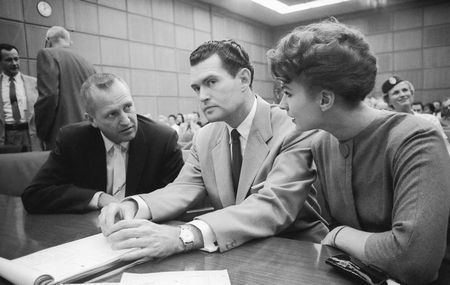
Carole Tregoff (r.) and Dr. Bernard Finch (c.) talk in the courtroom as Carole’s lawyer, Rexford D. Eagan (l.), listens in. Finch and his girlfriend, Carole, were on trial for the murder of the doctor’s wife, Barbara Finch, who was shot to death on July 18, 1959. (Bettmann / Bettmann Archive)
The problem for Bernie is he is a surgeon, not a career criminal. His plan is clumsy, cruel, and dissolves under police scrutiny.
Satin Pumps tracks the byzantine course of the case through three trials. The story has enough sexual tension to cause Grace Metalious’ 1956 novel, Peyton Place, to spontaneously combust. The trial is as mesmerizing as Kosareff’s title declares. Courtroom seats are filled by journalist Dorothy Kilgallen, British spy novelist Eric Ambler, and writers for the Perry Mason television series.
Like Kosareff, I, too, grew up in Southern California, so getting his take on the case, first through his 7-year-old eyes, and later through his adult research, is a treat. I recommend the book. Enjoy.
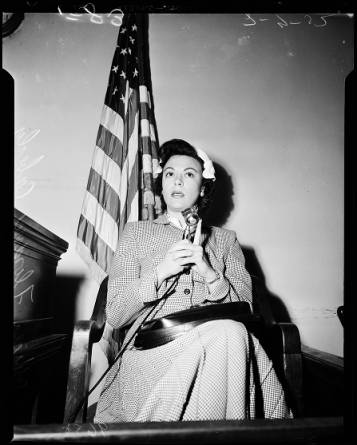
Florence Coberly testifies at the Parra inquest. (Photo courtesy USC Digital Archive)
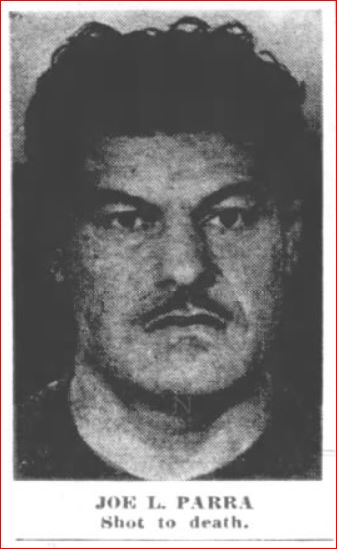
In 1952, LAPD Policewoman Florence Coberly had a bright future in law enforcement. She helped take down a career sex criminal, Joe Parra, in a treacherous sting operation.
Florence stayed tough during the inquest following Parra’s shooting—even when his brother Ysmael shouted and lunged at photographers. She appeared on television and received honors at awards banquets all over town.
After three years of marriage, she divorced her husband Frank in 1955. We’ve heard countless times how tough it is to be a cop’s wife, but I imagine being the husband of a cop is not any easier. The unpredictable hours and the danger can be enough to send any spouse out the door forever.
We don’t really know what caused the Coberly’s marriage to dissolve. The divorce notice appeared in the June 29, 1955 edition of the L.A. Times, but it was legal information only and gave no hint of the personal issues which may have caused the couple to break up.
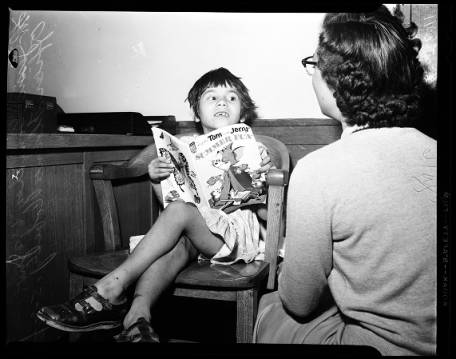
Florence with her back to the camera, befriends a lost girl c. 1954 [Photo courtesy of USC Digital Archive]
With no further mention of Florence in the Times for several years, we can assume that her career was on track. Then, nearly six years after the Parra incident, on July 2, 1958, the Times ran a piece buried in the back pages of the “B” section under the headline: Policewoman’s Mother Convicted of Shoplifting.
A jury of eleven women and one man found Mrs. Gertrude Klearman, Florence’s fifty-three-year-old mother, guilty of shoplifting. It is embarrassing to have your mom convicted of shoplifting, and it is worse if you are in law enforcement. But it is orders of magnitude more humiliating if you are a police officer busted WITH your mother for shoplifting.
According to George Sellinger, an off-duty police officer working as a store detective to supplement his income, Florence and her mother stole two packages of knockwurst, a can of coffee, a package of wieners and an avocado–$2.22 worth of merchandise. The accusation could destroy Florence’s career.
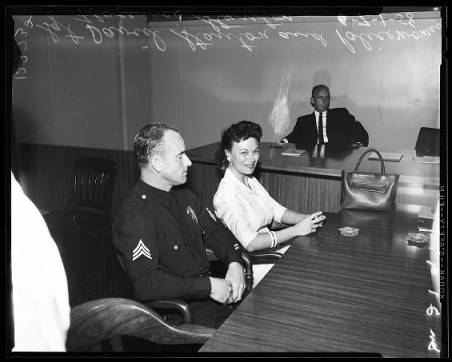
Florence seated next to her husband, Sgt. Dave Stanton. [Photo courtesy USC Digital Archive]
At her misdemeanor trial Florence’s attorney, Frank Rothman, vigorously questioned Sellinger and got him to admit that he had not actually seen Florence stuff the food items into her purse. He pressured her to submit to a search outside the grocery store based on the scant evidence seeing her with packages in her hand. Rothman made the case for illegal search and Florence got off on the technicality.
LAPD in the late 1950s was touchy about any hint of scandal or misbehavior by its officers. During the decades prior to William H. Parker’s ascension to Chief, the institution watched as some of their number went to prison for graft and corruption.
While a package of knockwurst hardly rises to the standard of unacceptable behavior that had plagued LAPD earlier, just being arrested was enough to get Florence suspended from duty pending a Police Board of Rights hearing.
It couldn’t have been easy for Florence to sit on the sidelines and await the decision. Law enforcement wasn’t a 9-5 job for her, it was a career and one for which she had displayed an aptitude.
While Florence waited on tenterhooks for the Board of Rights hearing, her mother received either forty days in jail or a $200 fine (she paid the fine).
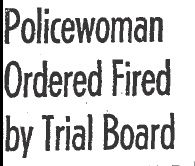
Florence’s hearing began on July 22, 1958, before a board composed of Thad Brown, chief of detectives, and Capts. John Smyre and Chester Welch. Even though a civilian court of law exonerated Florence, the board found her guilty and ordered her dismissed from LAPD.
Florence at the police board hearing. (Photo courtesy USC digital archive)
It was an ignominious end to a promising career, and I can’t help but wonder if there was more to Florence’s dismissal from the police force than the shoplifting charge.
In February 1959, Florence sued in superior court, seeking to be reinstated. She directed her complaint against Chief Parker and the Board of Rights Commission.
Florence denied her guilt in the shoplifting charge. She contended that the evidence applied only to her mother.
It took several months, but in July 1959 Superior Court Judge Ellsworth Meyer sided with the LAPD and refused to compel Chief Parker to reinstate Florence.
I salute Florence for her no-holds-barred, kick-ass entry into policing in 1952; and I would be remiss if I didn’t mention one last time that fantastic bandolier that dangled from her belt. I maintain my position that women police officers know how to accessorize.
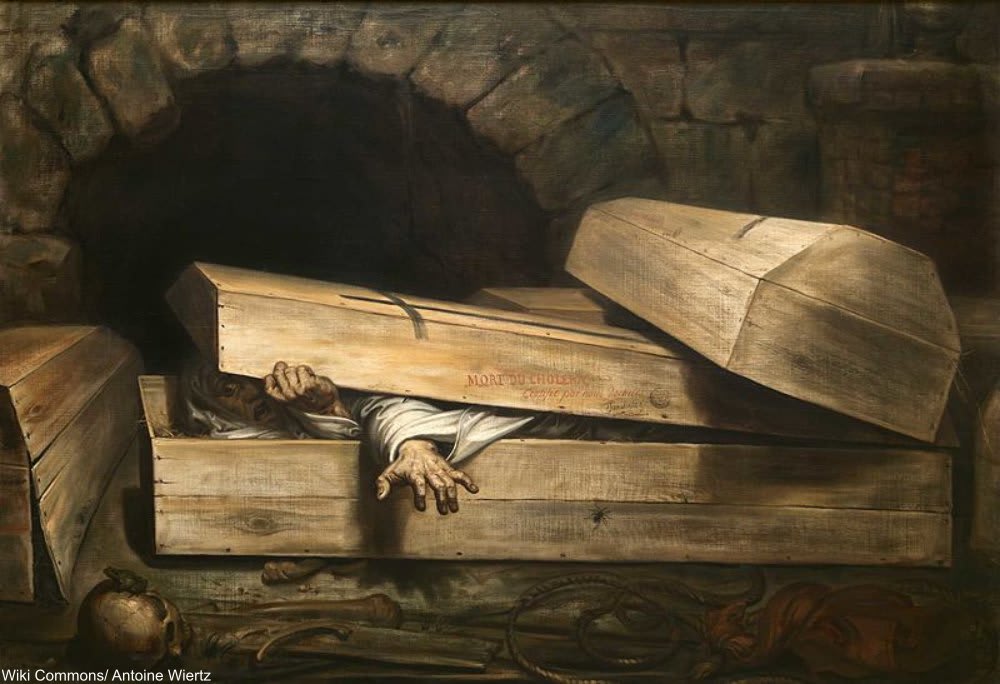
The following tale is especially terrifying for me. Maybe it was my childhood reading of the Edgar Allan Poe story, The Premature Burial, that has given me an absolute terror of being buried alive. Maybe I had a previous life in Victorian England where their fears of being buried alive reached hysterical levels.
Assuming I predecease him, I’ve instructed my husband to allow me ripen before disposing of my body. Seriously. I know that of the fates likely to befall me, premature burial is way down on the list. This is one of those fears that resists common sense.
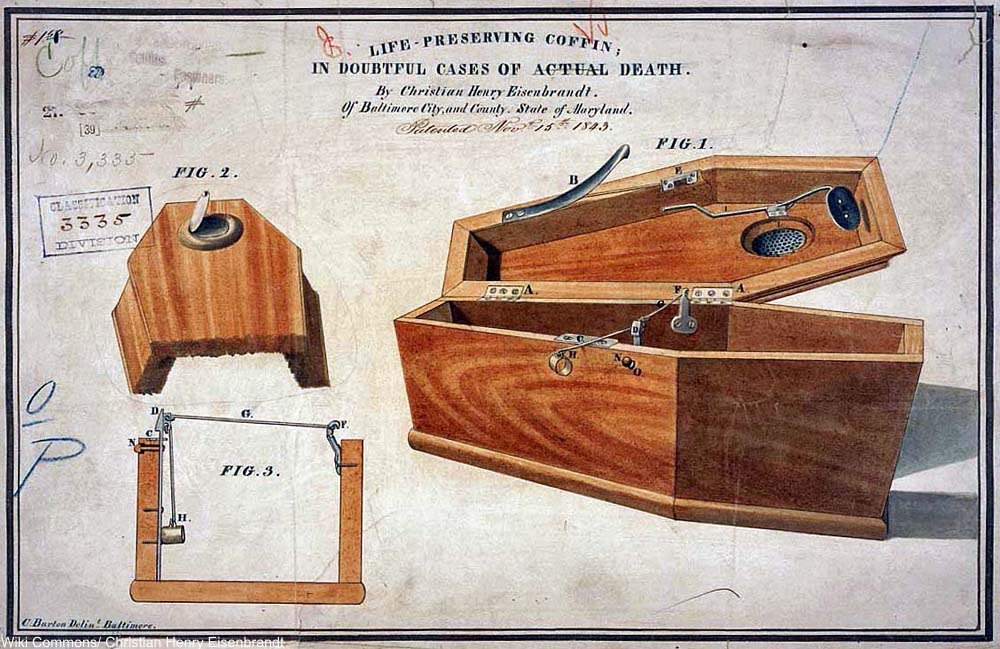
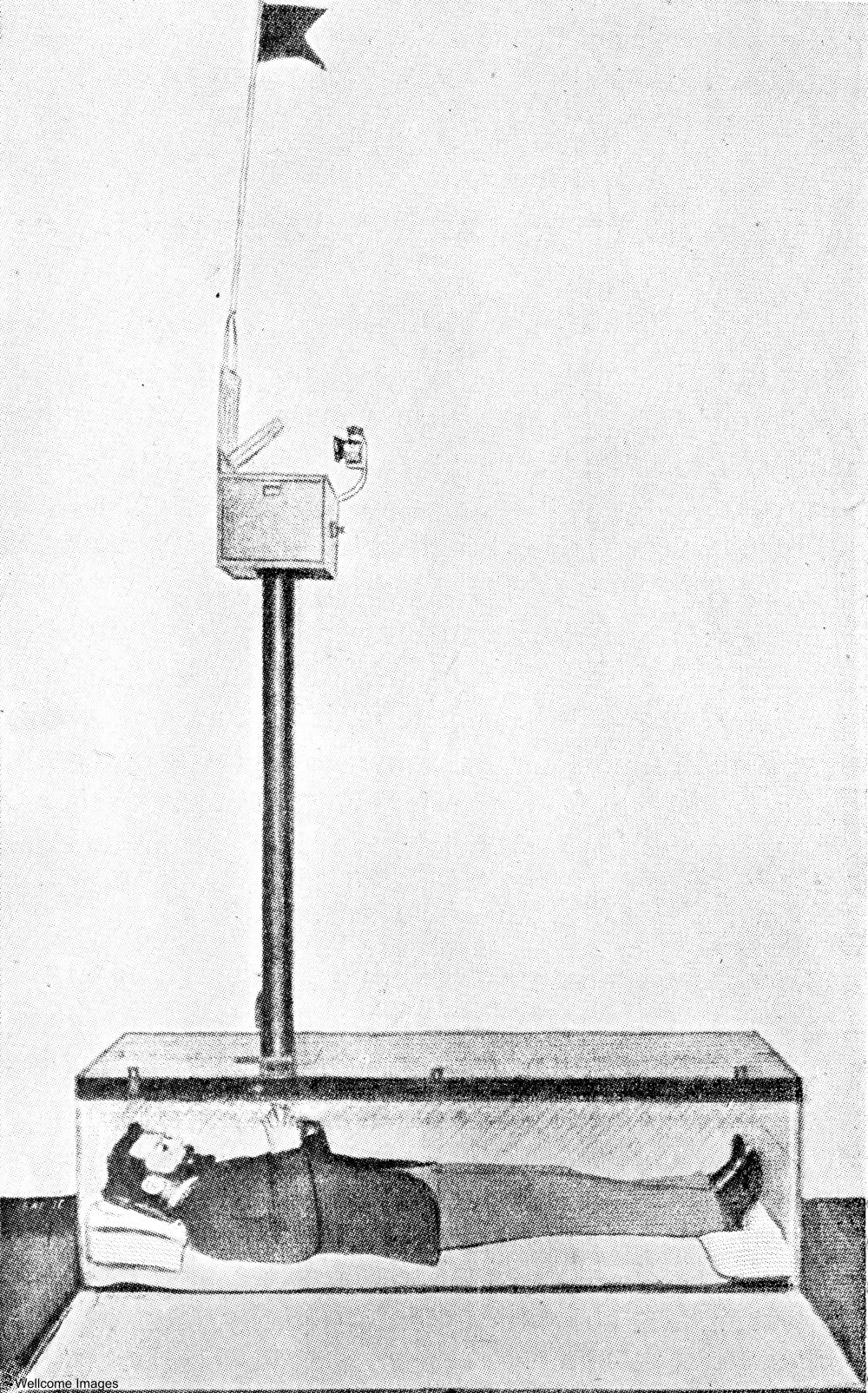
I know I’m not alone because clever Victorians devised various methods to avoid premature burial, like the safety coffin. No. I am not making this up.
Some coffins, like the one below, allowed the incarcerated victim to wave a flag, ring a bell, and to speak through a tube that reached to the surface to let passersby know someone alive was inside. In fact, such a coffin may be the origin of the saying, “saved by the bell.”
Enough about my personal fears—and forgive my digression. Let’s get to the story of Marie Billings who faced my biggest terror and lived to talk about it.
Late in the afternoon of May 9, 1928, Marie Billings answered a knock on her front door. A man stood waiting for her. He was tall, about 6’ 4”, and wore a dark suit with a grey pinstripe. He said he was a real estate salesman and interested in purchasing the home she shared with her husband, Howard, a local manufacturer.
Marie and Howard didn’t plan to sell their home at 5911 Allston Street in Montebello. Even so, she figured that there was no harm in listening to the salesman’s pitch. The two began a conversation and he followed her in to the house.
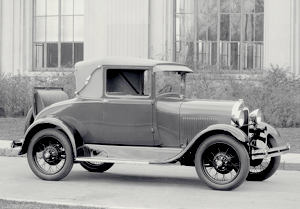
Without warning he slugged her over the head with a club he must have had concealed. Marie struggled in vain. Her attacker ripped her clothing and bound her with an electrical cord. Rendered helpless, she felt a silk stocking wind around her throat as the man choked her into unconsciousness. The stocking was removed from her neck and used to gag her. She was wrapped in a blanket and carried to his car, a Ford coupe.
1928 Ford coupe
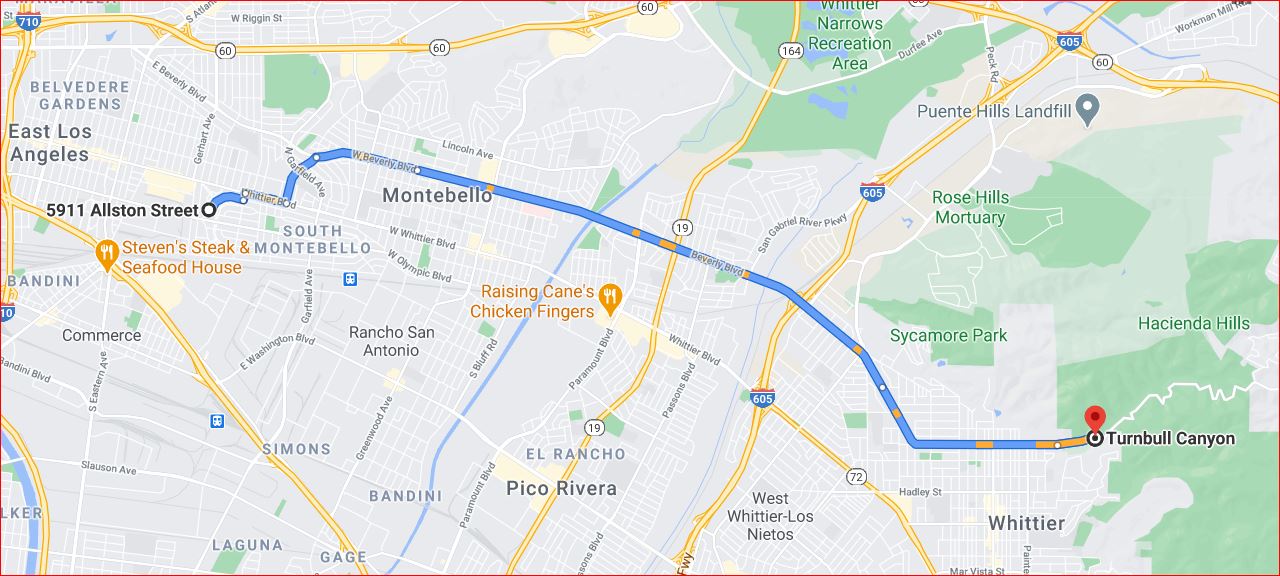
He drove her about eight miles to Turnbull Canyon in Whittier. Marie lay unmoving in the dirt. The man bent down and felt her pulse. She was still alive, so he beat her with an iron bar to finish her off.
Satisfied that she was dead, he covered her with dirt, brush, and leaves. He drove away.
Map of route from Marie’s home to Turnbull Canyon
Marie awoke and realized she was in a grave. HER grave. She resisted the urge to scream. Unable to breathe, she fought her way to the surface. She had just enough strength to free herself.
Badly beaten, Marie crawled two hundred yards to a nearby road. In her arms she carried the bloody blanket in which she was wrapped by her kidnapper. Her restraints trailed behind her.
She reached the road and flagged down a car driven by by W. J. Collins, a taxi driver. Collins drove her to the Murphy Memorial Hospital in Whittier.
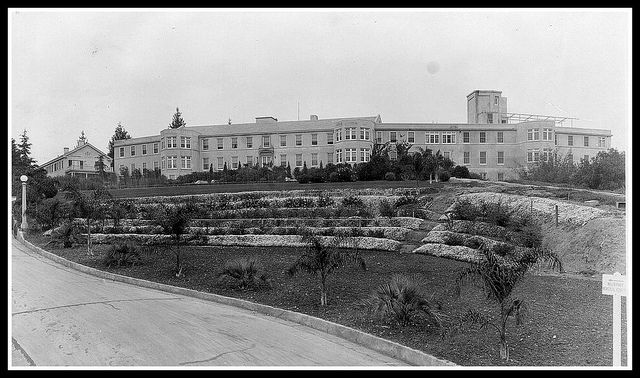
Murphy Memorial Hospital
Medical staff phoned the Los Angeles County Sheriff’s Department.
Under the direction of Captain William Bright, an investigation into Marie’s assault and attempted murder began.
Marie recovered enough to be interviewed by detectives. She gave a chilling account of her battering at the hands of a man she said seemed familiar. He was the same real estate agent who visited her home a year earlier.
Claude Peters of the homicide squad interviewed Mrs. Robert D. Ellis, who lived within a block of the Billings home. Based on Marie’s description of her attacker, Mrs. Ellis thought she recalled seeing him. She said, “I saw a man leaving the Billings house two or three days before the attack. He was carrying a large package and got into a Ford coupe and drove away.”
Based on the scant evidence they possessed, the sheriff’s department introduced an interesting theory of the crime that included a second suspect. They suggested that two accomplices battled to the death over Marie’s $500 diamond ring.
Alternatively, a second man may have witnessed the crime and attempted a rescue, which ended in his own death and burial.
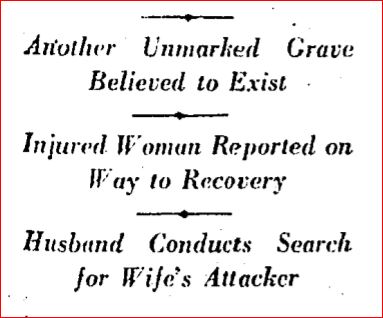
Howard, Marie’s husband, began his own investigation. He visited the makeshift grave and found a piece of torn clothing with a powder-burned bullet hole. He delivered the potential evidence to Captain Bright.
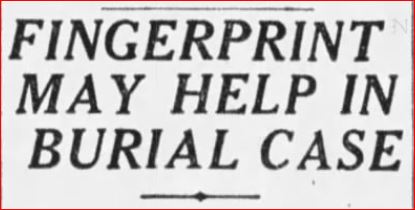
In a search of the Billings home, deputies found a length of pipe with one clear fingerprint on it. They hoped that it would lead them to a suspect—it did not. Tantalizing bits of evidence that led nowhere.
The case went cold. Detectives never found a second grave, and the identify of Marie’s attacker stayed a mystery.
This is one of those cases that will remain an itch I can’t scratch. I can only imagine how much it bothered the investigators who worked it at the time.
The man who attacked Marie was a sadistic monster. Did he commit other crimes? We will never know.