A Thanksgiving Eve Date with the Gas Chamber, Conclusion

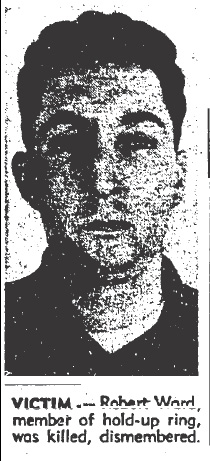
DITSON_WARDAfter shooting Bob Ward to death with a .38, Allen Ditson had to figure out what to do with the body. At least Carlos Cisneros was there to help him. Carlos began to dig a grave with his bare hands until Allen brought him a butcher knife from the car. Once the grave was ready Allen said that they would have to dismember Bob to prevent identification if someone should discover his remains. Using the butcher knife they removed Bob’s head and each arm at the elbow. They buried the remains and then tossed the head and arms into the truck of the car and drove back Allen’s store.

While Allen and Carlos were coping with the dead body, Keith Slaten turned up at the house of his friend Martha Hughes. He told her that he’d been in a fight and wanted to clean up his car. He was covered with blood and shaking like a leaf and Martha told him she didn’t believe he’d been in a fight.  He blurted out: “Well, God damn. All right, so we killed him.” Allen couldn’t keep his mouth shut either. The day after Bob’s murder he told Eugene Bridgeford everything that had happened after he pleaded illness and left.

What happened to Bob’s head and arms? Allen and Carlos took them to the home of Christine Longbrake a few days after the murder. Christine was an acquaintance of Allen’s and a couple of weeks before the crime she’d been in Allen’s shop and he’d told her that “there was someone they had to get rid of” because the man was trying to blackmail him.  Allen asked to use her garage as a place to get rid of the guy but she thought he was kidding. When Allen and Carlos turned up with two boxes Christine knew she couldn’t refuse any request they made. She stayed upstairs while the boxes were taken to the cellar. Allen knocked Bob’s teeth out with a hammer then placed what was left of him in the hole and then poured in a bottle of acid.  When the men came back upstairs Christine smiled nervously and said: “Is it somebody I know?” They smiled back and Allen said that she wouldn’t know him. Then he and Carlos drove out to Hansen Dam and tossed Bob’s teeth and dental plate into a gravel pit.DITSON_PIC
Christine hadn’t seen the last of Allen and Carlos. Not more than a few days after they’d buried the boxes in her cellar Carlos stopped by and told her everything. He even told her what was in the boxes underneath her house. Her nerves weren’t soothed when he told her that he could never kill a woman. In fact she was so unnerved that she told Allen she was going to move “…because I couldn’t stand living in this house …” Allen told her that if it bothered her so much he’d pay her rent if she’d just hang on a bit longer.

A bit longer turned out to be several months. In June 1960 Allen asked George Longbrake, Christine’s brother-in-law, if he would dig up the two arms and head under the house. George agreed and Allen bought him some aluminum foil so he could wrap up the bits of Bob that remained. Then, since it seemed the entire Longbrake family was involved anyway, Allen asked Wynston Longbrake, Christine’s husband, if he’d “help bury something.” Allen, Carlos, and Wynston drove from L.A. on Highway 99 to a place about 14 miles from Castaic Junction. He turned off the highway for about 100 yards. Carlos waited in the car while the other two carried the macabre foil wrapped packages out of sight, then dug a post-hole and buried them.
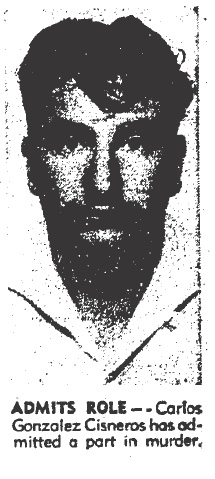
DITSON_CARLOSBecause Allen and Carlos were incapable of keeping quiet about what they’d done it was only a matter of time before the law caught up with them. The remaining gang members began to fear Allen more than they did the cops. On June 17, 1960 Keith Slaten went to the police and a few days later Eugene Bridgeford did the same. The statements were enough for the police to get a warrant to examine Carlos’ Cadillac–they found traces of human blood in the trunk. One day later the police conducted a similar examination of Keith’s Ford and found human blood on the upholstery. On June 28, “sometime after 1:00 p.m.” Allen and Carlos were taken into custody.

Allen maintained his innocence, but Carlos appeared to be genuinely remorseful and he wanted to talk. In his 1959 book, The Compulsion to Confess, Theodore Reik said “There is … an impulse growing more and more intense suddenly to cry out his secret in the street before all people, or in milder cases, to confide it at least to one person, to free himself from the terrible burden. The work of confession is thus that emotional process in which the social and psychological significance of the crime becomes preconscious and in which all powers that resist the compulsion to confess are conquered.”DITSON_HEADLINE1
Allen’s protestations of innocence didn’t sway the jury of five men and seven women.  He was found guilty and sentenced to death. Carlos was also found guilty in Bob’s murder and sentenced to death. In early November 1962, with their executions imminent, Governor Brown presided over a clemency hearing. Carlos’ remorse saved him. His sentence was commuted to life.

Allen never admitted his guilt to the police, but he did confess to nearly everyone else he knew. On November 21, 1962, without requesting a special holiday meal, Allen kept his Thanksgiving Eve date with the gas chamber.
A Thanksgiving Eve Date with the Gas Chamber

November 20,1962. Thanksgiving was two days away, but 41-year-old Allen Ditson wasn’t looking forward to it. He wouldn’t spend the day gnawing on a turkey drumstick or fighting with a cousin to claim the last slice of pumpkin pie. In fact Allen wouldn’t have the classic holiday dinner at all, unless he requested it for his last meal. If Governor Brown didn’t commute his death sentence, like he had done for Allen’s pal Carlos Cisneros, he would be executed in San Quentin’s gas chamber on Thanksgiving Eve.

*  *  *

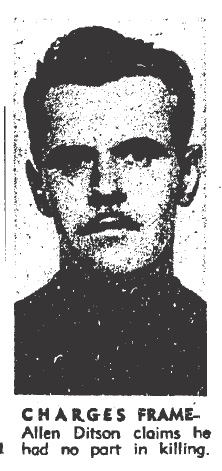
DITSON_HEADLINE1In 1959 Allen owned a small jewelry and watch repair shop at 7715 Hollywood Way in the San Fernando Valley. The former Kansas farm boy was the father of two, a WWII veteran and former pilot who had spent five years in uniform before being honorably discharged. When he was mustered out of the service he took courses in watch and jewelry repair then opened his own business. He worked long hours and he continued to take classes related to his trade. The time he spent away from home was hard on his marriage; so hard in fact that he and his wife separated. Even though they no longer lived together he saw his children “at least twice a week” and contributed to their support. His mother-in-law said “he’s been good to all of us.”
On the surface Allen’s life appeared completely normal, but it wasn’t. The seemingly average businessman had a secret, he was the mastermind of a gang of violent armed robbers. Under his direction the gang of about 15 men had netted an estimated $150,000 (equivalent to approximately $1.2 in current dollars) between January and October of 1959.

Like most gang leaders Allen had a lieutenant, his name was Carlos Gonzales Cisneros. According to court records Carlos lost his mother to tuberculosis and spent most of his infancy and childhood in foundling homes. He left school in 1950 when he was 17. He married, had four kids and worked at Lockheed as a sheet metal worker. He was 24-years-old and working the swing shift as a sheet metal worker at Lockheed when he met Allen. Allen was already running a gang and he slowly brought Carlos in. He began by telling the young man that “it would be nice to see him driving a Cadillac.” Eventually Carolos owned two Cadillacs.

Allen used skills he’d learned in the military to operate the gang. He was adamant that each member carry out his “assignment” with precision. If things went sideways and a gang member was busted he was to keep his mouth shut. Allen would see to it that he was provided with an attorney. Allen also made it clear that the penalty for being a “squealer” or a blackmailer was death.

During September and October 1959 a series of robberies were committed by Allen and Carlos and several gang members: Robert Ward, Keith Slaten, and Eugene and Norman Bridgeford.. During a robbery in October Robert “Bob” Ward failed his assignment. He was supposed to securely bind the store owners. He tied the man tightly, but the woman was able to free herself. Once freed the man grabbed his rifle and began shooting at the fleeing robbers. As they ran Eugene pitched the stolen cash box into some shrubs in an alley. Later that night Eugene and Carlos returned to retrieve the cash box and were busted on the spot. About a week later they made bail. During a meeting with Allen, Carlos and Eugene were informed that Bob was demanding money in exchange for keeping quiet about the gang.

On November 6, 1959, Allen told Eugene that he had “decided that tonight would be the best night to get rid of Bob Ward” because he was “through being blackmailed by a no-good-son-of-a-bitch like him.” Allen had already paid Bob $100 but had no intention of giving him one dime more. Allen came up with a plan to “…get rid of him.” Allen stayed at the store and let Carlos and Eugene implement his plan to take care of Bob.

Carlos and Eugene drove to a liquor store to pick up a couple of pints of booze. They knew that Bob was a heavy drinker and thought that he would be “more amiable” with a few shots of booze in him. Then they went to the house Bob shared with fellow gang member Keith Slaten. Carlos parked the Cadillac on the street in front of the house. Keith had seen them pull up and went out to greet them.  Keith and Bob thought they were going to pull another robbery. The men piled into Keith’s Ford. Keith was behind the wheel, Bob was in the passenger seat, and Eugene and Carlos sat in the back. They spent about 45 minutes drinking. Carlos picked up a hammer from the floor of Keith’s car and brought it down on the back of Bob’s head. Bob fell against Keith and screamed: “Keith, help me. They are trying to kill me.” Keith had his own life to worry about and gave Bob a shove so he’d be an easier target for Carlos–then he ran into the house. Carlos called him back and said, “just take it easy and it’ll be all right.”

In the interim Bob had managed to get out of the car and was leaning against a tree when Carlos found him and beat him down to the ground. Carlos backed his car into the driveway and after delivering a few more blows to Bob’s head put him in the trunk of the car. Carlos and Eugene drove off and Keith followed them in the Ford. Carlos had driven about half a mile before Bob regained consciousness and started pleading from his confinement in the trunk to be released. He said he thought his eye had come out of its socket. Carlos told him to be quiet and then turned up the car radio so he wouldn’t be able to hear Bob call his name.

Now thoroughly rattled Carlos misjudged a turn, struck the curb with the front wheel of the car and blew a tire. He spotted a pay phone, gave Eugene some change and told him to call Allen and ask him to bring a spare tire and a heavy duty jack (after all it was a Cadillac with a man in the trunk). About an hour later Allen arrived with a friend of his, Leonard York. They changed the tire and then Carlos, with Bob still in the trunk, took off for the jewelry store. Eugene and Leonard rode with Allen back to the store. When they arrived they could hear unintelligible noises coming from the trunk of the Cadillac. Allen said they’d have to get rid of Bob before the neighbors heard him and called the cops. Eugene took Leonard home and then begged off the rest of the evening saying he was sick.

Allen took a .38 revolver from the store and he and Carlos drove Bob out to the Newhall Pass. Allen opened the trunk and ordered Bob to get out. Unaided, the seriously injured man got out and stood on his feet. He asked for a cigarette. Allen shot him in the chest. He fell, got up, and ran toward Carlos. As they rolled over an embankment Allen shot Bob in the back paralyzing him. Allen walked down the incline to see if Bob was finally dead. He wasn’t. He said, “Give me another one.” Allen knelt down beside him, pressed the .38 to his head and killed him.

NEXT TIME: Which will it be for Allen Ditson? A turkey dinner with more to come, or the gas chamber?

A Cell of One’s Own, Conclusion

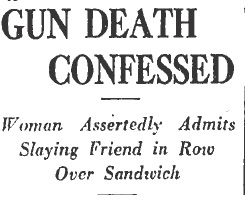
isa_confessionThe fight between Isa Lang and Edith Eufala Norwood over an avocado sandwich ended in death. Isa had grabbed a gun from her former landlady’s closet and shot her in the back of the head. Eufala died instantly.
Isa was indicted for the slaying and ordered to stand trial on March 7, 1935 in Judge Doran’s court. She entered a a double plea of not guilty and not guilty by reason of insanity; which seemed reasonable given her stated motive for the murder.

The 46-year-old former school teacher took the stand in her defense and told the jury of nine men and three woman how “Everything went black.” after she and Eufala exchanged angry words. Isa said that the quarrel escalated quickly because: “Mrs. Norwood grabbed the sandwich out of my hands and she called me names. As she ran into the kitchen with the plate I made with my own bread I ran to a closet and got the pistol.”

Aside from the harsh words, Isa’s rage was triggered because she claimed that she had used her own bread to make lunch. She didn’t reveal the source of the avocados. Isa testified that she didn’t recall pulling the trigger, but admitted that she must have done it.

Jurors learned that the two women had been friends for the several years during which Isa had been living in Eufala’s home. But their friendship ended when Isa was told to move out.

Following their deliberations the jury returned a verdict of guilty of murder in the first degree and set Isa’s punishment at life in prison. The defendant addressed the jury telling them that she was “willing to accept any punishment the law requires.”isa_convicted

The verdict and sentence ended the first phase of Isa’s trial–next the jury would have to decide if she was insane when she committed the murder.

Three alienists (psychiatrists) testified that while Isa was undoubtedly eccentric whe was not legally insane when she shot Eufala. Isa’s defense team offered their own witnesses in an effort to prove that she was not mentally responsible for the shooting. It took the jury five minutes to arrive at a decision–Isa was sane–she would serve life in the State Prison for Women at Tehachapi.

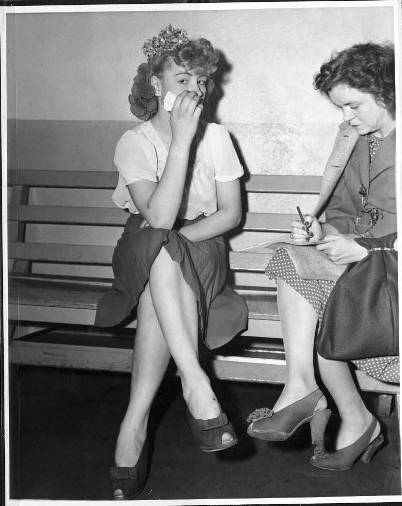
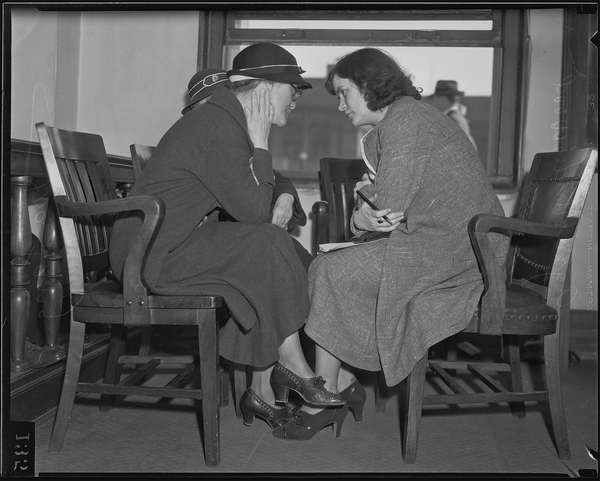
There were few high profile female killers, especially during the 1930s, who weren’t interviewed by Aggie Underwood. Aggie started working as a reporter for the Evening Herald & Express in January 1935 and, as you can see from the photo she scored an interview with Isa.

Isa Lang, convicted of murder, with reporter Agness  Underwood, Los Angeles, 1935 resize

Aggie Underwood, notebook in hand, interviews Isa Lang. [Photo courtesy of USC]

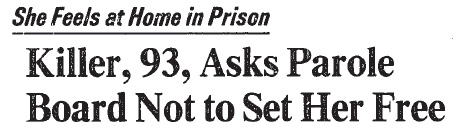
There were no further newspaper of reports on Isa until November 1976 when the Los Angeles Times did a piece on her. Isa had been a prisoner longer than any other woman in California–but that wasn’t her only claim to fame.

She was paroled in 1960 at age 71, and she told the interviewer, Charles Hillinger: “The first five years of freedom I really enjoyed. I had my own little apartment and a beautiful cat named Ginger. But the last four years were sheer hell. I became sick. I had to give up my apartment and go into a nursing home. I shared a room with five other elderly women. They were all senile. They had no idea where they were or what was going on. It was terrible. I was so lonely for all my friends in prison. I wanted to get back to prison in the worst way…”

isa_home in prisonAstonishingly, Isa was able to convince the Department of Correction that by giving up her parole and returning to prison she would be treated more humanely than she had been in the nursing home on the outside. Actually, now that I think about some of the stories I’ve read about nursing homes, maybe her request wasn’t so shocking after all.

Isa spoke with some pride of her years in prison: “I have worked at every job there is for inmates here over the years. The laundry, the kitchen, as a gardener in the yard, in the sewing room making American flags that fly over state buildings. For many years i was secretary for the superintendent. She also told Hillinger: “..I did your kind of work, too. I wrote feature stories and editorials for the Clarion, our prison paper, for 6 1/2 years.”

Isa revealed that she never married during her free years: “I’m glad for it. This is a tragic place for married women. Separated from their husbands. Their children in foster homes.”

As she got older and her health began to fail she was confined to a wheelchair, but inmates brought her gifts of rosebuds from the prison gardens–and staff members brought her flowers from their home gardens as well.

Isa wouldn’t say very much about the 1935 murder. “It was something that could happen to anyone. It was terribly foolish for me to get caught up in the situation that I did. I got stirred up. It certainly wasn’t worth it. I’ve accepted the consequences. Only God and I know what truly happened…”

Isa Lang in her 80s.

Isa Lang in her 80s.

That wasn’t the end of Isa’s story. In August 1982 the Los Angeles Times covered her again. At age 93 (she was the oldest person serving time in the state’s prison system) she was likely going to be paroled–and she wasn’t happy about it. She objected to the presence of reporters at her parole hearing, saying: “I don’t want any publicity. The last time somebody put something in the Los Angeles Times about me years ago, people started picketing for my release and even the governor got into it. I want those do-gooders to mind their own business.”

It wasn’t just reporters she objected to. She became prickly when her victim was described as having been her benefactor. “That woman was not my benefactor. I merely rented a room from her. I killed her because she called me a bastard and a harlot and I want the record straight on that.”

Robert Roos, a member of the parole board, tried to sum up the conundrum: “The questions really isn’t whether Isa Lang is suitable for parole. She is by our criterion no longer a danger to society. The real question is whether parole is suitable for her. I, for one, don’t want to impose a death sentence on this lady by forcing her out of a place she clearly considers home.”

Would Isa be evicted from prison? Yes, indeed. Her attorney, James Gunn, declared himself “flabbergasted” by the parole board’s decision. Even Los Angeles County Deputy District Attorney Charles Havens agreed: “I’m surprised at what they did. It just doesn’t seem the compassionate thing to do.” But the board decided to follow the letter of the law and using that measure Isa was released.

Columnist Patt Morrison wrote about Isa in May 1983. At age 94, the former lifer was living comfortably with a “very compatible” elderly woman–a fellow vegetarian and Seventh-day Adventist.isa_dies2

Isa Lang passed away in 1983 at age 95.

NOTE:  Again, many thanks to my friend and fellow historian Mike Fratantoni for directing me to this deranged tale.

Film Noir Friday on Saturday: Dragnet [1966]

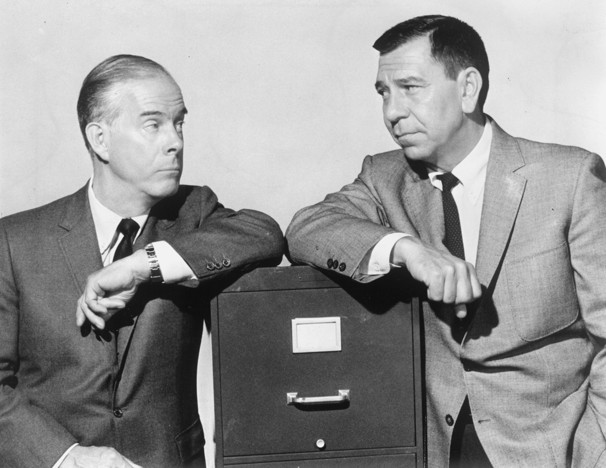
Harry-Morgan-jack-webbWelcome! The lobby of the Deranged L.A. Crimes theater is open! Grab a bucket of popcorn, some Milk Duds and a Coke and find a seat. Tonight’s feature is DRAGNET 1966, starring Jack Webb and Harry Morgan.

I’ve show this feature before but I thought that since I’m attending the JACK WEBB AWARDS event tonight it would be appropriate to show it again. I’m looking forward to the evening. It will, once again, be hosted by James Ellroy.

Dragnet 1966 is a made-for-TV movie that initiated the return of the Dragnet series to television. It was intended to be the TV pilot of Dragnet 1967 but was not aired as originally planned. It was eventually broadcast in 1969.

The Internet Movie Database says:

Sgt. Joe Friday is called back from vacation to work with his partner, Off. Bill Gannon, on a missing persons case. Two amateur female models and a young war widow have vanished, having been last seen with one J. Johnson. In the course of tracking down Johnson and the young ladies, the detectives wind up with two different descriptions of the suspect, one of which closely resembles a dead body found in a vacant lot. But the dead man, later identified as Charles LeBorg of France, proves not to be J. Johnson, when a third young model disappears.

The story is based on the Harvey Glatman case which I covered in a series of posts.

https://youtu.be/hO7oHxfw8oA

The Devil in Orange County – 2015 Update

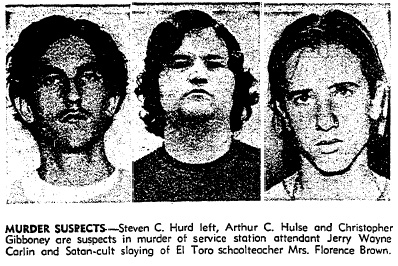
Several months ago I promised to provide an update, when I had one, on the results of a letter writing campaign asking California Governor Jerry Brown to overturn the upcoming parole of Arthur Craig Hulse for the 1970 murder of gas station attendant Jerry Wayne Carlin. Craig was also sentenced for his participation in the slaying of Florence Brown, a young wife and mother who had been car-jacked on her way to a PTA meeting.

Below is the follow-up on the story.

murder suspects

In 2013 I wrote a series of posts entitled “The Devil in Orange County” about one of the most notorious cases in the county’s history. My brother and I knew one of the killers, Arthur Craig  Hulse.   Nicknamed “Moose” he had been a visitor to my family’s home on many occasions during the time that he and my brother were in junior high school together.

Just days before Craig was busted, a good friend and I picked him up hitch-hiking. We had heard about the murders, they were headline news. On June 2, 1970 a gas station attendant, Jerry Wayne Carlin, had been beaten to death with a hatchet during a robbery that netted his killers $73, and  the following day a school teacher, Florence Brown, had been stabbed multiple times. Her mutilated remains were discovered two weeks later in a shallow grave off of Ortega Highway. We had no idea that Craig was involved until we heard about his arrest.

I suggest that you read the posts for details about the crimes which resulted in Craig, 16 at the time, being tried as an adult and sentenced to life in prison. When I followed-up on his case nearly two years ago I discovered that he was still incarcerated and had been denied parole for the 13th time in October 2012. He was not supposed to be eligible again for 5 years.

Since I began this blog in December 2012, I’ve written about more than 300 historic crime cases, and I have been surprised at the number of emails that I’ve received from the family members of both victims and perpetrators. One of the most touching emails I have received was from Patricia Kramer, Jerry Wayne Carlin’s widow.  Patricia wrote to me in October 2014 to inform me that Craig’s parole date had not only been moved up a few years, but that he had been granted release.

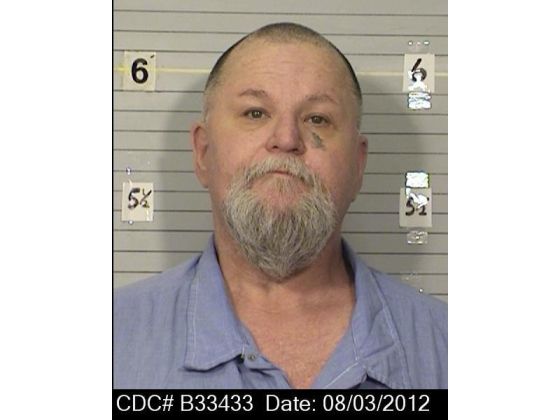
craig hulse photoPatricia lives out of state and wasn’t notified of the parole hearing in time to make arrangements to attend, so Craig’s request for release went unopposed. We organized a letter writing campaign to ask Governor Brown to overturn the parole because at his previous hearing, about a year before, the board had stated that Hulse still constituted an unreasonable danger to the public. What could have changed in such a short time?

The big change had come with the adoption of Senate Bill 260 “Justice for Juveniles with Adult Prison Sentences” which went into effect on January 1, 2014. The bill requires that the parole board “…review the cases of people who were under the age of 18 at the time of their crime and look at them differently than it does people who were adults.”

As a result of SB 260, Craig was able to request an earlier hearing–and it was at that time that his parole was granted.

There are some very complicated issues surrounding appropriate sentencing and/or treatment of juveniles who commit serious crimes; and there are no easy answers.

California is one of a small handful of states which grants authority to the governor to overturn a parole board’s decision. While in office Governor Brown has disagreed with the board in about 20% of the cases, so there were no assurances that Craig’s parole would be overturned.

A couple of days ago I heard from  Patricia. She told me that she had received word that Governor Brown had denied Craig’s release and that he would be eligible again in early 2015.

Patricia said that she will continue to oppose Craig’s release for as long as she lives.

Here are links to the 4 part series: The Devil in Orange County

The Devil in Orange County

The Devil in Orange County, Part 2

The Devil in Orange County, Part 3

The Devil in Orange County, Part 4

Thank you, Deranged Readers!

flappergun

Dear Deranged Readers:

When I began this blog in mid-December 2012 I had no expectations regarding how many people I might reach. Truthfully I was just compelled to do something I love, which to share twisted tales from L.A.’s deeply disturbed past.

The month of August was a personal best for the blog with over 26,000 visitors, most of whom had visited before! In the months since the blog began it has logged over 124,000 visitors — not just random hits. I know how busy everyone is, and I’m touched that so many of you find time for Deranged L.A. Crimes.

I take this endeavor seriously and I make every effort to keep the stories interesting and the facts straight.  I want you to know that I will always respond respectfully to your comments, even on those occasions when we may agree to disagree.

Again, my heartfelt thanks to each and every one of you for your support.

Now let the bad behavior continue.

Best,

Joan

The Devil in Orange County


flower_power

Groovy, baby.

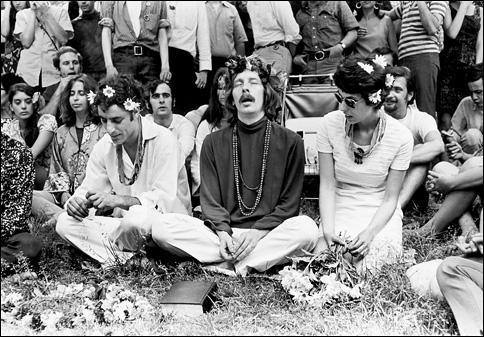
Beginning with the Summer of Love in 1967 the Baby Boomers felt that they were on to something profound — all you had to do was wear a garland of flowers around your head, smoke a few joints, flash the Peace Sign, and major changes in society would follow. If only it had been that simple.

bombing for peace If you were in your teens or twenties during that time, life was a contact high; everywhere you went it seemed like there was great music and free dope, but no high lasts forever. Eventually a decent buzz becomes harder to sustain.  At first you chase the high in the bright sunlight with energy and enthusiasm because it feels so damned good; but there comes a time when the high proves elusive — you catch glimpses of it as it disappears down deeper and darker alleyways.

Less than a year after the Summer of Love, on April 4,1968, Martin Luther King Jr. was assassinated. People barely had a chance to process the pain and horror of his death when, on June 6,1968, Robert Kennedy was gunned down in the pantry of the Ambassador Hotel in Los Angeles. The Age of Aquarius was on life support.

Robert F. Kennedy

Robert F. Kennedy

The ultimate perversion of the hippie ethos occurred on August 9, 1969, with the cruel and senseless torture and slaughter of Sharon Tate and her unborn son, Abigail Folger, Wojciejk Frykowski, Jay Sebring, and Steven Parent. The next night, Leno and Rosemary LaBiana were brutally murdered. The cryptic blood-scrawled words “Rise”, “Pig” and “Healter (sic) Skelter” at the crime scenes had terrified everyone. Had Satan had taken up residence in Los Angeles?  Maybe Hollywood was Sodom after all.

A raid on the Spahn Ranch in mid-August 1969 by L.A. County Sheriffs uncovered stolen car parts, teen-age runaways, drugs and weapons. While the raid was being conducted Woodstock (“Three days of Peace & Music”) was in full swing on Yasgur’s farm in New York.

By December 2, 1969 the Manson Family was being exposed for what they really were, remorseless killers. The month of December had started out bad and it wasn’t going to get any better.

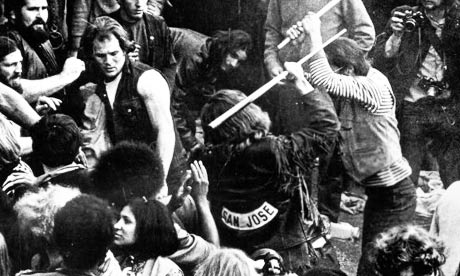
Hell's Angels attacking a concert goer at Altamont.

Hell’s Angels attacking a concert goer at Altamont.

The final fuck you to the hippie dreams of Flower Power came at a free concert at Altamont in Northern California on December 6, 1969. The concert was meant to be Woodstock West, but instead it became an ugly confrontation between the Hell’s Angels, who had been hired as security for the event, and the musicians and concert goers. The night ended with three accidental deaths and the stabbing death of Meredith Hunter.

Despite its early promise of peace & love, the ’60s had died a terrible death — bathed in blood, choking on shattered dreams and littered with acid casualties.

Maybe the ’70s would be better.

BEHIND THE ORANGE CURTAIN

Orange County, California, a collection of quiet suburbs, has long had a reputation for political and social conservatism. The inhabitants of Orange County are described as living behind “The Orange Curtain” a play on the infamous Iron Curtain which once separated communist and capitalist Europe.

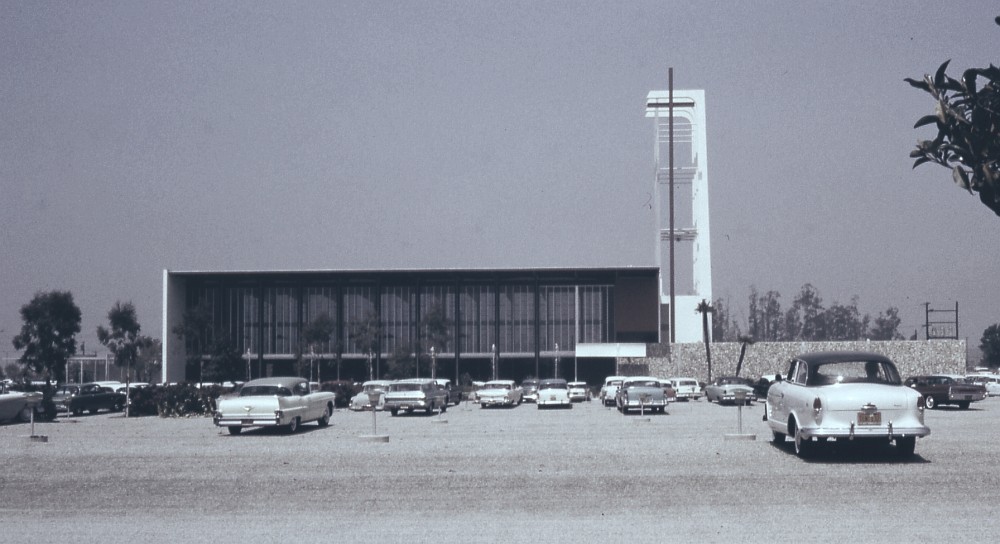
orange_groveI grew up behind the Orange Curtain in Garden Grove, a middle-class suburb close enough to Disneyland for my family to be able to watch the summer fireworks from our living room window. There were orange groves and strawberry fields near our home and the smell of orange blossoms, not easy to find anymore, brings back memories. The city’s claim to fame was as the home of the Garden Grove Community Church (the “drive-in” church) designed by the visionary architect Richard Neutra.

Garden Grove Community Church.

Garden Grove Community Church.

The first summer of the 70s was just beginning, and my brother’s best friend and I were driving around in my 1964 VW Beetle. We were headed home when we noticed Craig Hulse, whom we hadn’t seen in ages, hitch-hiking at the side of the road. I pulled over and Craig got into the car.

Craig was sixteen years old, a big kid, at least six feet tall and well over 200 lbs. We’d known him for years, he and my brother had gone to junior high school together. My brother is cursed with the Renner mouth — it’s an affliction I share — we seem to lack a necessary filter between the brain and mouth so we often say exactly what we’re thinking — and that isn’t always wise. A sense of humor and the ability to take a wicked joke at your expense was de rigueur in my family, but my brother’s quick wit and missing filter caused him a few problems in school.  However Craig, who had earned the nickname “Moose”, occasionally came to his rescue.

It was no surprise to find Craig hitch-hiking, everyone did in those days. We heard that he’d dropped out of school, run away from home and was heavy into Seconal and booze. Once he was in the car we asked him how he was doing and if he was okay. He said that things weren’t going well and that he was thinking about enlisting in the military to try to get his life in order. Enlisting would have had him on a plane to Vietnam before the year was over, but we figured maybe his life was bad enough to warrant drastic action. We dropped him off a few miles down the road and wished him well.

Days later, as the Manson jury was being selected, we heard that Craig had been arrested in connection with two brutal murders. One of slayings was rumored to have been part of a Satanic ritual.

The 70s were off to a scary start.

NEXT: Two murders and the dark side of an old friend.

Film Noir Friday: Dragnet 1966

Harry-Morgan-jack-webbWelcome!  The lobby of the Deranged L.A. Crimes theater is open! Grab a bucket of popcorn, some Milk Duds and a Coke and find a seat. Tonight’s feature is DRAGNET 1966,  starring Jack Webb and Harry Morgan.

Dragnet 1966 is a made-for-TV movie that initiated the return of the Dragnet series to television. It was intended to be the TV pilot of Dragnet 1967 but was not aired as originally planned. It was eventually broadcast in 1969.

The Internet Movie Database says:

Sgt. Joe Friday is called back from vacation to work with his partner, Off. Bill Gannon, on a missing persons case. Two amateur female models and a young war widow have vanished, having been last seen with one J. Johnson. In the course of tracking down Johnson and the young ladies, the detectives wind up with two different descriptions of the suspect, one of which closely resembles a dead body found in a vacant lot. But the dead man, later identified as Charles LeBorg of France, proves not to be J. Johnson, when a third young model disappears.

The story is based on the Harvey Glatman case.

http://youtu.be/ybhNquay6Sk

Deranged L.A. Crimes in Los Angeles Magazine

crime_cover

Los Angeles Magazine has added a crime page to its on-line content and Deranged L.A. Crimes is pleased to be a contributor! To check it out click HERE.

I’m researching some great new stories for the blog — including a trunk murder, so I’ll be back in a couple of days with more killer deranged crimes from historic Los Angeles.


Aggie Underwood: In Memoriam

aggie_perry fowler collection

Portrait of Aggie Underwood taken by Perry Fowler. Courtesy of Scott Martinez.

Agness “Aggie” Underwood passed away 29 years ago today. We never met but she has had a profound influence on my life, particularly during the last several years.

I’ve been obsessed with crime novels and true crime since I was a kid, and my compulsion to read it has never diminished. Writing about true crime is a relatively new endeavor for me and I attribute that, in large part, to Aggie’s influence. She is the inspiration for this blog and for the Deranged L.A. Crimes Facebook page, and I am proud to have authored her Wikipedia page — she was long over due for recognition.

As I’ve dug deeper into the crimes that have shocked and, in some ways, defined Los Angeles, I’ve felt Aggie’s presence.  Aggie worked in Los Angeles from the late 1920s through the late 1960s — and for nearly two decades she was a reporter. My interest in history and crime set me on the path to write about it, but it’s been my admiration for Aggie that has made me want to tackle many of the same cases that she wrote about.

I gave a lecture at the Central Library in downtown Los Angeles on June 29th entitled SLEEPING BEAUTIES: DERANGED L.A. CRIMES FROM THE NOTEBOOK OF AGGIE UNDERWOOD — here is an excerpt from my presentation. I hope you enjoy it.

Thanks for everything, Aggie.

***************************************************

In 1926 as a young wife and mother Aggie had no interest in working outside the home, but she wanted a pair of silk stockings in the worst way. When her husband, Harry, told her that there wasn’t enough money in the budget for her to buy them, Aggie said she’d get a job and earn the money.

Aggie & Harry [Photo courtesy CSUN Special Collections]

Aggie & Harry [Photo courtesy CSUN Special Collections]

Aggie quickly realized that she may have put her foot in her mouth rather than into a new pair of silk stockings; she didn’t have a clue about where to find work. Fate intervened when a friend of hers, who worked at the THE RECORD, phoned and told her that the newspaper needed someone to temporarily operate the switchboard.  Aggie took the job and it would turn out to be one of the most important decisions of her life.

Aggie came to enjoy the hustle and bustle of the newsroom and she loved being in the midst of a breaking story.  In December 1927, the city was horrified when William Edward Hickman, who called himself “The Fox” murdered and then butchered twelve year old school girl, Marian Parker. Hickman fled after the murder and the resulting manhunt was one of the biggest in the West.

00027428_marian parker

Marian Parker [Photo courtesy of LAPL]

In her autobiography Aggie recalled how she felt when they got the word that Hickman had been captured in Oregon:

“As the bulletins pumped in and the city-side worked furiously at localizing, I couldn’t keep myself in my niche.  I committed the unpardonable sin of looking over shoulders of reporters as they wrote.  I got under foot.  In what I thought was exasperation, Rod Brink, the city editor, said:

‘All right, if you’re so interested, take this dictation.’ 

I typed the dictation—part of the main running story.  I was sunk.  I wanted to be a reporter.”

She eventually got her wish and began reporting on stories for THE RECORD. Smart and hardworking, she made a name for herself locally and was courted by William Randolph Hearst for his publishing empire.

She resisted his overtures (and even his offers of more money) because she was happy at THE RECORD. The smaller paper gave her the opportunity to learn all aspects of the business – she thought working for Hearst might pigeon-hole her.

It wasn’t until THE RECORD folded in 1935 that Aggie agreed to become a reporter for THE HERALD.  She said that she had heard the term “working for Hearst” uttered contemptuously; but she had been too busy learning her craft to pay much attention to the gibes.

Aggie interviewing a mourner at Angelus Temple.

Aggie interviewing a mourner at Angelus Temple.

She said:

“…I did not feel I stigmatized myself when I accepted the HERALD-EXPRESS offer.  The invitation was a life line, and one did not need to be bereft of ideals to tie onto it.”

In her 1949 autobiography, NEWSPAPERWOMAN, Aggie described what it was like to be a reporter on the Herald:

“The Herald-Express is too fast for the sort of reporter who flounders when he is required to produce a new lead on a running story for each upcoming edition “

Aggie never floundered. She had reported from the scenes of disasters like the 1933 Long Beach earthquake, and she’d also covered some of the most heinous crimes committed in the city.

1933 Long Beach earthquake [Photo courtesy LAPL]

1933 Long Beach earthquake [Photo courtesy LAPL]

During the 1930s there were several daily papers in Los Angeles and Aggie had to be a fierce competitor.  In her autobiography Aggie wrote about the time she beat another reporter to some photos:

“Once, on a rather cheap murder and suicide, Casey Shawhan, then an Examiner reporter, and I were rifling a bureau drawer for pictures—no we weren’t housebreaking—when we grasped a pile of photographs simultaneously.  The tug of war was unequal, for Casey had played football at U.S.C.  So I kicked him in the shin.  He let go of the pictures and, clasping his bruise, danced on his other leg, howling, ‘O-o-h, gahdammit.  I’ll get even with you, Underwood.  You wait and see.’”  I didn’t wait.  I was scurrying off to the office with the pictures.”

Aggie thought of herself as a general assignment reporter; however, she gained a reputation as a crime reporter.  Good detectives are observers and so are good reporters, which may explain why stories circulated that Aggie had solved crimes.

aggie_harry raymond_Page_29

Aggie interviewing an unknown bad dame at Lincoln Heights Jail. [Photo courtesy of CSUN Special Collections]

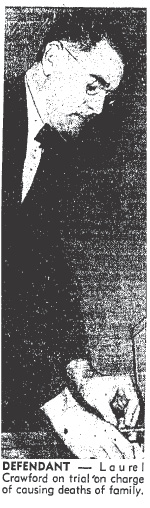
In late 1939, Aggie went out on a story that appeared to be a tragic accident – a family of five had been killed when their car had tumbled hundreds of feet down a mountainside near the Mt. Wilson Observatory.  There was one survivor, the husband and father of the victims, Laurel Crawford.

laurel_crawfordAggie wasn’t allowed to interview him because cops felt he’d been through enough; however, Aggie made a deal with one of the deputies who allowed her to listen in while Crawford was being questioned.  Aggie observed the man, and she had a hunch.  One of the Sheriff’s department homicide investigators asked Aggie:

“What do you think of it, Aggie?”

She didn’t hesitate, and replied:

“I think it smells.  He’s guilty as hell.”

Aggie had observed not only Crawford’s demeanor, which led her to believe his display of grief was disingenuous, but she had also noticed that his shoes weren’t scuffed, and his clothing wasn’t dirty, torn or wrinkled, which made his story of climbing down the mountain to the wreckage of the family sedan pretty tough to believe. Additionally, Crawford had stated that he had picked up the body of one of his daughters and held her, but there was no evidence of blood on his clothing.  Aggie’s Spidey-Sense was engaged.freespidey2sense2

A thorough investigation of the case proved that Crawford had taken out insurance policies on each of the victims, worth a total of $30,500 (that’s over half a million in today’s money!)  Laurel Crawford was sentenced to four consecutive life terms with a recommendation that he never be paroled.

For years Aggie covered everything from celebrity trials to gruesome murders. In January 1947 arguably the most infamous murder case in L.A.’s history broke; the mutilation slaying of twenty-two year old Elizabeth Short.

Elizabeth Short aka The Black Dahlia [Photo courtesy LAPL]

Elizabeth Short aka The Black Dahlia [Photo courtesy LAPL]

Underwood was assigned to the story. There have been several people over the years who have claimed credit for naming the victim The Black Dahlia; and Aggie was one of them.  Aggie said that the Black Dahlia tag was dug out on a day when everyone was combing blind alleys. She decided to check in with Ray Giese, a Det. Lt. in LAPD homicide, to see if any stray fact may have been overlooked.

According to Aggie, he said: “This is something you might like, Agness.  I’ve found out they called her the ‘Black Dahlia’ around that drug store where she hung out down in Long Beach”.   Like it?  She LOVED it!

Aggie interviewed Robert “Red” Manley, the first serious suspect in the Black Dahlia case, and she was prepared to follow the story to its conclusion when without warning, she was benched.

Robert "Red" Manley [Photo courtesy LAPL]

Robert “Red” Manley [Photo courtesy LAPL]

After a couple of days of cooling her heels in the newsroom she decided to bring in her embroidery hoop.  Pretty soon she heard snickers.  Aggie said that one of her colleagues laughed out loud and said:

“What do you think of that?  Here’s the best reporter on the Herald, on the biggest day of one of the best stories in years—sitting in the office doing fancy work!”

Aggie was quickly reassigned to the Dahlia case, and just as quickly yanked off of it. It was then that she was given the news that she was being promoted to city editor!  Aggie said she never understood the timing of her promotion – she would have preferred to follow the Dahlia story until it went cold.  But it was an important moment in her career and for women in journalism – Aggie was the first woman in the U.S. to become the City Editor of a major metropolitan newspaper!

*********************************************************************

P.S. I’m currently researching the Laurel Crawford case  — it’s diabolical.