Coming May 14, 2024–Of Mobsters and Movie Stars: The Bloody “Golden Age” of Hollywood

This gorgeous cover is the winner of the WildBlue Press cover contest. It evokes the glamour of old Hollywood, yet suggests the dark side of the city and the era.

Of Mobsters and Movie Stars is available for pre-order on Amazon for release on Tuesday, May 14, 2024. You will also be able to purchase the book in hardcover, paperback, eBook, and, coming soon, audiobook, on the Amazon and WildBlue’s websites.

My connection with many of you inspired me to tackle a book project. I can’t thank you enough for your support over the past 12 years. I’m looking forward to many more years here (and a few more books!) I’ll let you know about any book signings and interviews, so stay tuned. I’ve created some content for my author page on WildBlue, so please visit me there and sign-up to receive updates.

There are 37 stories in Of Mobsters and Movie Stars, including an early killer couple who went on a spree while Bonnie Parker and Clyde Barrow were still in grammar school. One of the most shocking tales is about a man who plotted to kill his wife using two Diamondback rattlesnakes named Lighting and Lethal.

Many people have asked if Los Angeles had a mob. The answer is they had two. The earliest was headed by Joe “Iron Man” Ardizzone, an old-school gangster straight out of Central Casting. The other mob, orders of magnitude more powerful and insidious than Ardizzone’s, was the Hollywood studios. Using hired thugs called “fixers,” the studios wielded power over actors and politicians. When choreographer Busby Berkeley killed three people while driving drunk, the studio came to his aid. When director, and husband of Jean Harlow, Paul Bern, died under suspicious circumstances, the studio intervened.

One of the ugliest incidents of studio power was the attempted cover-up of the brutal rape of a young actress at a studio hosted event. The victim refused to be silent and, as far as I’m concerned, is the Godmother of the #metoo movement.

I posted excepts from Mobsters and Movie Stars on WildBlue. Below is one of them.


Excerpted from The Torso Murder

“William Pettibone, Ray Seegar, Floyd Waterstreet, and Glen Druer explored the muddy river bank for hidden treasures on May 18, 1929. The boys noticed something that looked like a turtle shell or strange prehistoric fish 150 feet from the bridge in the city of Bell. One boy took a stick and poked it into an end of the bony structure and held it aloft for the others to gape at. The boys spent a few minutes before realizing their treasure was a human skull.

With the head impaled on a stick, the boy ran up to the roadway. He waved it around until a female motorist stopped. The horrified woman kept it together long enough to drive to a public telephone where she called Bell’s Chief of Police. Chief Smith and Motor Officer Steele met the woman and the group of boys near the river. The woman declined to give her name. Smith’s officers told Captain Bright about the grisly find. Bright accompanied Deputies Allen, Brewster, and Gompert to the scene. While deputies searched the area, an enormous crowd of curious on-lookers gathered.

The initial autopsy yielded nothing which could identify the deceased. At least the skull still had several extant teeth, which made an identification possible. Local newspapers printed the photos and drawings of the teeth and distributed them to dentists.

With limited remains, the experts needed to perform a miracle. Amazingly, they did just that.”

Black Dahlia: Another Confession and Another Murder

The investigation into Beth Short’s murder grew colder every day. Police investigated all the crackpots who claimed responsibility for the heinous crime. They went through stacks of letters and postcards that named potential suspects and offered various theories about the culprit. They rousted local sex offenders and searched in vain for the crime scene. If only the killer would confess.

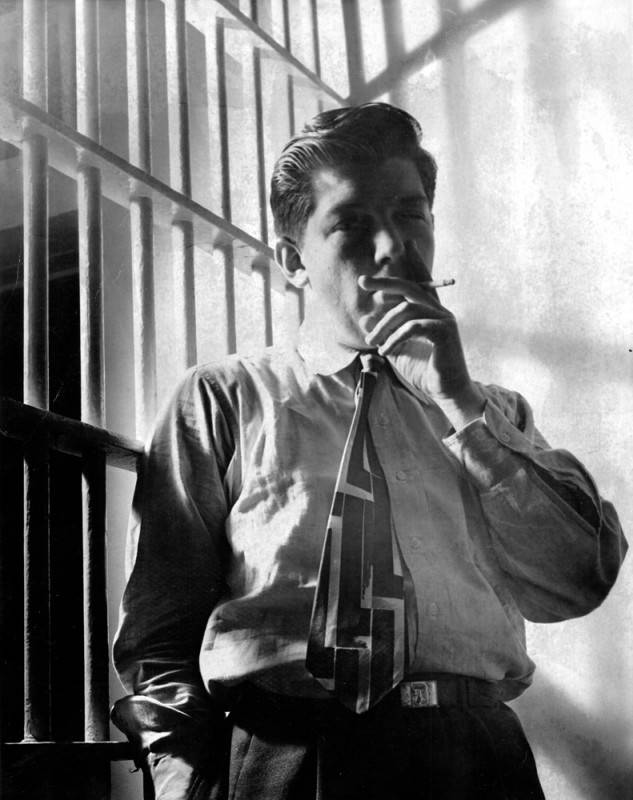
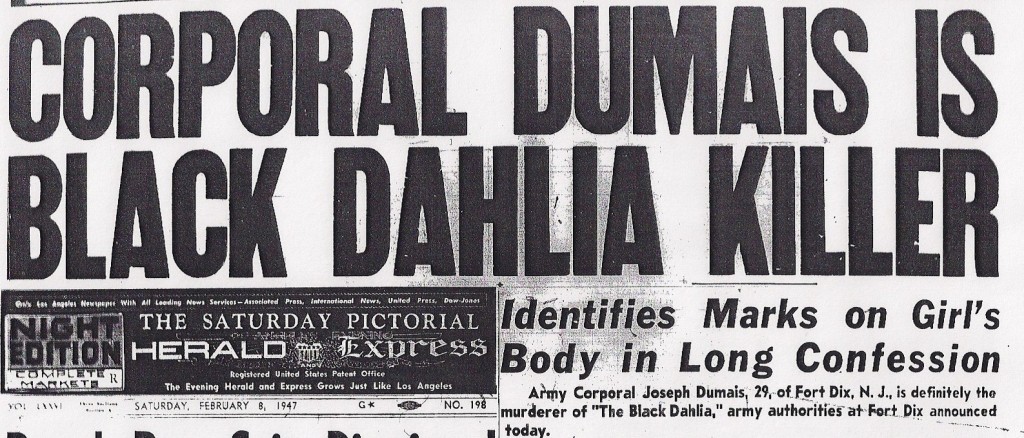
On February 8, 1947, Joseph Dumais, an Army Corporal, came forward and admitted he dated Beth Short. Not only had they dated, he was sure he had killed her. The Herald announced “Corporal Dumais Is Black Dahlia Killer.” The story began, “Army Corporal Joseph Dumais, 29, of Fort Dix, N.J., is definitely the murderer of ‘The Black Dahlia,’ army authorities at Fort Dix announced today.”

Dumais returned to Fort Dix wearing blood-stained trousers with his pockets crammed full of clippings about the murder. In a hand-written 50-page confession, he claimed he dated Beth five days before the discovery of her body—then he suffered a mental blackout.

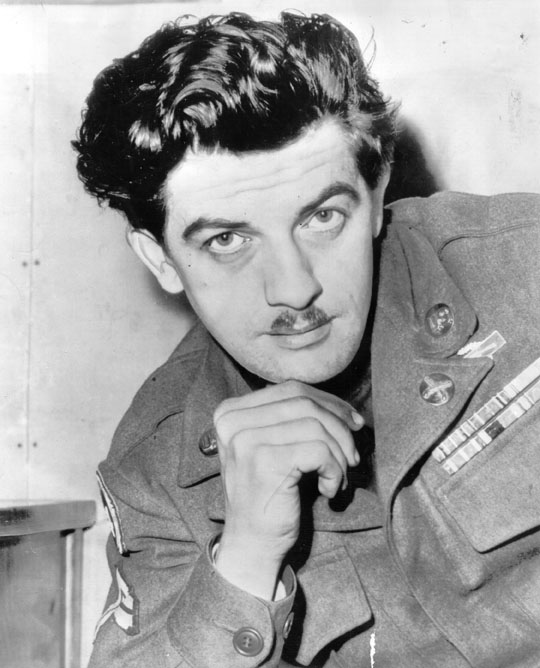
Joseph Dumais

The good-looking corporal seemed like the real deal. Army Capt. William R. Florence, head of the Fort Dix Criminal Investigation Department, said, “I am definitely convinced that this man is the murderer.” In his zeal to be the one to solve the gruesome murder, Capt. Florence overlooked the superficial nature of Dumais’ answers to his questions. Dumais had only to read the news coverage of the case, and then unleash his imagination to be credible in the short run. When Florence asked, “Does it seem to you at this time that you committed this crime? Dumais answered yes. But as Dumais stated earlier, he blacked out and recalled nothing until he arrived at Penn Station.

Getting to the nitty-gritty details, the Capt. asked, “Do you know how her body was mutilated?” Dumais said he did, but did not wish to describe the injuries. Again, Capt. Florence asked Dumais if he could have committed the murder. Dumais replied, “Yes, it is possible because of my actions in the past.”

In his confession, Dumais told Army authorities he stabbed Beth in the back and around the mouth, then severed her body with a meat cleaver. He washed the body of blood and dumped it in a vacant lot in Leimert Park.

Dumais’s story was riddled with holes. He said he had a date with Beth in San Francisco on January 9 or 10, but could not explain how he got to Los Angeles and then back to Fort Dix. Further questions revealed Dumais to be a blackout drunk. He said he was “rough on the girls” when he had been drinking. Dumais’s credibility eroded with each new statement.

On February 10th, as Dumais’s story unraveled, Los Angeles awakened to the news of another brutal murder of a woman. The Herald put out an extra edition with the headline, “Werewolf Strikes Again! Kills L.A. Woman, Writes B.D. on Body”.

The victim of the “Werewolf Killer” was forty-five-year-old Jeanne French. Her nude body was discovered at 8 a.m. on February 10, 1947, near Grand View Avenue and Indianapolis Street in West L.A. Police were frustrated and overworked. The women of Los Angeles were terrified. What the hell was going on?

Detectives at the scene of Jeanne French’s murder.

NEXT TIME: The Lipstick Murder

Black Dahlia: January 26, 1947 to February 15, 1947

Beth Short’s family buried her at Mountain View Cemetery in Oakland, California. The cemetery is located 375 miles north of the vacant lot in Leimert Park, where Betty Bersinger found her, and 3,000 miles away from Medford, Massachusetts, where her journey began.

Law enforcement worked around the clock to find the killer. On January 25th, as Beth’s family laid her to rest, a police search of a trash dump at 1819 East 25th Street in Vernon turned up one of her shoes and her handbag. Police carefully handled the items to preserve possible fingerprints. Because he saw her last, detectives called on Red Manley to identify the items.

Robert Manley identifies Beth’s purse and shoe

Without hesitation, Red told them the handbag smelled of the perfume Beth wore when he drove her from San Diego to the Biltmore on January 9th. He recognized the shoe from a pile of shoes presented to him by police. Feeling the heel of each shoe, Red stopped at a black right pump. He held it up and said, “This is it! I’m sure of it.” The shoe was the only one with double taps—heel and toe. Red paid to have an additional pair of new taps put on the heels of Beth’s shoes when they left San Diego. Beth loved hearing the tap, tap, of her toe and heel hitting the pavement as she walked.

Detectives thought the shoe and purse might be the same as those reported by Robert Hyman. He said he saw them in a trash can in front of his café at 1136 Crenshaw Blvd, about two miles from 39th and Norton. Trash collectors took the can before police arrived; but they traced the load to the Vernon dump. Hyman could not identify the bag and shoe.

Meanwhile, LAPD Capt. Jack Donahoe ordered extra officers to sift through the contents of a cryptic envelope mailed to the Examiner. On January 22, James Richardson, the paper’s editor, received an anonymous call. The man told Richardson he had items belonging to Beth. He thought they would “spice up” the case. Two days later, the Examiner received a call from the post office regarding a peculiar package. Someone, likely the killer, soaked the package in gasoline and addressed it “To The Los Angeles Examiner and other newspapers.” The package contained personal documents, pictures, Beth’s birth certificate, and a 75-page address book in brown leather.

Publicity-seekers, and sad mental cases, contacted police. Police received many communications through the mail. The first, the gasoline-soaked package, was almost certainly authentic. The others included a letter intercepted in Pasadena. Enclosed in the improvised envelope, a note cut and pasted from newspaper headlines, read, “Dahlia killer cracking. Wants terms.” Another letter, not considered authentic, read, “We’re going to Mexico City—catch us if you can.”

One note had a message scrawled in ink. In bold, capital letters, it read, “Here it is. Turning in Wednesday, Jan. 29, 10 a.m. Had my fun at police.” The note was signed “Black Dahlia Avenger.” The Avenger was a no-show. He sent a follow-up note to the Los Angeles Times. The note read, “Have changed my mind. You would not give me a square deal. Dahlia killing was justified.”

Daniel Vorhees, a transient in his thirties, surrendered to the police at Fourth and Hill Streets. He said he “couldn’t stand it anymore.” Detective Charles King and Dr. Paul De River, a police psychiatrist, agreed to wait until Voorhees recovered from his “bewildered and befuddled state” before giving him a lie detector test. Police cleared Voorhees.

By February 1st, police said they were giving up trying to contact Beth’s killer through letters and appeals. Sick pranksters sent anonymous notes, some from as far away as the Bronx, and signed them “Black Dahlia Avenger.” 

A local newspaper received half a dozen Black Dahlia messages in one mail delivery—one with postage due. An exhausting number of fortune tellers, spiritualists, mediums, and even clergymen wrote to police with their own solutions of the crime.

In the two weeks since the murder, hundreds of police door-knocked thousands of doors in a futile search for the crime scene. Several false confessors were detained and released.

The women of Los Angeles lived in fear.

NEXT TIME: A suspect and another murder.

Red Manley and the Black Dahlia

In his 1991 autobiography, Reporters: Memoirs of a Young Newspaperman, Will Fowler recalled one of his colleagues, Baker Conrad, had noticed a telegram among Elizabeth Short’s belongings. The Examiner’s editor, Jim Richardson, dispatched Fowler to the address on the telegram, 8010 Mountain View Avenue in South Gate.

When Fowler arrived at the bungalow court, a strikingly beautiful young woman greeted him. Her name was Harriette Manley. Fowler let her believe he was a cop.

During their conversation, Harriette said her husband phoned her from San Francisco after he saw his name in the newspapers in connection with Elizabeth Short’s murder. Red reassured Harriette that he’d had nothing to do with the slaying. He said he “loved her more than any man ever loved his wife.” 

At 10:00 pm on January 19th, two LAPD sergeants, J.W. Wass and Sam Flowers, staked out the home of Red’s employer in Eagle Rock. When the suspect’s sedan pulled up, the officers approached him with their guns drawn. An Examiner photographer was there to capture the arrest.

Robert ‘Red’ Manley

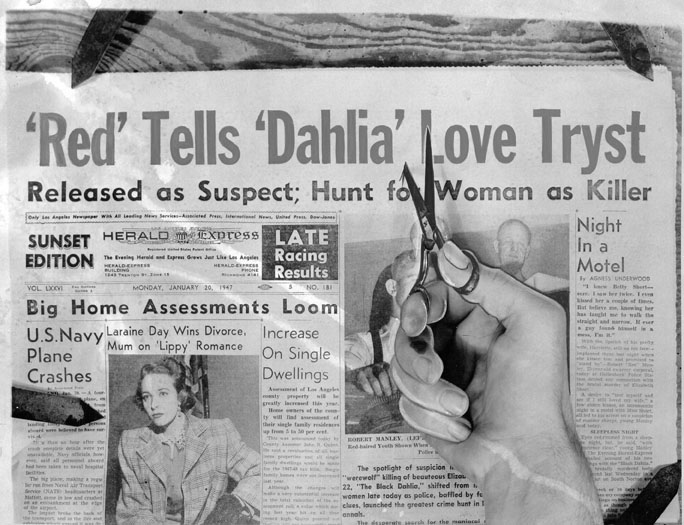
The next day, Aggie Underwood interviewed him. Red needed no encouragement to unburden himself. He told her how he’d picked Beth Short up on a San Diego street corner. How they had spent an “erotically uneventful” night in a motel and how he eventually dropped her off at the Biltmore Hotel on January 9th.

Red finished his tale with a heartfelt statement. “I’ll never pick up another dame as long as I live.”

Aggie believed Red and shared her gut feelings with the police. Red was forthcoming in his interview. Aggie knew he wasn’t a killer. Red was a frightened man with goofy ideas about love, marriage, and fidelity.

“I was only trying to test my love for my wife,” he said as he sought to explain his brief escapade with Beth Short.

Red said he first saw Beth standing on a street corner in San Diego while on a business trip ten days before Christmas. “She looked cute, so I thought, well, I’ll make a little test and see if I’m still in love with my wife, or whether I could ever fall for anyone else.”

According to Red, he and Harriette, married for just 14 months, were going through a “readjustment period.” He said they had a “few misunderstandings, but nothing important.”

He swore up and down that Beth was the only woman he picked up since his marriage. When he approached her that day, Beth was coy. “She turned to me and said, ‘Don’t you think it’s wrong to approach a girl this way?’” Wrong or not, she got into his car within a minute or two. Before he dropped her off in Pacific Beach, where she was couch-surfing at the home of Elvera and Dorothy French. they sat in his car and talked. He asked her if she would go out to dinner with him. “That would be nice,” she said.

Red drove back up the highway and rented a motel room. He picked Beth up that evening and they went to a nightclub and danced until midnight. Afterwards, they stopped at a drive-in for a snack. He said they talked for a few minutes in front of the French home. Red kissed her goodnight, but said she was a little cold.

He didn’t see her again until January 7, on his next trip to San Diego. He wired ahead to let her know he would be in town. They went nightclubbing again. Then they stayed together in a motel on their way back to Los Angeles.

Red’s story, and his demeanor, convinced Aggie he was not a killer, but that didn’t mean she let him off easy.

If there was one thing that Aggie detested, it was a sob sister. For those of you unfamiliar with the term, a sob sister is a female journalist who writes overly sentimental copy. That sort of journalism was never Aggie’s thing. She said, “A sob sister could have wept with and over Manley, interpolating, editorial gushes to prove what a big bleeding-heart beat in her breast. To hell with that. I’d rather have a fistful—an armload—of good solid facts.”

Her armload of facts made Aggie’s interview with Red Manley riveting. In fact, her city editor, who normally cautioned her to keep her copy short, let the entire interview run without a ton of photos. He knew a great interview when he read one. Aggie was the only Los Angeles reporter to get a by-line in the Dahlia case.

Why, then, amid the covering of the murder, was Aggie yanked off the story? With no warning or explanation, Aggie found herself benched. The city editor let her cool her heels in the newsroom without a thing to do. 

Aggie spent a couple of miserable days at her desk, bored out of her mind. Then she got pissed-off enough to fight back. She didn’t get huffy or raise her voice. She brought in an embroidery project. In no time, the other newsroom denizens were snickering. One newswoman, Caroline Walker, said, “What do you think of that? Here’s the best reporter on the Herald, on the biggest day of one of the best stories in years—sitting in the office doing fancy work!” 

The next day, they reassigned Aggie to the story—only to pull her off a second time. What the hell was going on?

NEXT TIME: The Black Dahlia case continues.

Aggie Underwood–Newspaperwoman

On October 27, 1936, in a special edition celebrating the Herald’s twenty-fifth anniversary as an evening daily, city editor John B.T. Campbell wrote this about Aggie Underwood:

“Aggie Underwood should have been a man. A rip-snorting, go-gettum reporter who goes through fire lines trails killers . . . using anything from airplanes to mules to reach the spot that in newspapers is  . . . marked with an arrow or an X. What a gal! Usually followed by one or two photographers who . . . get lost when unable to keep up with this speedy lady. Favorite occupation is following a good murder. Favorite story, a good murder. Favorite photograph, a good murder. Favorite fate for all editors, good murder. Help!”

Today we may struggle with the “should have been a man” comment, but at that time it was high praise. Aggie was still new at the Herald, starting in January 1935. She undeniably made an impression on the newsroom. She recalled those early days as “happy-go-lucky.” The reporters worked hard and played just as hard; often going in a group to Chinatown for dinner, or gathering at a bar in Pico Gulch (about half a block from the office, on Pico between Figueroa and Georgia streets).

1931 photo shows the Goodyear blimp “Volunteer” soaring over the Evening Herald building to pick up a bundle of Twentieth Birthday editions for delivery to officials at city hall.

In her work, Aggie made it a point never to ask for special treatment because she was a woman. One night, she arrived at a brush fire in Malibu. A Sheriff’s deputy stopped her. “It makes no difference if you are a reporter. No woman can go in there.” She was considering her next move when she heard a man’s voice. He addressed the deputy, “It’s all right, lad. She’s been to a hell of a lot more of these things than you ever have. Go on through, Aggie.”

The voice belonged to Sheriff’s Department Inspector Norris G. Stensland, one of my favorite LA law enforcement officers.

Aggie worked well with law enforcement. She took the time to write to an officer’s superior to express how helpful he was. In this way, she built long-standing relationships based on mutual respect. Reporters like Aggie have a lot in common with detectives. Each knows the value of maintaining their composure and assessing a scene. Both cops and reporters know the value of developing informants.

One time, on a tip, Aggie arrived at the scene of a love-triangle murder. The cop at the door refused entry to Aggie, not because she was a reporter, but because she was a woman. “You can’t go in there, lady. It’s pretty bad in there. It’s no place for a woman. It’s a mess of blood all over.” Paul Dorsey, a Herald photographer who was with her, said to the officer, “Don’t worry about her. She can take it. Worry about me. Chances are that I can’t.”

In August 1935, Aggie got a tip that LAPD detectives planned to search the home of a woman accused of shooting and gravely wounding her husband at a dinner party days earlier. Aggie arrived before detectives Aldo Corsini and Thad Brown, who sought the pistol used by the woman. Aggie said the detectives were concerned about entering the home because of a huge gaunt German Shepherd. Nobody had fed or given water to the poor thing since the arrest of his mistress. The dog, frightened and stressed, barked from behind a window.

Victim of shooting interviewed by Aldo Corsini and Thad Brown. Photo courtesy UCLA digital collection.

Aggie had an epiphany. “Look, Thad, Corsini and I will go to the back door and make one hell of a noise and distract the dog. While we’re doing that, Thad, you go in through the window, right there beside the front door, then unlock the front door and rush out. I’ll go in then and tame your dog; I’m not afraid of him.”

Aggie heard dogs are aggressive when they are afraid of taller, bigger humans who seem threatening. She figured the best way to approach the frightened animal would be to get down to his level. Corsini wasn’t about to get on his knees to confront the dog, and neither was Brown, but Aggie refused to retreat. Facing the dog, Aggie talked to him in a soft voice, and cautiously moved her hand toward his head. She petted his head gently and said, “What’s the matter, fellow? You hungry and thirsty?” The big dog whimpered. Aggie stood up and went to the kitchen sink to fill his bowl with water. She set out some food for him, too. He became her shadow. He followed Aggie around the house while the detectives searched for the gun, which they found in a laundry bag. The woman later went to prison for attempted murder.

Thad Brown promoted to captain of homicide/chief of detectives. The rank and file would have made him chief of police if politics hadn’t put William Parker in the office instead. Aggie said for years Brown blushed when asked if he had tamed any wild dogs lately.

Aggie’s cordial relations with police provided her with exclusive stories. She rolled up to a house in Eagle Rock one afternoon after getting a report of a double mystery death. Several LAPD homicide detectives stood around outside, waiting for the living room to air out. Aggie said after ten days, the corpses were ripe. The couple died in the middle of a sex act on the living room couch. Detectives weren’t sure whether they had a murder-suicide or an accident. Aggie wanted to catch the Herald’s next deadline, so she made a deal with Captain H. H. Bert Wallis. They identified the dead man, but they still didn’t know the woman’s identity. No detective wanted to enter the house until the smell dissipated. Aggie said she would brave the stench and retrieve the woman’s handbag, which sat on a table visible from outside.

The woman was nude except for a slip rolled up to her chest. The man, in his union-suit, had fallen to the floor. His penis had burst, and Aggie had to step over him to reach the handbag. She tried to hold her breath, but the smell of decaying flesh was pervasive, clinging to her favorite brown wool dress. Aggie grabbed the purse and handed it to Wallis. In gratitude, he gave her a head start on the story. It turned out the man met the woman in a bar, brought her home, and they died of carbon monoxide poisoning because of a faulty heater.

Aggie loved the brown wool dress. She saw it in a shop window and bought it on lay-away. In a conversation with Aggie’s daughter, years later, I learned the fate of the dress. Mary Evelyn told me Aggie came home that night, peeled off the dress and burned it in the fireplace, saying, “I’ll never the smell of death out of it.”

Aggie at the Black Dahlia body dump, January 15, 1947.

During her career, Aggie reported on hundreds of crimes. The most infamous of them began on the morning of January 15, 1947.

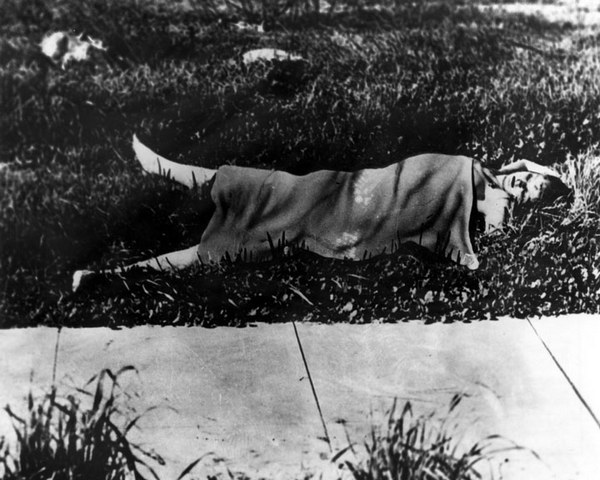
Aggie claimed to be the first reporter at the body dump site on Norton near 39th in Leimert Park. She was likely one of the first. It scarcely matters now. The deceased was a young woman, naked and obscenely posed. Her head is north, her legs spread and point south. A couple of days later, they identified the woman as twenty-two-year-old Elizabeth Short from Medford, Massachusetts. She became known as the Black Dahla.

Aggie interviewed the initial suspect in the grisly murder, Robert “Red” Manley. She sized him up and concluded he was not the killer. Despite an intense investigation, the case remains unsolved.

This post concludes my month-long tribute to Aggie, who inspired me to create this blog eleven years ago.

Aggie in her early days as city editor. Note the baseball bat on her desk. She said she kept the bat to deal with Hollywood press agents.

As we bid adieu to 2023, and prepare for new challenges in 2024, I thank you so much for your continued readership. This blog is one of my passions. I love relating true tales from L.A.’s past. Crime is banal, but the people who commit crime are endlessly fascinating. I’ve begun exploring stories for the upcoming year—there are some excellent ones. Within the next several days, I will begin my annual coverage of the Black Dahlia case, so stay tuned.

Happy New Year!

Tell My Wife I Love Her

Driving east on Ventura Boulevard in North Hollywood (now Studio City), architect Julian L. Zeller saw a well-dressed man staggering out of the weeds on the south side of the street. Zeller stopped to render aid. The man said, “I was shot by bandits in the hills. The bandit stole my car and my sweetheart.” Then he said, “If I die, tell my wife I loved her.” The man bled profusely and grew weaker as Zeller rushed him to the Hollywood Receiving Hospital. Zeller assisted his injured passenger into the hospital’s emergency room. Doctors tried, but they could not save the man.

From the contents of his pockets, police tentatively identified the deceased as fifty-one-year-old Merton L. Jenks. Merton, a wealthy real estate broker and oil speculator, lived in Beverly Hills with his wife Ruby. A prominent member of the Los Angeles Athletic Club, Merton had friends in high places, like the Police Commissioner.

As detectives contemplated their first steps in investigating Merton’s death, motorcycle officer J. E. Clementine sped to answer a call at 11414 Berry Street in the hills above Ventura Boulevard. The resident, Mrs. J. B. Mield, phoned because a woman arrived at her doorstep pleading for help.

Clementine guided his bike to the curb of the Berry Street home and found a hysterical woman in the yard. The woman choked out her name, Helen Moffitt. She calmed down enough to tell Clementine that she and a companion, Merton Jenks, were the victims of a hold-up at the top of the hill.
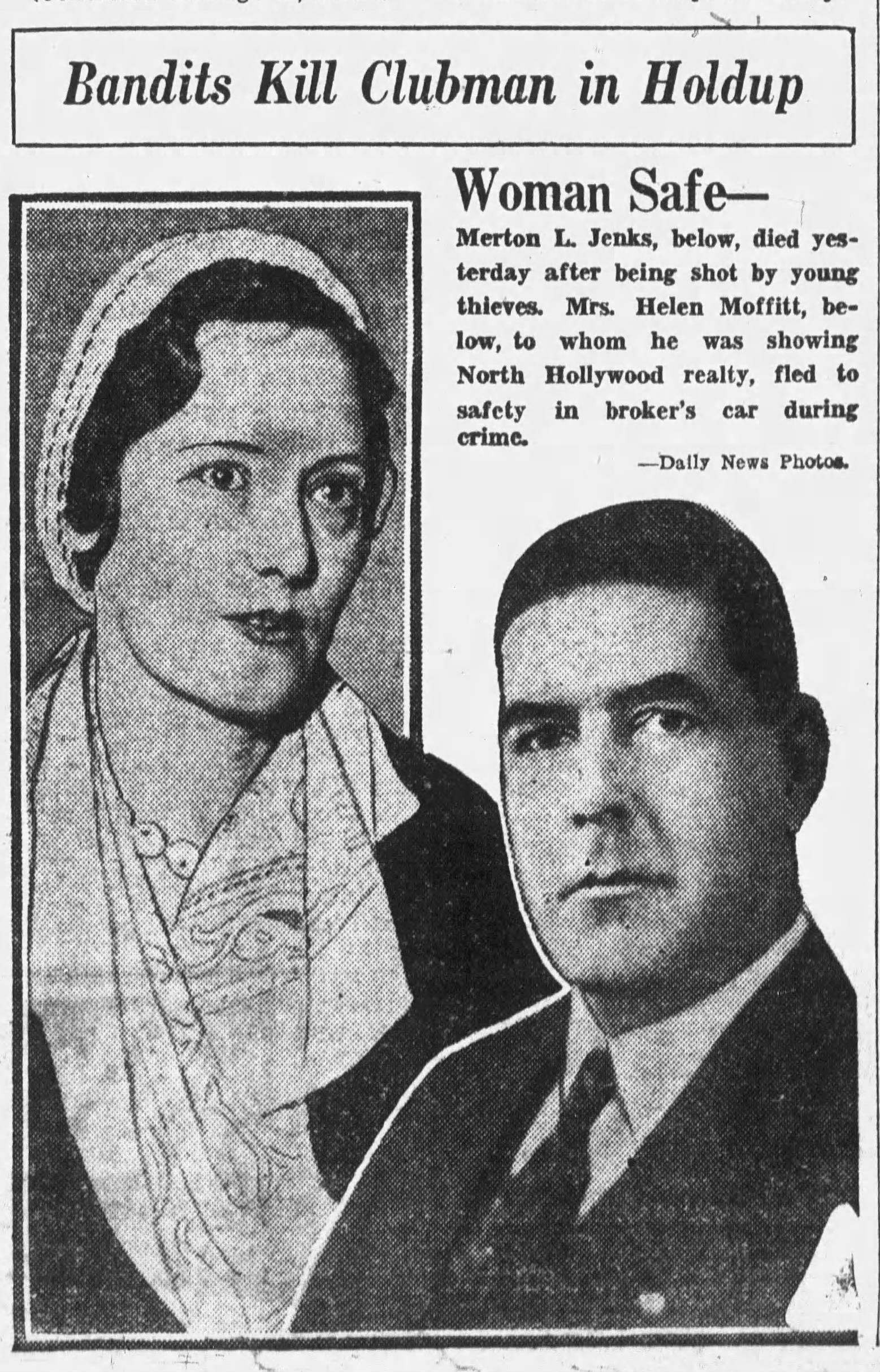
Helen said she did not know what happened to Merton. As soon as he grappled with the armed robber, she took off in the car to get help.

Chief Detective Joe Taylor and Inspector David Davidson took Helen downtown to LAPD’s Central Station for questioning. They contacted her husband, Norval, a Glendale car salesman, and he joined them.

Detectives asked Helen how well she knew Merton, and why they parked on a lonely road in the hills. She said, “I met Mr. Jenks at my sister’s home about a year ago. He knew that myself and my husband were anxious to dispose of our house in Venice and he was interested in showing me some new places. Tuesday, he called for me at home and we went to the North Hollywood district. We drove up to the head of Berry Drive (where the shooting took place) and stopped to admire the view.”

“Mr. Jenks got out of the car and was standing talking to me when suddenly a man walked out of the bushes by the roadside. He was dressed in blue-bib overalls, a blue shirt, and a cap. He had a white handkerchief drawn over his face through which holes were cut.”

The bandit held a gun on the couple and told them to “Stick ‘em up.”

Helen thought the bandit hit Merton over the head with a gun. She said, “I saw Mr. Jenks stagger over the embankment. My first thought was to get help and, as the motor of the car was still running, I moved to the driver’s seat and drove as fast as I could to the first house, where I could get a telephone.”

The detectives listened attentively to Helen’s account of the crime; but they did not entirely buy her story.

When police and deputy coroners searched Merton’s belongings, they found photographs of Helen. One in the back of a gold watch and another in his wallet. In one photo, Helen wore a bathing suit. They also found a telegram postmarked in Santa Monica. It read: “You have been my Valentine for several years.” It was signed “H. S.” Was it from Helen?

The couple clearly had a relationship, and likely parked on the lonely hillside for more than the view. Judging from the newspaper coverage, police weren’t the only ones to doubt Helen’s story. They began reporting the story as a “petting party,” and a “love tryst.”
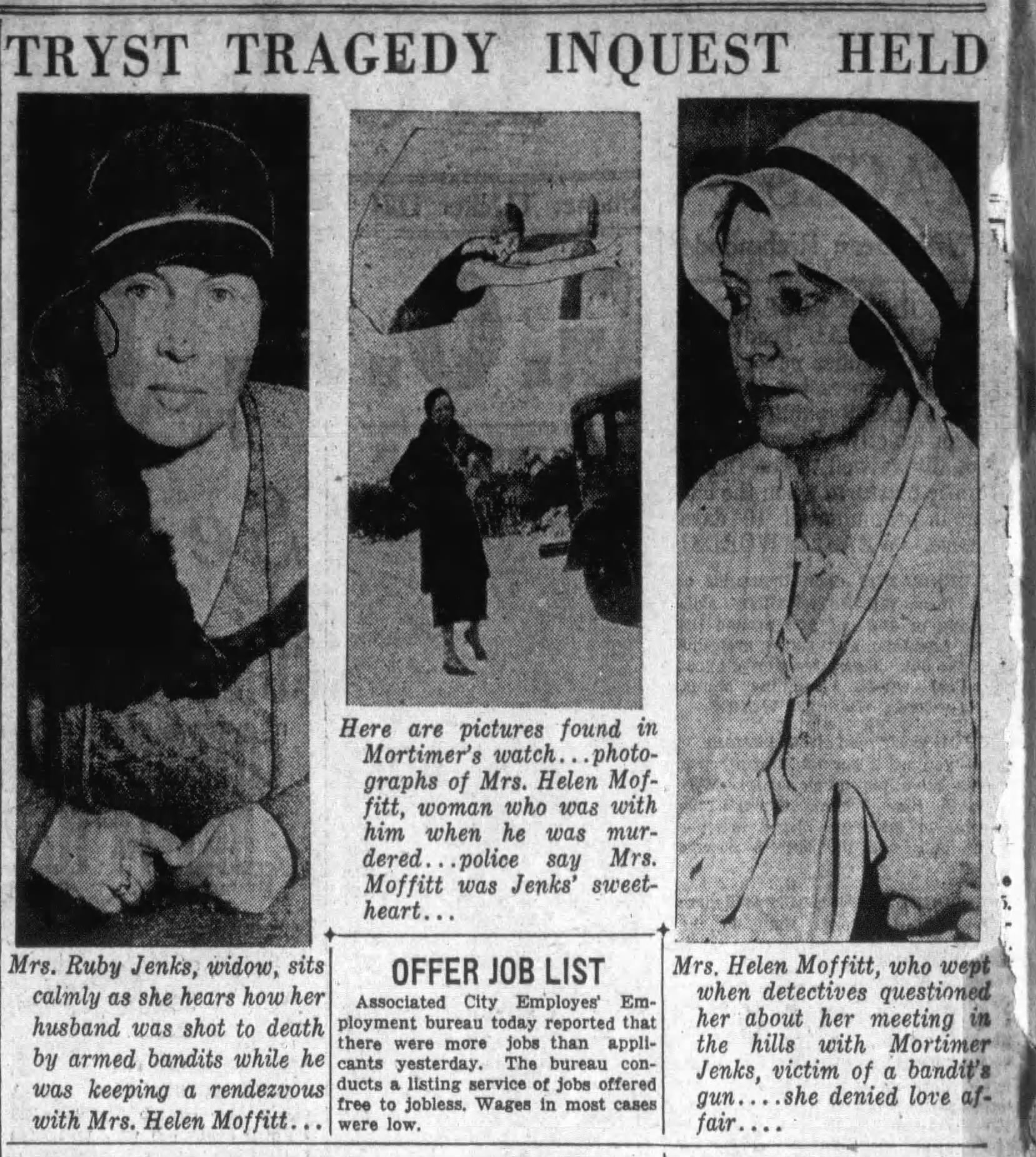
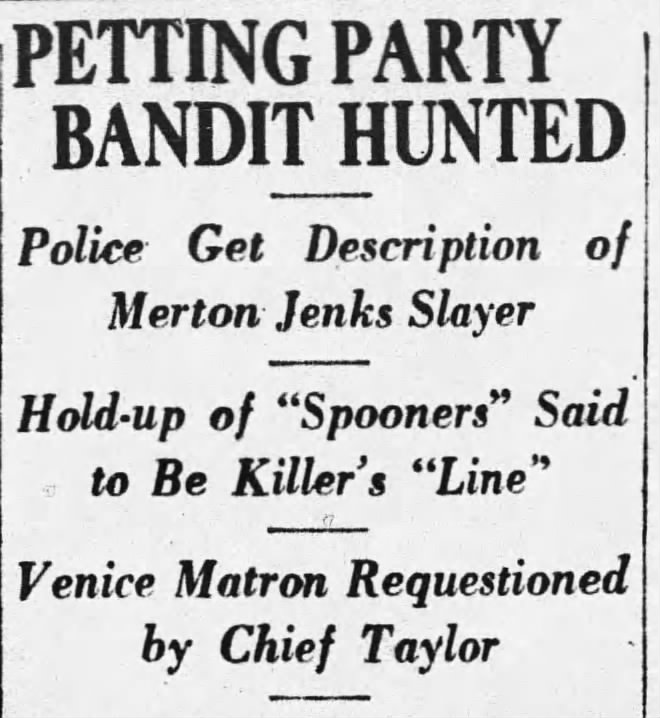
If you are not familiar with the term, a petting party was a gathering at which couples would hug, kiss, and perhaps fondle each other. Petting did not always stop with a kiss, but it stopped short of intercourse. Popular during the 1920s, and into the 1930s, petting parties outraged the older generation. Which, of course, was the point.

The post-WWI era saw a fundamental shift in the behavior of young adults. The previous generation had to follow strict courtship rules. Modern couples no longer had anyone looking over their shoulders. Three things contributed to the shift. World War I. Cars. Prohibition. The war made cynics and hedonists of many of its young survivors. Cars offered mobility and privacy—a bedroom on wheels. Prohibition normalized law-breaking.

By 1932, when Helen and Merton parked in the hills above Ventura Boulevard, petting parties were passe. But couples of any age who wanted privacy often drove to a remote spot.

Helen’s ever-changing version of events did not help the investigation. In fact, the only part of her story that did not change with each telling was her description of their assailant.

Before he died, Merton told Zeller two people attacked him. But Helen insisted only one man held them up.

Within days of the crime, police brought three suspects, Robert Gilreath, Robert Campbell, and William Saxton, into the station for questioning. They soon released them.

Inspector David Davidson, in charge of the investigation, told reporters they believed the bandit might be one who specifically targeted couples parked in the hills. Following Merton’s refusal to comply with the robber’s demands, the bandit slugged him. When he ran, the bandit shot him in the back. Merton may have been a faithless husband, but he did not deserve to die.

Among his belongings police found Merton had a carry permit, issued by the Sheriff’s Department on September 16, 1931. At the time of issuance, Merton said he needed a gun for “travel protection.” However, having an affair with Helen, may have made him cautious. Perhaps he feared her husband coming after him. However, Norval seemed genuinely surprised that Merton kept photos of Helen, or had a relationship with her.

Was Norval feigning surprise? Detectives could not afford to take him at his word. They investigated and found he spent the afternoon of the shooting in a movie theater.

On Thursday, July 16, the coroner’s jury returned a verdict in Merton’s death, “shot by persons unknown with homicidal intent.”

Helen testified at the inquest. The attractive 30-year-old insisted there was “no lovemaking,” and she and Merton sat in his car “looking at the scenery.” Deputy Coroner Monfort challenged her.

“Now, Mrs. Moffitt, you were never in the rear seat of that car at any time, were you?”

“I never was,” she replied.

“How do you account for the forty-five minutes you spent with Mr. Jenks at this point?”

“Well, we were admiring the scenery, and there was a general discussion about real estate and other topics. I don’t remember all that was said.”

The reason for Monfort’s line of questioning is not clear, although he may have suspected Helen hired someone to kill Merton. It was troubling that Merton said two persons attacked him, and Helen said there was one.

Two weeks after the murder, police searched Helen’s home looking for a weapon. Two hundred yards from where the bandit stood, police found a .32 caliber shell fired from an automatic. Police chemist, Ray Pinker, said he could match the shell to a gun if they found one.
The case stalled. In September, twenty-three-year-old Chester Bartlett surrendered himself to police and confessed he had “done something wrong” in the hills near Mulholland. Bartlett’s confession did not survive scrutiny. He admitted he attempted suicide by swallowing gasoline. The obviously unstable man may have done wrong, but he did not commit murder.

The scant leads dried up, and nobody offered new information, so police had to shelve the Jenks case. It remains unsolved.

What happened on June 14, 1932? Hungry, homeless and without hope, many desperate people roamed the streets of Los Angeles during the Great Depression. Did one of them pick up a gun and attempt to rob Merton and Helen? Did Merton perish at the hands of a would-be robber, or was he the victim of something more sinister?

We can only speculate.
Black Dahlia–Conclusion

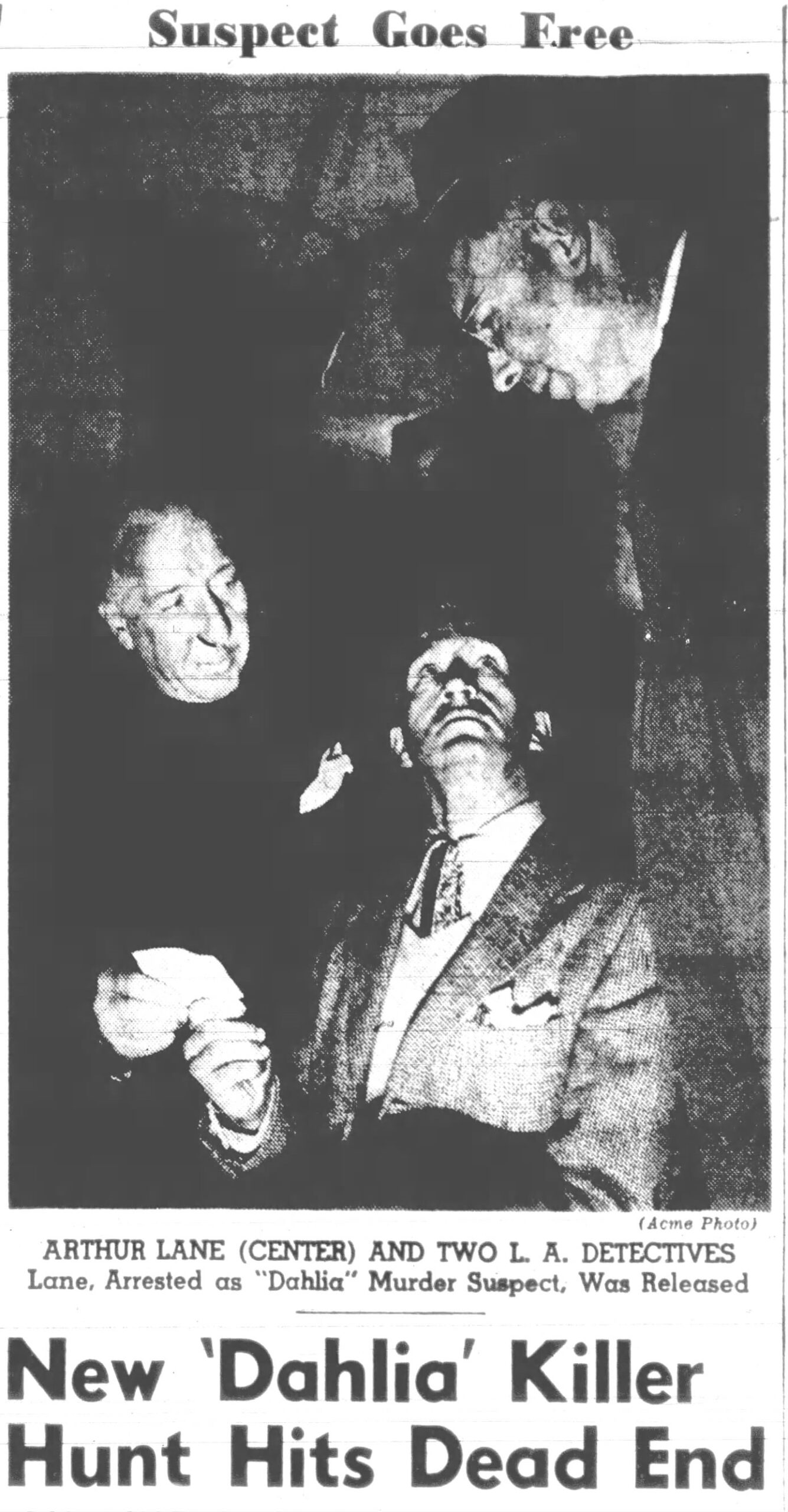
NOTE: The Long Beach Independent-January 15, 1949. I believe the detectives in the photo are Harry Hansen and Finis Brown.

Two years passed with police no closer to a solution for Elizabeth Short’s murder. The 1949 Los Angeles Grand Jury intended to hold LAPD’s feet to the fire for failing to solve the Dahlia case and several other unsolved homicides and disappearances of women during the 1940s.

On September 6, 1949, the jury’s foreman, Harry Lawson, told reporters that the administrative committee scheduled a meeting for September 8.

Lawson said:

“There is every possibility that we will summon before the jury officers involved in the investigation of these murders. We find it odd that there are on the books of the Los Angeles Police Deportment many unsolved crimes of this type. Because of the nature of these murder and sex crimes, women and children are constantly placed in jeopardy and are not safe from attack. Something is radically wrong with the present system for apprehending the guilty. The alarming increase in the number of unsolved murders and other major crimes reflects ineffectiveness in law enforcement agencies and the courts, and that should not be tolerated.”

In his statement, Lawson places the blame for the unsolved homicides squarely on the shoulders of law enforcement and the courts. What Lawson failed to understand was that crime was changing. No longer could police assume a woman’s killer was her husband or boyfriend. Stranger homicides were nothing new, but neither were they common.

The population of post-war Los Angeles skewed young and, because of a variety of factors, like the acute housing shortage, they were transient. A potent and deadly mix of opportunity and a large victim pool made it easy for the criminally inclined to do their worst. Women had a false sense of security about men in uniform. Behavior considered risky by today’s standards was acceptable during the 1940s.

From the outbreak of the war, the government encouraged women to support men in uniform. Newspapers and women’s magazines devoted countless column inches to ways in which they could aid fighting men. Women formed “Add-A-Plate” clubs. The mission of the clubs was to invite a soldier home for a meal. Women also routinely picked up soldiers and sailors hitchhiking because it was their patriotic duty.

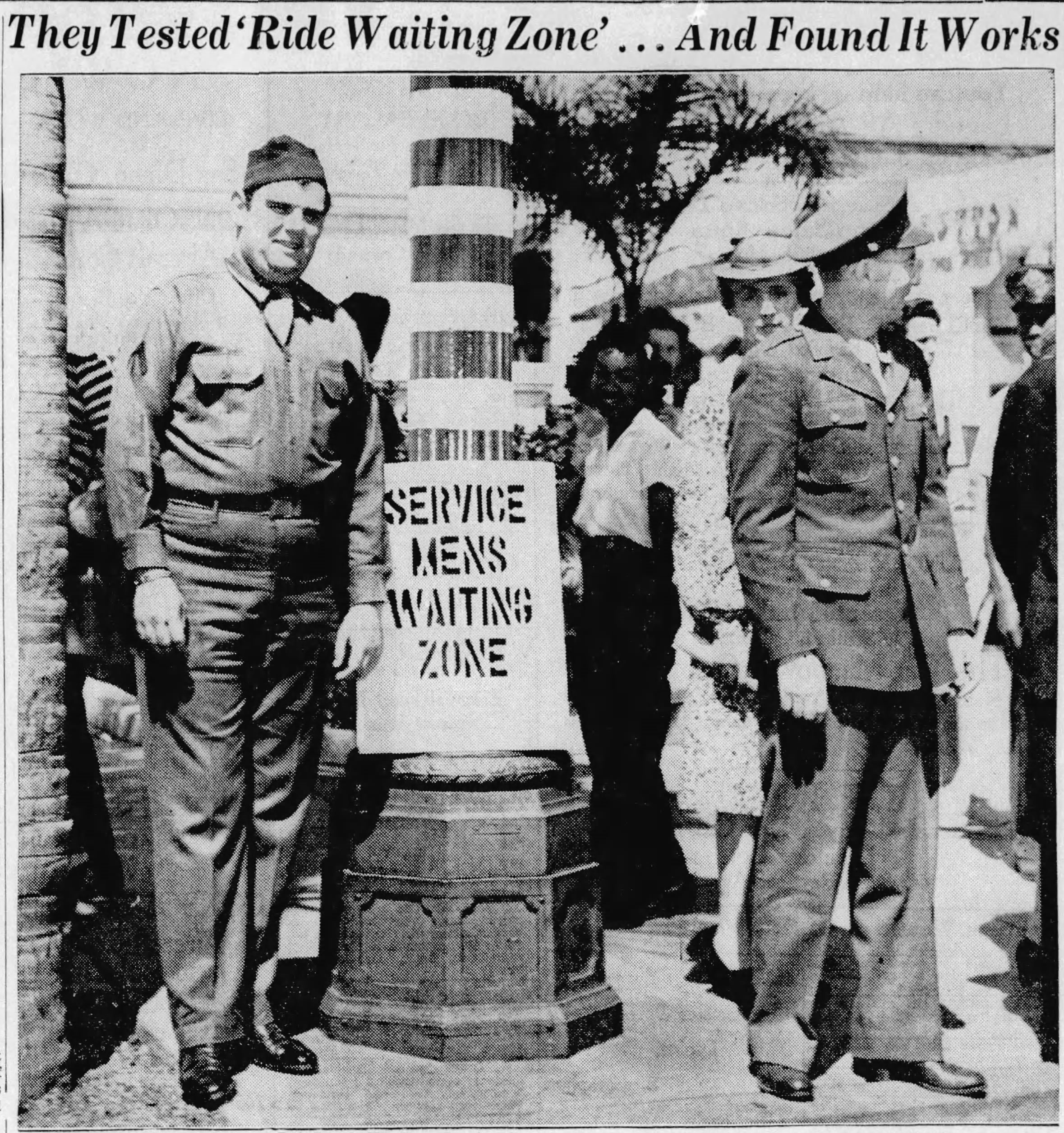
On April 2, 1943, the Pasadena Post wrote about a “ride waiting zone” which gave military men a place to stand and be visible to passing motorists who would then give them a ride. Most of the men were decent and law-abiding, but some returned home severely damaged by their war experiences. How many of those men were capable of murder?

Pfc. George Morrow, left, and Pvt. Dennis Ward could not wait until painters had completely finished the first service men’s waiting zone before they tried it out.

LAPD detectives spared nothing in their investigation of Short’s slaying. They took over 2700 reports. There were over 300 named suspects. They arrested fifty suspects who they subsequently cleared and released. Nineteen false confessors wasted law enforcement’s time and resources.

In 1949, the DA’s office issued a report on the investigation into Short’s murder. In part, the report stated:

“[she] knew at least fifty men at the time of her death and at least 25 men had been seen with her within the 60-day period preceding her death. She was not a prostitute. She has been confused with a Los Angeles prostitute by the same name… She was known as a teaser of men. She would ride with them, chisel a place to sleep, clothes or money, but she would then refuse to have sexual intercourse by telling them she was a virgin, or that she was engaged or married. There were three known men who had sexual intercourse with her and, according to them, she got no pleasure out of this act. According to the autopsy surgeon, her sex organs showed female trouble. She had disliked queer women very much, as well as prostitutes. She was never known to be a narcotic addict.”

Distracted by the continuing saga of local gangster Mickey Cohen, the jury turned their attention away from the carnage. In the end, they passed the baton to the 1950 grand jury–which also found itself sidetracked.

Mickey Cohen and his bullet proof car.

What happened to the women who disappeared? It is unlikely that we will ever know. It is also unlikely we will identify the killer(s). People will always speculate about the cases, and every few years a book about the Black Dahlia slaying will emerge claiming to have solved the decades long cold case. None of the books I’ve read so far is credible.

I do not accept theories which rely on elaborate conspiracies perpetrated by everyone, from a newspaper mogul to a local gangster to an allegedly evil genius doctor. My disbelief is based in part on the fact that most people are incapable of keeping a secret. Benjamin Franklin said, “Three (people) can keep a secret if two of them are dead.” Eventually, someone talks.

Elizabeth Short’s killer probably kept his depraved secret but, even if he didn’t, anyone who knew the truth is long dead.

NOTE: This concludes my series of Black Dahlia posts for now. I hope you will stay with me through 2023 as I unearth more of L.A.’s most deranged crimes.

The Black Dahlia Hoax

Six weeks into the Black Dahlia investigation and detectives had little to show for their efforts. Then, suddenly, it looked like they finally caught a break.

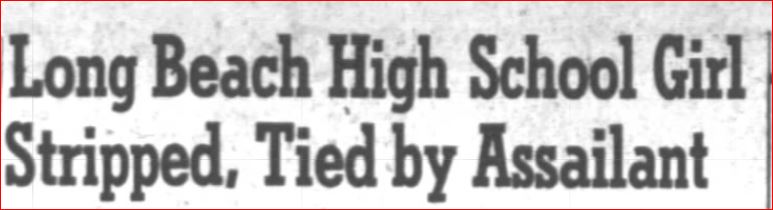
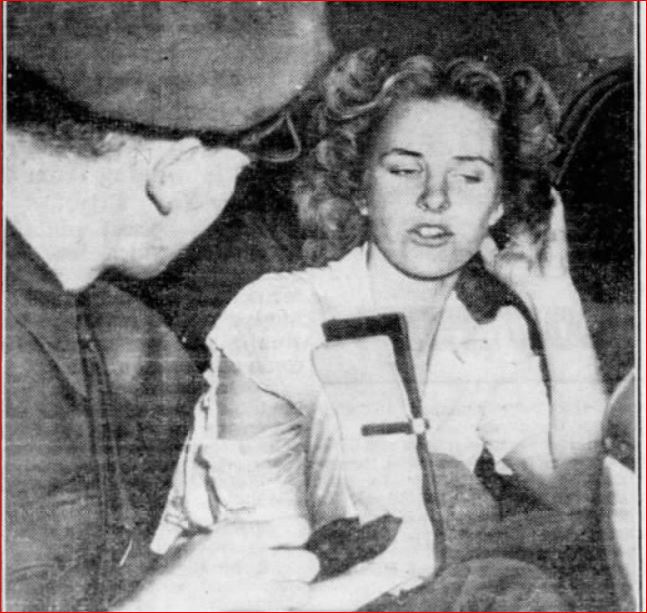
On February 26, 1947, a motorist, Clarence F. Gutchem, discovered a young woman on Willow Street in Long Beach. Lying on an embankment, it appeared she rolled there after being tossed from a car. She was partially nude and bound with strips of her underwear. Gutchem notified police.

They transported the girl to Seaside Hospital where doctors found bruises, scratches and a cigarette burn on her left wrist, but no signs of rape. She identified herself as Jacqueline Mae Stang, a seventeen-year-old student at Polytechnic High School in Long Beach. Detective Inspector C.J. Novotny arrived to take Jacqueline’s statement.

She described her attacker as a swarthy, middle-aged man; but she couldn’t recall much else. Doctors released her into her parents’ care.

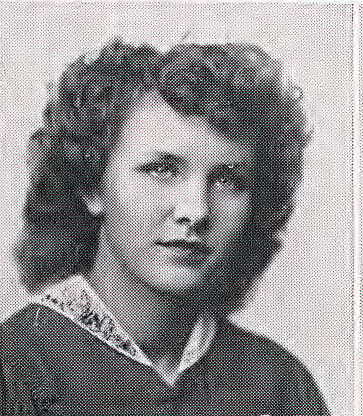
Jacqueline Stang’s high school photo

The day following the attack, juvenile officer Margie Cale paid Jacqueline a visit. Jacqueline told the same story she gave Detective Novotny, but she added more details. She stated she was walking home from school at 6 pm when she noticed a man following her. Spooked, she ran, but the man caught up with her, grabbed her arm and pulled her into an alley. The man put a chloroformed leather glove over her mouth. She struggled, but lost consciousness. She came to and realized she was almost naked. Her attacker scratched her and blew cigarette smoke into her mouth. Jacqueline said, “he laughed fiendishly.” She was frightened she would die until a stray dog appeared and started barking. Startled, the man ran to his car and sped off.

Police question Jacqueline Stang

Jacqueline’s account of her attack was harrowing. However, Margie’s experience with kids taught her to read between the lines, and she knew when they were lying. The pieces didn’t fit, and she didn’t believe a word of Jacqueline’s story.

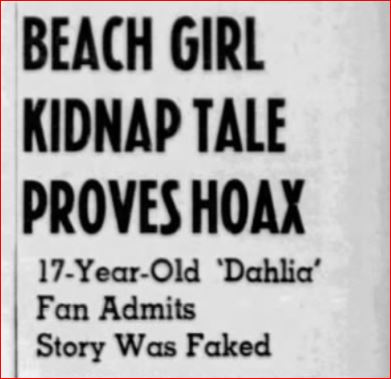
Realizing Margie saw through her, Jacqueline confessed. She said, “I tied myself, I scratched myself and I burned myself.” Margie went to her boss, juvenile superintendent Joseph M. Kennick. Together, they went to Jacqueline’s parents.

What prompted Jacqueline to make up such a horrendous story and harm herself? The attractive teenager refused to answer. Detective Captain L. Q. Martin questioned some of Jacqueline’s school friends. The friends told Detective Martin Jacqueline seemed obsessed with details of the murder. They said Jacqueline asked them, “I wonder if I’d be expelled from school if I should be attacked?”

Newspaper coverage hinted that Jacqueline’s reason for the hoax may have had something to do with a football player. Was she trying to get his attention? Jacqueline remained tight-lipped.

Jacqueline’s confession came as a tremendous disappointment to police, who hoped they finally had a link to the Black Dahlia killer. Kennick said they would take her to Juvenile Court and hold her on a charge of giving police false information.

No further reports of Jacqueline’s misadventure appeared in the newspapers, so it is likely the juvenile court felt her self-inflicted wounds were enough punishment.

Did a Woman Kill the Black Dahlia?

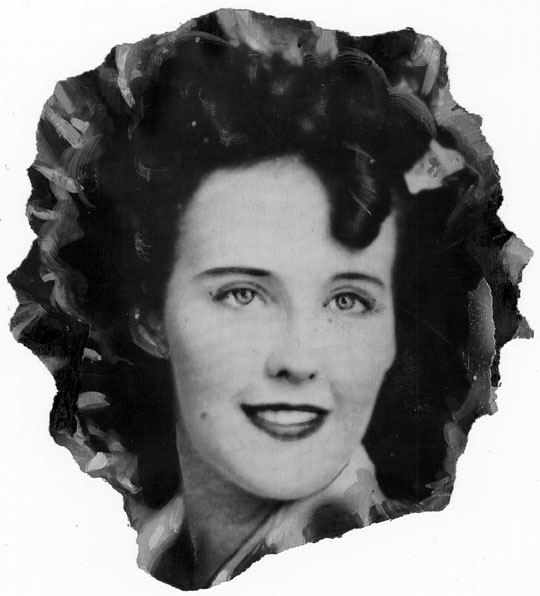
Elizabeth Short aka The Black Dahlia [Photo courtesy LAPL]

In the days following the discovery of Elizabeth Short’s body, crumpled up confessions given by every sad drunk and deranged publicity seeker littered the local landscape. Most of the confessors were men. But even though none of the women who confessed were guilty, the cops thought maybe a woman had committed the murder. After all, L.A. has its share of female killers.

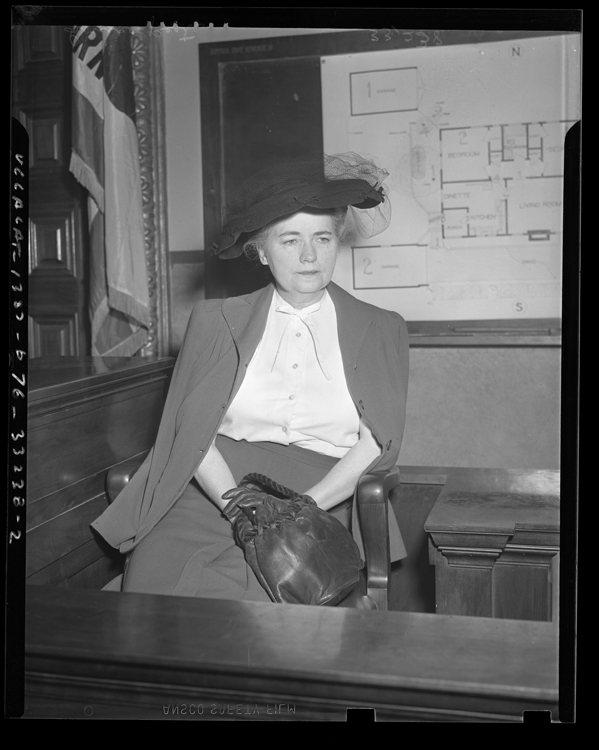
Louise Peete in court. [Photo: UCLA Digital Archive.]

The Herald ran side-by-side photos of three homicidal women arrested in L.A. Louise Peete (one of only four women ever executed by the State of California) was a serial killer. Police arrested her for murder in the 1920s. Found guilty, she served eighteen years in San Quentin. A few years after her release, she committed another murder for which she paid with her life.

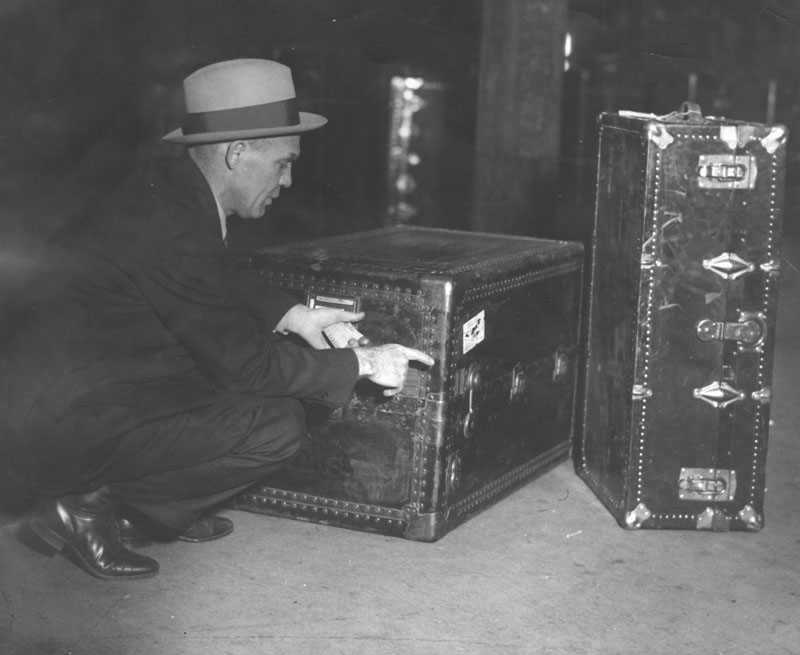
Trunk containing remains of Winnie Ruth Judd’s victims.
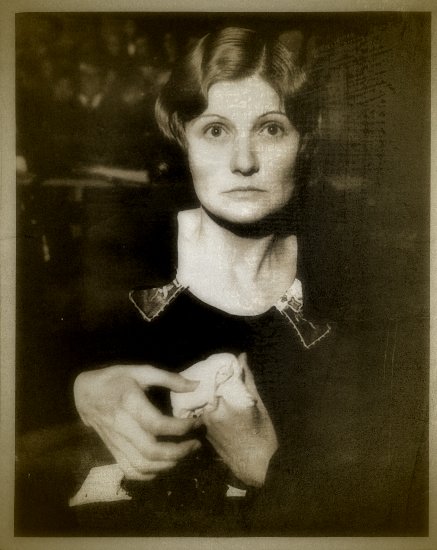
Winnie Ruth Judd

Winnie Ruth Judd committed two murders in Arizona. Police arrested her in L.A. when a trunk containing the dismembered remains of Hedvig Samuelson and Anne Le Roi leaked bodily fluids in the baggage claim section of a local train station.

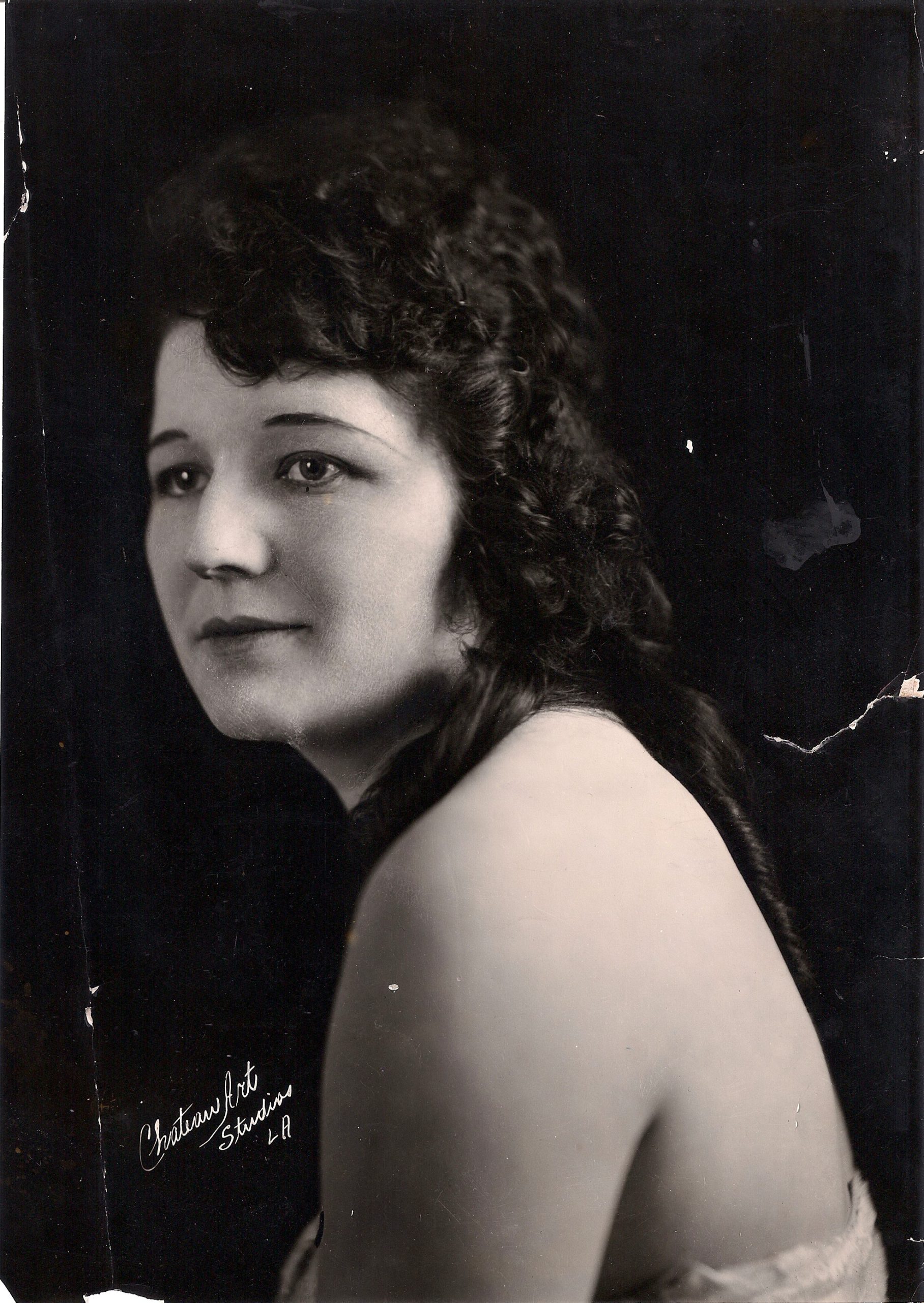
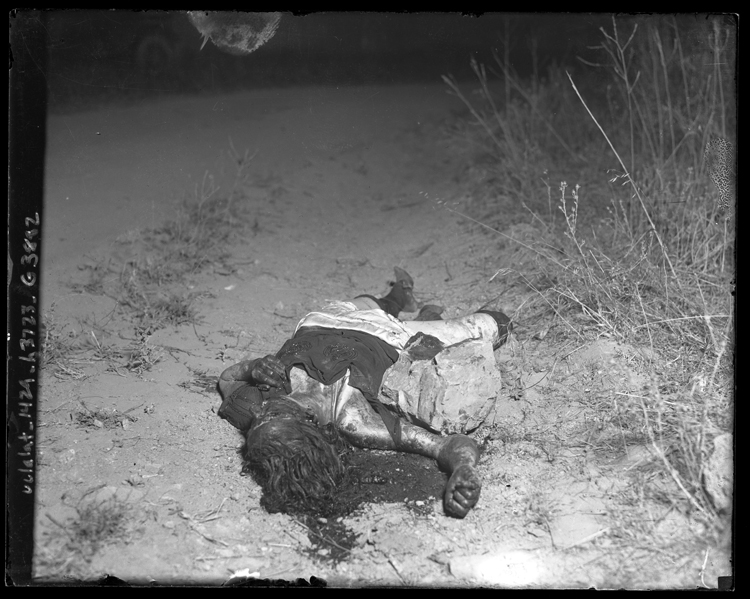
In 1922, Clara Phillips (aka “Tiger Girl”) murdered Alberta Meadows, the woman she suspected was a rival for her husband’s affections. She struck Meadows repeatedly with a hammer, and then, in a fit of adrenalin fueled rage, she rolled a 50 lb. boulder onto the torso of the corpse.

Clara Phillips

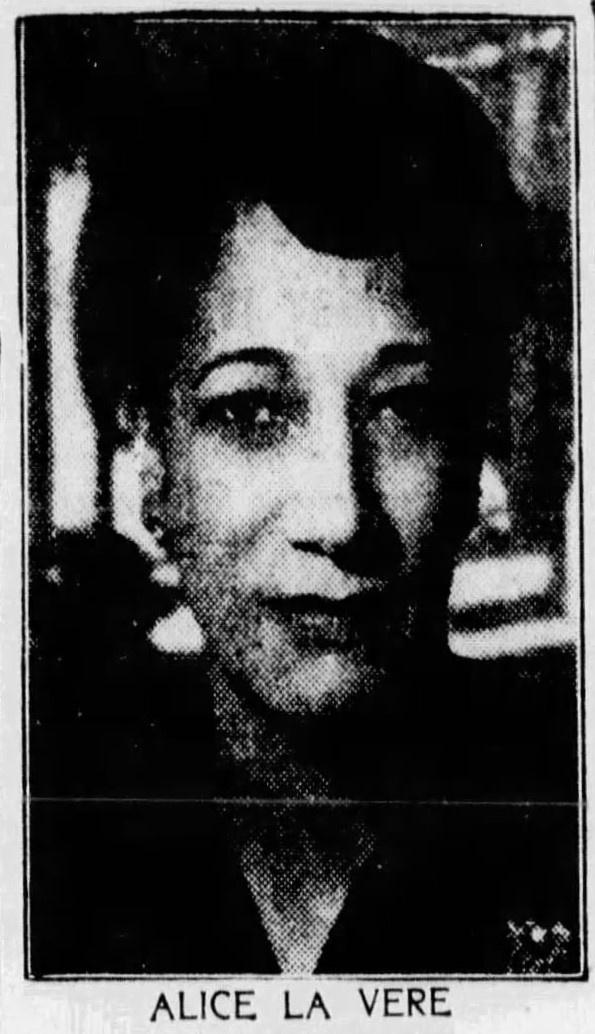
The possibility of a woman murdering Short wasn’t far-fetched. The Herald featured a series of columns written by psychologist Alice La Vere. La Vere previously profiled Short’s killer as a young man without a criminal record, but she was open to the killer being a woman. In fact, she abruptly shifted gears from identifying a young man as the slayer to enthusiastically embracing the notion of “… a sinister Lucrezia Borgia — a butcher woman whose crime dwarfs any in the modern crime annals.”

Body of Alberta Meadows — victim of Clara Phillips’ wrath. [Photo courtesy of UCLA]

La Vere was an expert for hire, and if the Herald editors had asked her to write a profile of the killer as a mutant Martian alien, she’d likely have done it. Still, she made a few insightful comments in her column. “Murderers leave behind them a trail of fingerprints, bits of skin and hair. The slayer of ‘The Black Dahlia’ left the most telltale clue of all–-the murder pattern of a degenerate, vicious feminine mind.”

Even more interesting was La Vere’s exhortation to police to look for an older woman. She said, “Police investigators should look for a woman older than ‘The Black Dahlia.’ This woman who either inspired the crime or actually committed the ghastly, unspeakable outrage need not be a woman of great strength. Extreme emotion or high mental tension in men and women give great, superhuman strength.”

One thing I find interesting about La Vere’s profile of a female perpetrator is that she said the woman would be older than Short. In recent years, an older woman became an integral part of a theory about the murder.

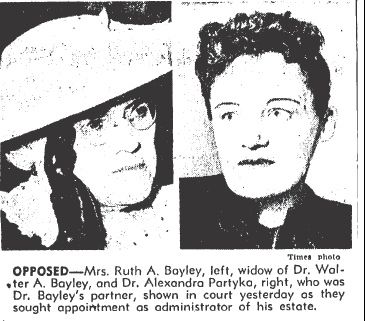
It is a theory put forward by Larry Harnisch. Harnisch, formerly of the Los Angeles Times, wrote an article for the paper on the fiftieth anniversary of Short’s death. In the years since, he has done a lot more digging into the case and has unearthed an important connection between the body dump site near 39th and Norton, and two medical doctors. One doctor, Walter Alonzo Bayley, lived in a house just one block south of the place where Betty Bersinger found Elizabeth Short’s body. At the time of the murder, Bayley was estranged from his wife; however, she still occupied the home. Bayley left his wife for his mistress, Alexandra Partyka, also a medical doctor. Partyka emigrated to the U.S. and wasn’t licensed to practice medicine, but she assisted Bayley in his practice.

Following Bayley’s death in January 1948, Partyka and Dr. Bayley’s wife, Ruth, fought over control of his estate. Mrs. Bayley claimed Partyka was blackmailing the late doctor with secrets about his medical practice. Secrets damning enough to ruin him.

There is also a link between Bayley’s family and Short’s. In 1945, Dr. Bayley’s adopted daughter, Barbara Lindgren, was a witness to the marriage of Beth’s sister Virginia Short to Adrian West at a church in Inglewood, California, near Los Angeles.

Larry discussed Dr. Bayley in James Ellroy’s “Feast of Death”. [Note: Be forewarned that there are photos of Elizabeth Short in the morgue.]

A woman could have murdered Elizabeth Short. Could the woman be Alexandra Partyka? The chances are that we’ll never know–or at least not until Larry Harnisch finishes his book on the case. 

Black Dahlia: False Confessors

Every high-profile murder case gets its share of false confessors. The police have no choice but to check them out, no matter how ludicrous the claim is. It is frustrating for investigators to travel down dead-ends, but they never know from where, or from whom, a break will come.

In late January 1947, two female confessors contacted LAPD detectives to confess their guilt. Minnie Sepulveda telephoned LAPD’s University Station from a bar. She said, “I just stabbed a girl. I killed Elizabeth Short.” They quickly dismissed her claim. Police also dismissed Emily Williams’ confession. Williams, a former WAC, suffered from an undescribed mental ailment.

False confessor, Minnie Sepulveda. [Photo courtesy of LAPL]

The confessions kept coming.

Thirty-three-year-old Daniel Voorhees of Phoenix, Arizona, telephoned the LAPD homicide squad room and told them he murdered Elizabeth Short. He said he would surrender to them at the corner of 4th and Hill downtown. At first, he refused to elaborate on his claim. Detective Lieutenant Charles King, with Dr. Paul De River, police psychiatrist, postponed a lie detector test until Voorhies recovered from his “bewildered and befuddled” state.
Daniel Voorhees. Photo courtesy LAPL.

Voorhees said he arrived in town on January 15 and checked into a hotel at 1012 E. Seventh Street at 10:45 a.m. He checked out the next day. He said he met Short on Hill Street “two weeks ago” (about the time of the murder) and took her for a ride on a Wilshire bus. He claimed he dated Short in 1941. Not only was she a 16-year-old schoolgirl in 1941, she didn’t arrive in Los Angeles until 1943. In his confession note, Voorhees misspelled his alleged victim’s last name. Police, who never actually believed his ramblings, released him.
Photo courtesy LAPL.

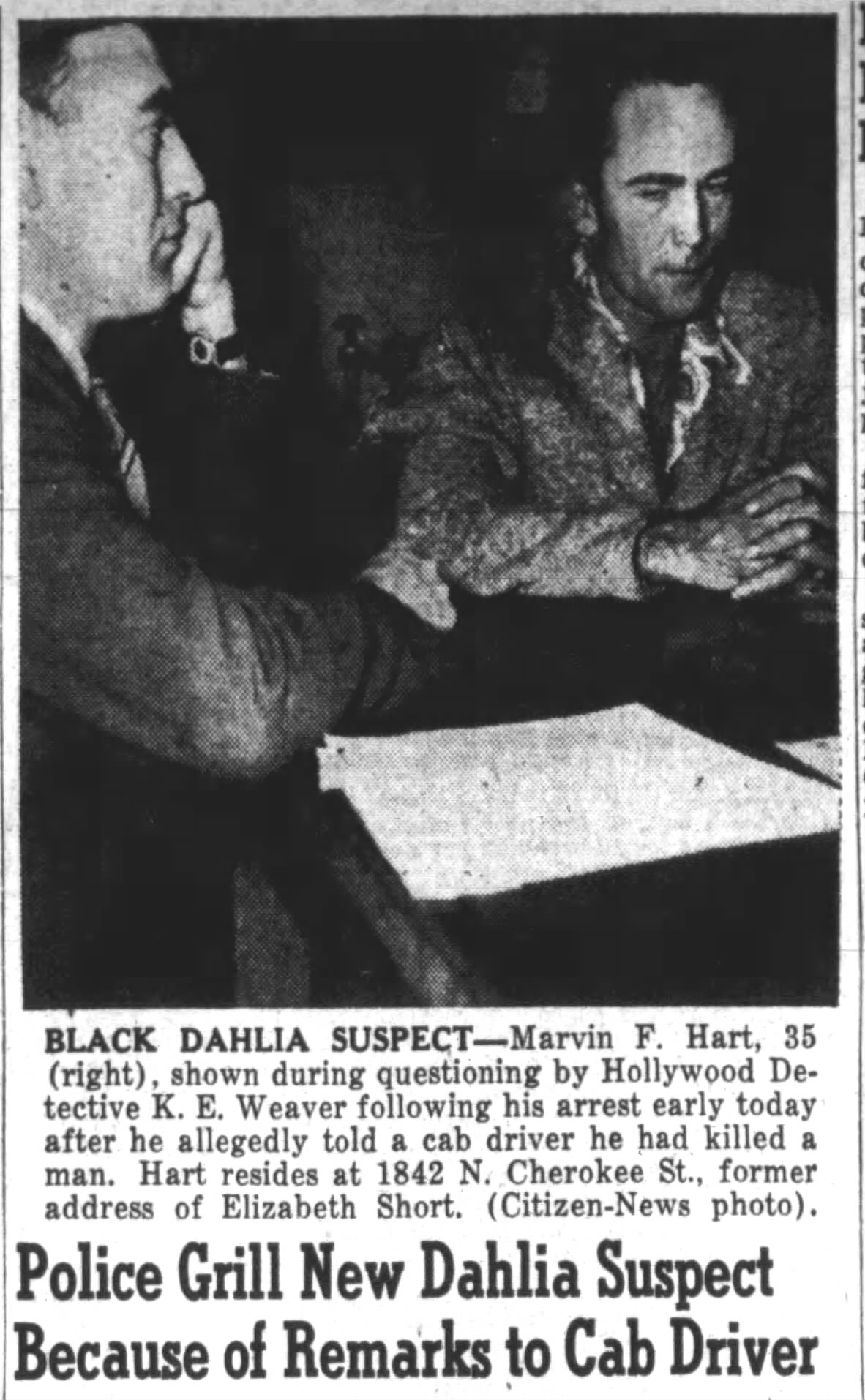
Marvin Hart, a thirty-five-year-old physical culture instructor, didn’t learn his lesson from the war-time mantra, “Loose Lips Sink Ships.” The drunk chatterbox told a taxicab driver, “Get me out of here; I have just killed a man.” The driver picked Hart up on Wilshire near the Los Angeles Country Club and drove him to a rooming house at 1842 N. Cherokee Street in Hollywood. The same building in which Short lived for a time. Rattled, the taxi driver went to the police and gave his statement.

Detectives brought Hart in for questioning. That he lived in the same building as Short and took her out a few times piqued their interest. They asked him to explain nis torn coat. “I had a fight with my girlfriend. We were at a party in West Los Angeles last night, and I guess I got pretty drunk.”

Marvin Hart. Photo courtesy LAPL.

Hart was a bone-headed blabbermouth, but he wasn’t a killer.

LAPD Vice Squad officers arrested Altadena resident Hugh Torbert Jr., on April 17, after trailing him and a female companion to a downtown hotel. While the officers waited for the perfect moment to break down the door and make a bust, they overheard Torbert tell the woman with him he knew Short, but didn’t want to get involved in the investigation.

Hugh Torbert. Photo courtesy LAPL.

Captain Jack Donohoe, head of LAPD’s homicide detail, checked into Torbert’s background. Torbert was in the Army and served at Camp Cooke, where Short worked at the Post Exchange. Tantalizing bits of information; leading to another blind alley.

One confessor made front page news. Joseph Dumais.

The February 8, 1947 edition of the Herald, announced that the army had the Black Dahlia’s killer in custody.

The Herald story began with a definitive statement. “Army Corporal Joseph Dumais, 29, of Fort Dix, N.J., is definitely the murderer of the Black Dahlia, army authorities at Fort Dix announced today.”

Dumais, a combat veteran, returned from leave wearing blood-stained trousers with his pockets crammed full of clippings about Short’s murder. According to the Herald, Dumais made a 50-page confession in which he claimed to have had a mental blackout after dating Elizabeth Short in Los Angeles five days before Betty Bersinger discovered the body.

Joseph Dumais. Photo courtesy LAPL.

The good-looking corporal seemed like the real deal. He told the cops, “When I get drunk, I get pretty rough with women.” Unfortunately, when police checked his story against known facts, the confession didn’t hold up. The Army sent Dumais to a psychiatrist.

Time passed, and the investigation faded from the headlines. So, too, did the steady stream of confessors.

On November 8, 1950, a thirty-five-year-old movie bit player and member of the Screen Actor’s Guild, Max Handler, became the twenty-fifth person to confess to murdering Elizabeth Short (one man confessed four times).

Handler phoned LAPD homicide and said he was “cracking up.” In his signed confession, he said, “I killed the Black Dahlia girl, for which I am sorry.” He said he didn’t recall committing the murder.

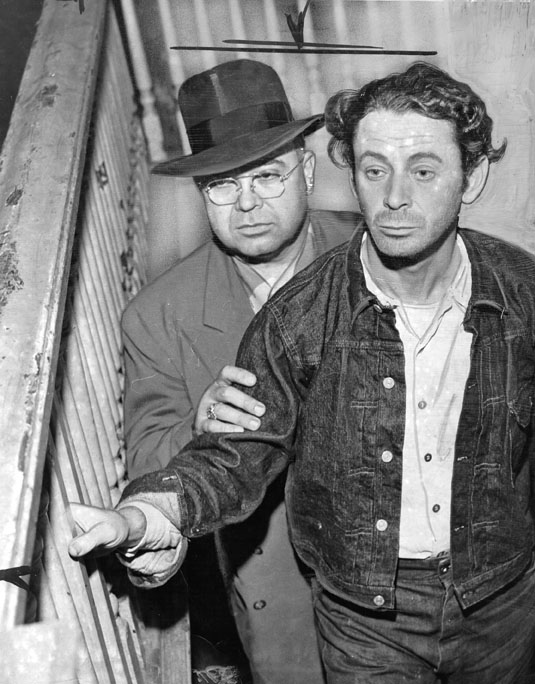
Max Handler with Det. Ed Barrett (in hat and glasses). Photo courtesy LAPL

Detectives revealed that a man resembling Handler and a young woman resembling Short were seen together in a Hollywood bar and at a motel on or about the date of her murder, January 15, 1947.

One clue gave detectives hope. In Short’s purse, found several days after her murder, was the business card of a local real estate company. The same company Handler worked for.

Police abandoned a lie detector test because Handler was so distraught, they knew they would never get an accurate reading.

After several days in police custody, Handler recanted his confession. He said the reason he confessed is he wanted police protection. From whom?

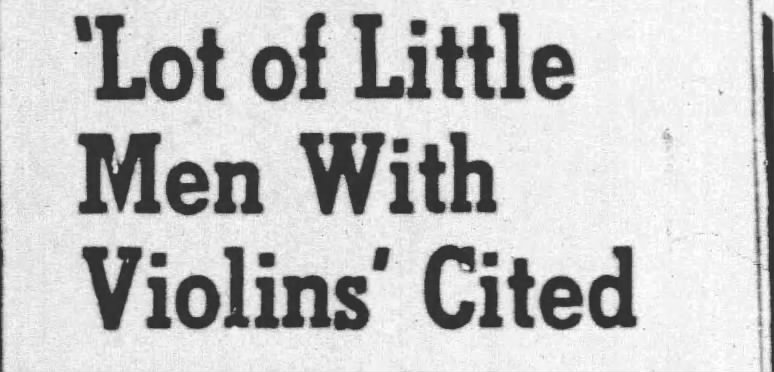
According to Handler, “A lot of little men with violins have been chasing me around. I wanted police protection. I knew they’d only laugh at me if I’d tell them about the men with the violins. So, I figured out another way to get the protection I needed.”  

Detective Lieutenants Harry Hansen and Ed Barrett, referred Handler for a sanity test before the county Lunacy Commission.

The personal demons that caused Handler to confess to the Black Dahlia murder didn’t keep him from appearing in movies. He had an interesting career. He appeared in many B movies, but he also turned up in productions like The Asphalt Jungle, From Here to Eternity, and my favorite, Crime Wave. His last film credit, in 1960, is for The Adventures of Huckleberry Finn.

Handler died in 1993.

Even seventy-six years after the murder, people still phone LAPD about the case.